English हिन्दी
Connect with us

Latest world news

US supports Defense cooperation with India, punishes Pakistan

Published

on

US supports Defense cooperation with India, punishes Pakistan
[vc_row][vc_column][vc_column_text]House of Representatives passes amendments in NDAA-2018

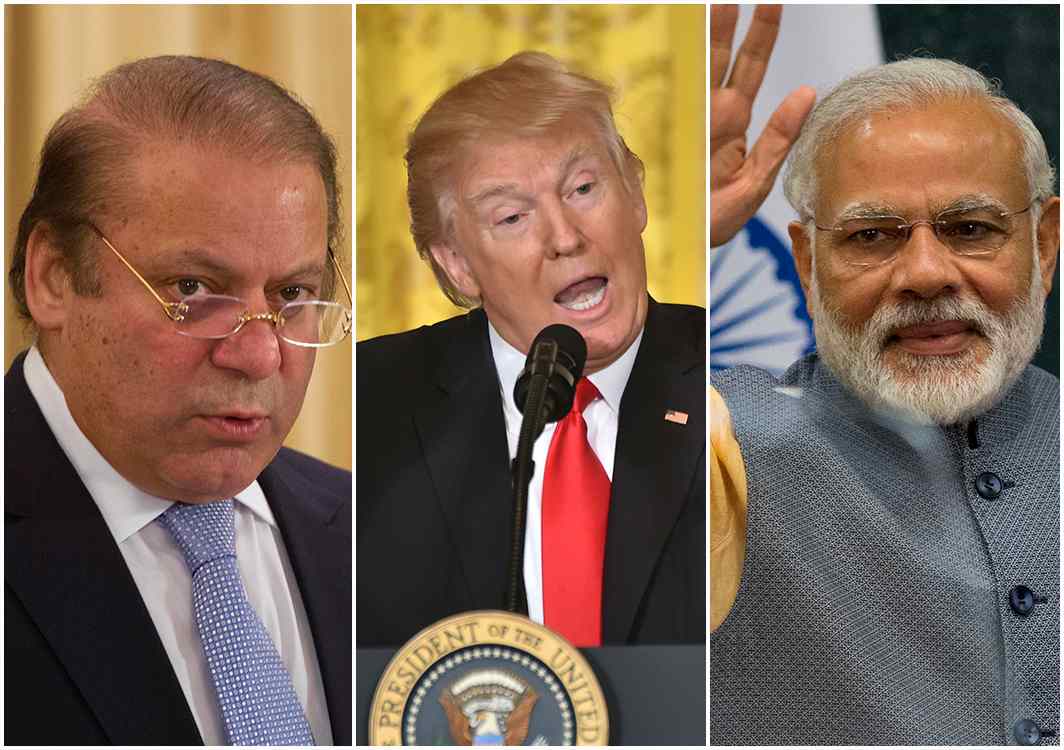
The US political leaders across their affiliation are growingly turning in favor of India and expressing their displeasure with Pakistan for its alleged ongoing support to the terrorist groups involved in trans-border activities. On Friday, the US House of Representatives (lower house) has passed a 621.5 billion dollar defense expenditure bill to advance defense cooperation with India.

At the same time, the House voted for three legislative amendments to impose tougher conditions for reimbursement of defense funding to Pakistan, 400 million dollars, making it conditional to Islamabad showing “satisfactory progress” in fight against terrorism.

Islamabad is also criticised for persecution of minorities seeking political and religious freedom and imprisonment of  Shakil Afridi, a physician who helped in locating Osama bin-Laden before he was shot in Abbotabad in May 2011.

India related recommendations were incorporated in National Defense Authorisation Act (NDAA) 2018, while amendments imposing tougher sanctions for reimbursement of defense funding to Pakistan would be implemented in retrospect for the period of NDAA-2017.

The India related amendment was moved by Indian-American Congressman Ami Bera and was adopted by a voice vote by the House with 344 in favor and 81 against the proposal. Now it requires the Secretary of Defense, in consultation with Secretary of State to develop a strategy for advancing defense cooperation between US and India.

Ami Bera, while supporting the India related amendment said, “The US is the world’s oldest democracy and India is the world’s largest democracy. It is vitally important to develop a strategy that advances defense cooperation between the two countries.”

After the amendment was passed, Bera was quoted saying, “I am grateful this amendment passed and look forward to the Defense Department’s strategy that addresses critical issues like common security challenges, the role of partners and allies, and areas for collaboration in science and technology.”

He specifically mentioned about how it was useful for US defense in the region. He said, “Cooperation between US and India enhances our own defense and our ability to meet the evolving security challenges of the 21st century.”

According to US law, Secretary of Defense and Secretary of State have to develop strategy for advancing defense cooperation between the two countries within 180 days. It needs to be passed by the Senate before sending to President Donald Trump to sign into law.

The previous NDAA-2017 had designated India as a major defense partner which brings India at par with closest American partners in terms of defense trade and technology transfer.

Cara Abercrombie, Deputy Assistant Secretary of Defense for South and Southeast Asia, on Thursday, said that India and US Defense relationship is on positive track. She reportedly said “… [As] we look at the global order, and when we look at the evolving security environment within Asia, India’s rise and role [is] evolving, [and] we see the United States and India increasingly viewing the region in the same way and our interests are very much aligned.”

While addressing a New York gathering she said, “This is all rooted in when we look at the region and [what] we share. We have the same [aerial] security interests, the same counter-proliferation, counter-piracy, and counter- terrorism [interests].”

Alongside, the House of Representatives, voted for three legislative amendments to impose tougher sanctions for reimbursement of 400 million dollars defense funding to Pakistan. The conditions are reportedly imposed because of the Islamabad’s alleged ongoing support to terrorists and terror outfits, about which several top US officials and lawmakers have repeatedly expressed concern in the past.

Following the passage of the amendments by the House of Representatives to the NDAA-2018, Secretary of Defense has to certify that Islamabad was maintaining security along the Ground Lines of communication through Pakistan, taking demonstrable steps to support counterterrorism operations, disrupting cross border attacks and countering the threat of improvised explosive devices. He has to certify that Pakistan continues to conduct military operations against the Haqqani Network in North Waziristan in coordination with Afghanistan government.

The Pakistan related amendments will negatively affect Pakistan retrospectively.  The amendment specifies that the total reimbursement and support authorised for Pakistan during the period beginning on October 1, 2017, and ending on December 31, 2018, 400 million dollars, would not be eligible for national security waiver.

The Pakistan related amendments were moved by Congressman Dana Rohrabacher and Ted Poe, Member of the Foreign Affairs Committee and Chairman of Subcommittee on Terrorism, Non-proliferation and Trade.  Poe was quoted as saying, “Today, Congress took a step forward to end Pakistan’s betrayal of the US with the addition of an additional certification requirement.”

US has also raised the issue of persecution of minority groups seeking political and religious freedom and imprisonment of Shakil Afridi, a physician who helped locating Osama bin Laden before he was finally killed in Abbotabad. The amendment said that Afridi was a hero to whom the people of US, Pakistan and world owe a debt of gratitude for the help.

In April this year, US national Security Advisor Lieutenant General HR McMaster visited New Delhi to pick up strings of defense and security ties that had blossomed during Barack Obama administration.

Prime Minister Narendra Modi travelled to US recently and developed close chemistry with US President Donald Trump. Defense cooperation also figured during the 5-hour engagement at White House.[/vc_column_text][/vc_column][/vc_row]

Latest Politics News

Tarique Rahman-led BNP set for landslide win in Bangladesh elections

BNP led by Tarique Rahman has crossed the majority mark in Bangladesh’s national elections, with projections suggesting a two-thirds majority. Jamaat has conceded defeat.

Published

on

Tariq Rehman

The Bangladesh Nationalist Party (BNP), led by Tarique Rahman, is heading towards a decisive victory in Bangladesh’s national elections, with projections indicating a clear parliamentary majority.

Early media projections at 8:00 am local time suggested that the BNP had comfortably crossed the 150-seat mark required to form the government in the 300-member parliament. One projection placed the party at 212 seats, putting it well on course for a two-thirds majority.

The BNP has already declared that it is prepared to form the next government after securing what it described as a majority mandate from voters.

Meanwhile, the Islamist-led alliance headed by Shafiqur Rahman of Jamaat-e-Islami was projected to win 70 seats. Although a significant improvement compared to its previous performance, the tally fell short of its expectations. Shafiqur Rahman conceded defeat and said his party would avoid confrontational opposition politics, adding that it would engage in “positive politics.”

Final results awaited, US extends congratulations

The Election Commission is yet to announce the final results for 299 constituencies where voting took place. An additional 50 seats reserved for women will be allocated based on party lists.

Even before the official declaration, the United States embassy in Dhaka congratulated Tarique Rahman and the BNP, describing the outcome as a “historic victory.”

Political transition under way

Bangladesh’s interim leader Muhammad Yunus is expected to step down once the new government assumes office. The Nobel Peace Prize winner has led the country since the ouster of Sheikh Hasina in August 2024 following a mass student-led uprising.

Yunus’s administration had barred the Awami League from contesting the elections by suspending its registration.

This election marked the first in decades without the participation of two dominant political figures — Sheikh Hasina and former prime minister Khaleda Zia, who passed away in December last year.

After nearly 17 years in exile, Tarique Rahman, 60, returned to Bangladesh following his mother Khaleda Zia’s death and quickly emerged as the frontrunner for the prime minister’s post.

Referendum on reforms held alongside polls

Voters also participated in a referendum on the July National Charter, a reform package negotiated by the Yunus-led interim administration and multiple political parties. The proposals include limiting prime ministers to two terms, forming an upper house of parliament, and restoring a caretaker government system to oversee elections for 90 days to ensure neutrality.

Sheikh Hasina criticised the election process, calling it “deceptive” and alleging low voter turnout. In a statement, she demanded cancellation of what she described as an “illegal and unconstitutional election” and sought Yunus’s resignation.

India watching developments closely

India is closely monitoring the situation due to its strategic and diplomatic interests in the region. Following recent political shifts in Dhaka and concerns over minority safety, New Delhi has emphasised that it will assess the mandate once results are officially declared.

When asked about the polls, MEA spokesperson Randhir Jaiswal said India would wait for the final outcome before commenting further.

With final results expected soon, Bangladesh appears set for a major political transition, with the BNP poised to return to power in a significant comeback.

Continue Reading

Latest world news

Jamaat, BNP supporters clash in Dhaka as Bangladesh votes in 13th parliamentary polls

Clashes erupted in Dhaka’s Mirpur as Bangladesh voted in its 13th parliamentary elections, marking the first polls after Sheikh Hasina’s ouster.

Published

on

bangladesh protest

Clashes broke out between supporters of Jamaat-e-Islami and the Bangladesh Nationalist Party (BNP) in Dhaka’s Mirpur-10 constituency as Bangladesh voted in its 13th parliamentary elections on Thursday.

Jamaat-e-Islami chief Shafiqur Rahman is contesting from the Mirpur-10 seat. Polling is being conducted for 299 seats in the Jatiya Sangsad, Bangladesh’s parliament.

Voting details and electoral process

Voting began at 7.30 am local time (7 am IST) under the first-past-the-post system. Results are expected to start coming in by evening.

Out of the 300 parliamentary constituencies, polling in Sherpur-3 has been cancelled following the death of a candidate. A total of 12.77 crore registered voters are eligible to cast their ballots. The majority mark in the 299-seat contest stands at 150.

In addition to these seats, 50 positions in the Jatiya Sangsad are reserved for women. These members are elected by Members of Parliament through proportional representation using the single transferable vote system.

First polls after Hasina’s ouster

This election marks the first parliamentary contest since former prime minister and Awami League chief Sheikh Hasina was removed from office following massive student protests in August 2024. Her long-time political rival, BNP leader Khaleda Zia, passed away in December the following year.

Hasina and Zia alternated in power from 1991 until Hasina returned to office in 2009. She remained prime minister for over 15 years and 200 days and had won the 2024 elections before being deposed months later.

For the first time in decades, voters are participating in national elections without either of the two dominant political figures shaping the contest.

Changing political landscape

With the Awami League excluded from participating due to its crackdown during the student protests, the political space has shifted significantly.

Tarique Rahman, son of Khaleda Zia, returned to Bangladesh in December after nearly 17 years in exile. The 60-year-old has emerged as a frontrunner for the prime minister’s post, drawing on the support base of the BNP and his late mother.

Jamaat-e-Islami, once allied with the BNP, is now leading its own coalition. It has secured backing from the National Citizen Party, a student and Gen-Z platform that emerged from the anti-Hasina protests.

Referendum on July National Charter

Alongside the general election, voters are also participating in a referendum on the July National Charter. The charter has been agreed upon by the Muhammad Yunus-led interim government and several political parties.

Key proposals in the charter include limiting prime ministers to two terms or 10 years, creating an upper House of parliament, and restoring the caretaker government system to oversee elections for 90 days to ensure free and fair polls.

Regional implications

The outcome of the election is expected to influence regional dynamics involving India, China and Pakistan.

Bangladesh had been seen as closer to India during Sheikh Hasina’s tenure. However, there has been a shift towards Beijing and Islamabad in recent times. Relations between India and Bangladesh have reportedly been tense under the Yunus-led interim arrangement.

Among the two principal contenders, the BNP is considered relatively more inclined towards New Delhi than Jamaat-e-Islami.

India is also monitoring the situation amid reports of attacks on minorities and killings of Hindus following Hasina’s ouster. Authorities have expressed concerns about potential violence on polling day.

Continue Reading

Latest world news

Donald Trump calls India trade deal historic, highlights rise in US coal exports

Donald Trump describes the India trade deal as historic and links it to rising US coal exports, while India reiterates national interest in energy decisions.

Published

on

Donald Trump

US President Donald Trump has described the recent trade agreement with India as “historic”, saying it has contributed to a sharp rise in American coal exports.

Speaking at the Champion of Coal Event on Wednesday, Trump said the United States has strengthened its position as the world’s leading energy producer and is rapidly expanding its footprint as an energy exporter.

He said that trade deals signed in recent months with countries including Japan, South Korea and India have helped increase coal exports from the US.

“America is now the number one energy producer in the world. We’re becoming a massive energy exporter. In just the past few months, we’ve made historic trade deals with Japan, Korea, India, and others to increase our coal exports dramatically. The quality of our coal is supposed to be the finest anywhere in the world,” Trump said.

He also asserted that American coal is considered among the best globally in terms of quality.

India says national interest will guide energy choices

Meanwhile, on February 9, Foreign Secretary Vikram Misri said that India’s energy-related decisions will continue to be guided by national interest.

During a special briefing by the Ministry of External Affairs (MEA), Misri underlined that India’s energy policy is driven by adequate availability, fair pricing and reliable supply. His remarks came amid reports suggesting that India may be reducing its oil imports from Russia.

Clarifying how energy sourcing decisions are made, Misri said procurement is handled by oil companies based on prevailing market conditions. These companies assess availability, risks, pricing and logistical considerations while following internal accountability and fiduciary processes.

“As far as the actual sourcing of energy is concerned, this is undertaken by oil companies, which make decisions based on market conditions. They assess availability, evaluate risks, analyse costs, and follow their internal accountability processes and fiduciary responsibilities. At any given time, there is a complex matrix of considerations, including financial and logistical aspects, that these companies must take into account,” he said.

He added that both government and business decisions in the energy sector would continue to prioritise national interest.

Misri also noted that India remains a net importer of oil and gas and, as a developing economy, must remain mindful of resource availability and the inflationary impact of import dependence.

Continue Reading

Trending

© Copyright 2022 APNLIVE.com