English हिन्दी
Connect with us

India News

Paranjoy Refutes Allegations of ex-colleagues

Published

on

Paranjoy Refutes Allegations of ex-colleagues
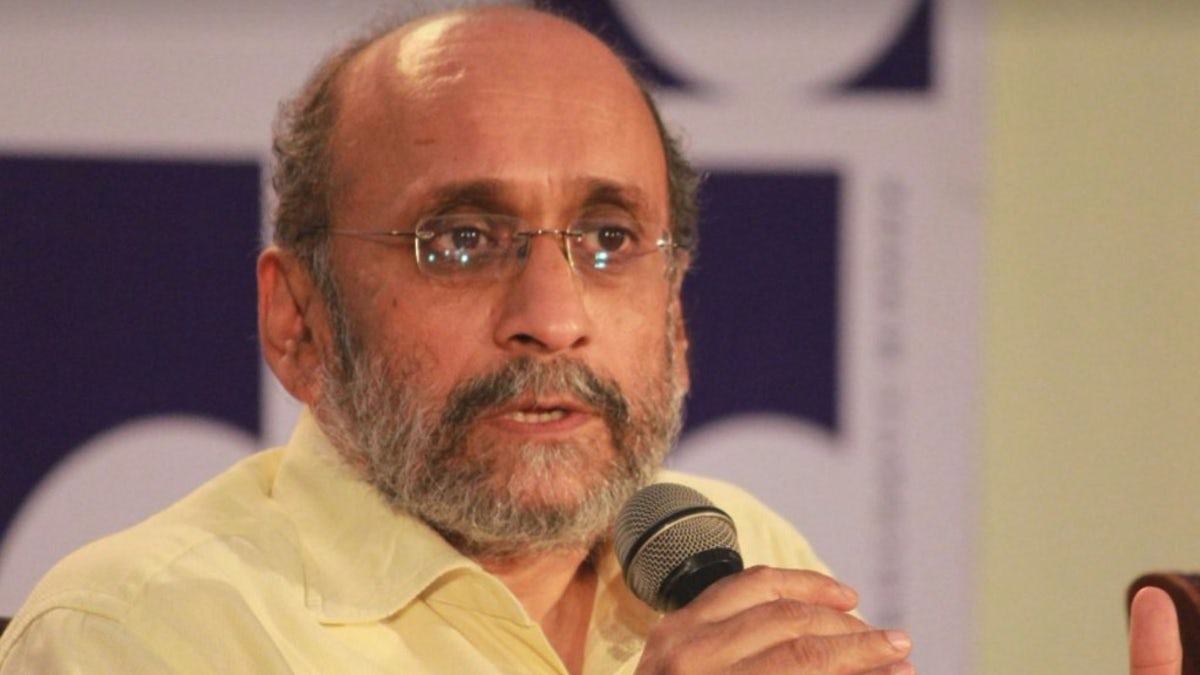
[vc_row][vc_column][vc_column_text]Forced to resign as editor of Economic and Political Weekly (EPW) and targeted on social media for his article against Adani Group, Paranjoy Guha Thakurta – also accused by some members of the staff of the journal of various misdemeanours – has broken his silence to refute their charges.

Over a week after EPW staff members raised questions about Paranjoy Guha Thakurta’s behaviour during his tenure as editor of the journal in a ‘confidential’ letter to the Sameeksha Trust board, Guha Thakurta has decided to break his silence, which he says was “interpreted by some as my tacit acknowledgment of the claims made by some of my former colleagues.”

The EPW staff members had questioned the decision to pull down the the article “Modi Government’s ₹500 Crore Bonanza to Adani Group Company ” (EPW , 19 June 2017) from the website as per Guha Thakurta’s instructions, undermining the review process of articles “for his associates, persons of influence, and has entertained partisan endorsements to research papers without following the review process and evaluating the merit of the article”, higher payments to certain authors (usually his old associates), which would have been 20 times higher than the token amounts paid to contributors, and “a grave assault on the work culture in the EPW office, with many of us on staff being made to feel uncomfortable by inappropriate, sexual and sexist comments made by Mr Guha Thakurta”.

In a statement issued on August 2, Guha Thakurta has rebutted the allegations point-wise. Here is the text of his statement:[/vc_column_text][vc_row_inner css=”.vc_custom_1501765788145{padding-top: 20px !important;background-color: #a2b1bf !important;}”][vc_column_inner][vc_column_text]Statement issued by Paranjoy Guha Thakurta

Dated: 02 August 2017

  1. I have agonised for days about whether I should put out this statement, ever since the letter dated 25 July 2017 sent by eight of my former colleagues in the Economic and Political Weekly (EPW) to the trustees of the Sameeksha Trust, owners and publishers of the EPW, entered the public domain soon after it was sent. This was a letter that was not meant to have reached me. But now that it is circulating widely, I have decided it is time to respond. My silence on the points raised in the letter have been interpreted by some as my tacit acknowledgment of the claims made by some of my former colleagues.

This is far from correct.

  1. On the issue of my allegedly undermining the review process in the EPW, I wish to assert that I exercised my prerogative as an editor to shorten the review process in the cases of barely a handful of articles out of the hundreds of articles that were published in the print and web editions of the EPW in the 15 months that I was privileged to serve in this position. I wish to place on record that among this handful of articles was one that was strongly recommended for publication by one of the Trustees of the Sameeksha Trust. After this article was published, it attracted a strong rejoinder which too was published. The same Trustee also wrote an email to me expressing unhappiness at the rejection of a particular article. While it is not normal practice in the EPW to specify the reasons for rejecting an article, in this instance, because a specific complaint had come from a Trustee, I requested the reviewer to specify the reasons for rejecting the article. These reasons were then emailed to the Trustee who retorted with a harangue questioning the decision of the reviewer.

I wish to, therefore, categorically deny the claim that I have undermined the review process in the EPW.

  1. On the claim that I favoured my close associates by promising to pay them substantially more than what the EPW normally pays its contributors, the following facts should be noted. One particular investigative article by Subir Ghosh (my co-author and close associate) on the cartels that were apparently responsible for the spike in the prices of tur and urad dal was published on the website of the EPW. This article was written after more than a month of research based on a perusal of thousands of pages of documents that were leaked to me by a whistleblower. Another article on Kingfisher Airlines by Nihar Gokhale (a freelance journalist who could become my close associate) was published on the EPW website based on leaked internal documents of a bank. I proposed a payment of Rs 30,000 and Rs 20,000 respectively for the two authors of the two articles which I felt would be commensurate with the efforts they had put in. These were not the typical articles contributed to the EPW for which the authors are paid token amounts. The articles were specially assigned.

An important point to note in this context is that the EPW recently received a generous grant from a foundation for its digital edition and one component of this grant was specifically meant for “corporate investigations” and “web exclusives” for which a separate budget has been earmarked. Nevertheless, I had in addition raised a sum of Rs 50,000 from an individual as a donation for corporate investigations. This person subsequently withdrew his donation on learning about my resignation. At this point of time, neither Ghosh nor Gokhale have been paid the amounts I had “promised” them.

  1. On the question of the editor writing signed articles, from the day I joined the EPW as editor on 04 April 2016 till the day I resigned 15 months and 15 days later, eight articles written and/or co-authored by me have been published in the digital and/or print editions of the EPW. I have never been ashamed of the fact that for the forty years I have been a journalist, I have been a reporter for much of the time. Over and above the articles I authored or co-authored, I had during my tenure as editor been responsible for publishing close to two dozen articles that may be described as “investigative” in nature. I wish to state that not only did these articles attract more than the usual number of readers to the website of the EPW, but also that not a single fact published had to be retracted or were contradicted. My former colleagues refer to an article on alleged over-invoicing of imported coal by prominent private and public companies that I published on the very first day I joined the EPW. That was also the day I received a copy of a document (on which the article was based) that had been sent to 50 different government establishments. I wanted the EPW to be the first to publish the news and indeed, after the EPW published the report, it was picked up by a number of Indian and international dailies and publications.
  2. It has also been alleged by my former colleagues that I had compromised the “egalitarian” work culture in the EPW. They are indeed entitled to their opinion. I do not agree with them. I believe I did try and accommodate the viewpoints of my former colleagues even when I vehemently disagreed with them. It is up to the larger community of the EPW to evaluate the contribution I made to this reputed publication.
  3. What has pained me the most is the claim that I have on occasions used inappropriate and sexist/sexual language in office. On only one (repeat one) occasion, did I inadvertently use a phrase in a conversation with a woman colleague that may have been considered inappropriate. On realising this, I immediately apologised to her. Later in the day I followed it up with an email to her placing on record my apology for what I had said. I cannot prove what I have stated as my email account with the EPW has been suddenly blocked. It is important to note that if my way of functioning with my women colleagues in office had on occasions caused them discomfort as is being alleged in the letter to the Trustees, I am not aware if any formal complaint was ever made. That this is being made an issue now seems like it is part of a bigger agenda to malign me personally.
  4. I am taking particular umbrage at the decision to suddenly block what used to be my official email account. This is contrary to the explicit assurance that had been given to me that I would be allowed access to my EPW email account for a few weeks after my resignation from the post of editor of the EPW on 18 July. I sincerely hope that what is contained in my EPW email account will not be tampered with. I also hope I will still be given an opportunity to access my email account to retrieve what is rightfully my own work.
  5. I am particularly thankful to my former colleagues for expressing their disagreement with the manner in which the trustees of the Sameeksha Trust directed/instructed/ordered me on 18 July to pull down an article on Adani Power Limited ostensibly because a lawyer representing the company had sent the EPW a letter/notice alleging defamation without having moved a court of law. My former colleagues have rightly perceived this action as an encroachment on editorial autonomy.
  6. In conclusion, I wish to reiterate that the institution that is the EPW is far bigger than any individual and will always be that way. Its survival and further development, I believe, is the responsibility of the larger EPW community that has sustained and nurtured it.

Yours faithfully

Paranjoy Guha Thakurta

Gurgaon (Haryana)[/vc_column_text][/vc_column_inner][/vc_row_inner][/vc_column][/vc_row]

India News

Simone Tata passes away at 95: A look at the visionary who shaped Lakme and modern retail

Simone Tata, the pioneering business leader who built Lakme and helped shape India’s modern retail sector, passed away at 95. Here’s a look at her legacy.

Published

on

simone tata

Ratan Tata’s stepmother and celebrated business leader Simone Tata passed away on December 5, 2025, at the age of 95. Known for her pioneering role in building Lakme and transforming India’s retail landscape, she leaves behind a remarkable legacy that redefined Indian consumer culture.

A legacy that shaped Indian business

Simone Tata, born in Geneva in 1930, first came to India at the age of 23. Two years later, in 1955, she married Naval H. Tata and gradually became an integral part of the Tata family’s business vision. Her journey with the Tata Group began in the 1960s, when she was appointed to Lakme—then under Tata Oil Mills.

Under her leadership, Lakme quickly grew into one of India’s most trusted cosmetic brands. She rose to the position of managing director and later chairperson, introducing global formulations and modernising beauty products for the Indian market. Lakme’s rise was also rooted in a strong national vision—launched on former Prime Minister Jawaharlal Nehru’s suggestion to reduce foreign exchange spent on imported makeup.

Transforming retail through Trent and Westside

After Lakme was sold to Hindustan Lever Limited in 1966, Simone moved to Trent, where she helped build one of India’s earliest modern retail chains. This later gave birth to Westside, a brand that has become synonymous with contemporary Indian shopping culture.

She also played a key role in philanthropic initiatives, guiding organisations such as the Sir Ratan Tata Institute and supporting cultural and children-focused foundations.

Family, personal life and final farewell

Simone Tata is survived by her son Noel, daughter-in-law Aloo Mistry, and grandchildren Neville, Maya and Leah. She also drew public attention in recent years for being the only member of the Tata family to attend Cyrus Mistry’s funeral, despite the widely known strained ties between the families.

Her funeral will take place on Saturday morning at the Cathedral of the Holy Name Church in Colaba, Mumbai.

Continue Reading

India News

Centre orders probe into IndiGo crisis, expects normal flight operations in three days

Amid record cancellations by IndiGo, the Centre has ordered a high-level inquiry and expects flight schedules to stabilise by Saturday, with full normalcy in three days.

Published

on

indigo

The Centre has initiated a high-level inquiry into the massive disruption of IndiGo’s operations, with the government projecting that flight schedules will begin stabilising by Saturday and full normalisation is expected within three days. The announcement comes as cancellations by the airline crossed 500 for the second consecutive day, severely impacting passengers across major airports.

Civil Aviation Minister Ram Mohan Naidu said the government has directed urgent measures to ensure swift restoration of services. Within minutes of his statement, the aviation regulator DGCA announced the formation of a four-member committee to examine the circumstances leading to the delays and cancellations.

DGCA forms committee as cancellations spark scrutiny

The DGCA said IndiGo was given sufficient time to implement revised Flight Duty Time Limitations (FDTL), yet the airline recorded the highest number of cancellations in November. The regulator added that the pattern suggested gaps in the carrier’s internal oversight and preparedness, warranting an independent probe.

The committee will review the sequence of events that triggered disruptions and recommend measures to prevent a recurrence.

Flight duty rules relaxed; minister defends move

Amid criticism from the Opposition and experts, the DGCA temporarily suspended certain FDTL rules, increasing pilot duty limits from 12 to 14 hours. The changes were widely questioned, with allegations that the government was yielding to pressure from IndiGo.

Naidu defended the decision, stating the move was taken solely to safeguard passengers and that safety standards would not be compromised.
He reiterated that passenger care and convenience remain the top priority.

Assurance of refunds, real-time updates, and support

Highlighting steps taken to ease passenger distress, the minister said airlines must:

  • Provide accurate, real-time updates before travellers leave for airports
  • Initiate automatic refunds for cancelled flights without requiring follow-ups
  • Arrange hotel accommodation for passengers stranded for extended periods

Senior citizens and persons with disabilities have been accorded special priority, including access to lounges and additional assistance. Refreshments and essential services are to be provided to all affected travellers.

Inquiry to determine accountability

The government said the high-level probe will identify what went wrong at IndiGo, establish responsibility, and recommend systemic corrections to ensure such disruptions do not occur again.

Continue Reading

India News

India and Russia vow to walk together against terrorism, reaffirm strategic partnership

PM Modi and President Putin reaffirm India-Russia unity against terrorism, deepen energy and trade cooperation, and discuss peace efforts amid the Ukraine conflict.

Published

on

Prime Minister Narendra Modi and Russian President Vladimir Putin on Friday underlined that India and Russia “walk together in the fight against terrorism,” reinforcing a decades-old strategic partnership that remains steady amid global geopolitical churn. The leaders issued the joint statement following talks at Hyderabad House in Delhi, where they also announced steps to boost trade, economic cooperation, and energy collaboration.

India-Russia stand firm on counter-terror cooperation

PM Modi described President Putin as a “dear friend” and highlighted Moscow’s consistent support to India on counter-terror efforts. Russia had earlier strongly condemned the terror attack in Jammu and Kashmir’s Pahalgam, allegedly linked to Pakistan-based Jaish-e-Mohammed, and reiterated solidarity with India’s fight against terrorism in all forms.

The joint remarks emphasized that the bilateral friendship, rooted in trust and mutual respect, has remained resilient for decades despite global challenges.

Focus on energy, trade and use of national currencies

A key highlight of the engagement was Russia reaffirming “uninterrupted shipments” of fuel to India. PM Modi expressed gratitude for Russia’s commitment, noting energy cooperation as a crucial pillar of the relationship. While he did not specifically mention oil purchases, given ongoing Western pressure, he emphasised cooperation in civil nuclear and clean energy.

The two countries also discussed expanding economic ties, including a possible free trade agreement. President Putin said bilateral trade was being targeted to reach USD 100 billion, and acknowledged progress toward using national currencies for payments — a remark expected to draw global attention.

Putin shares peace plan insights on Ukraine conflict

Putin briefed the Prime Minister on Russia’s perspective for a peaceful resolution to the ongoing Ukraine war and appreciated India’s continued role as a “champion of peace.” PM Modi reiterated India’s consistent position on dialogue and diplomacy.

Agreements across jobs, health, shipping and minerals

Officials exchanged multiple agreements covering employment mobility, health, shipping, chemicals and cooperation in critical minerals — further broadening the strategic footprint of the partnership.

Continue Reading

Trending

© Copyright 2022 APNLIVE.com