
Latest world news
Syria: Chemical facility was producing anti-cancer drugs


Condemnation and appreciation pours-in
Responding to Friday’s attack on its soil, Syria has condemned “with the strongest terms” the aggression by US, Britain and France and called on the International community and the UN Security Council to strongly condemn the act which can only lead to further ignite tensions and pose threat to the international peace and security.
According to Syrian official news agency SANA, Ministry of Expatriates and Foreign Affairs has, in its letter to UN Secretary General and Chief of UNSC on Saturday on the gross violation of International Law and the UN’s Charter committed by US, Britain and France said, “At 03:55 am (at local time) the US, Britain and France launched a ferocious aggression on Syria through firing 110 missiles towards Syrian targets in Damascus and other Syrian cities and areas, the majority of which were shot downed by the Syrian air defense systems.”
“Some of the missiles hit one of the buildings of the Research Center in Barzeh in Damascus, which includes an educational center and scientific laboratories, causing material damage only while other missiles targeted a military position near Homs were forced to deviate from their tracks, meantime their explosions resulted in the injury of 3 civilians,” added the Ministry.
 The letter further said that “It affirmed that the aggression of western arrogance and hegemony regimes came as a result of the feeling with frustration due to the failure of the conspiratorial project and in response to the defeat of their tools of the terrorist organizations in front of the progress achieved by the Syrian Army”.
Meanwhile Syria’s permanent representative at the UN Dr. Bashar al-Jaafari said that the tripartite US-British-French aggression on Syria came as a revenge for the defeat of these three countries’ terrorist proxies in Ghouta.
Jaafri was speaking during a Security Council session held on Saturday upon Russia’s request to condemn the tripartite aggression. He said that this aggression gives a message to terrorists encouraging them to use chemical weapons again in the future, adding that Syria and its allies and friends will respond to this aggression.
In another interesting development it was revealed that, in contrast to the claim by the western powers of hitting Syria’s chemical weapons program, the facility based in Barzeh district houses “the Institute for Development of Pharmaceutical and Chemical Industries” which is specialised in producing anti-cancer drugs which are direly in short supply amid western sanctions.
According to Tehran based Press TV, Saeed Saeed, head of the institution said the center was previously used by the Organisation of the Prohibition of Chemical Weapons (OPCW) but now works on pharmaceutical products.
“Since the Syria crisis broke out, the country has been short of all kinds of medicines due to the sanctions from Western countries. Foreign companies stopped exporting high-quality medicines to Syria, especially anti-cancer medicines. So we have been conducting researches on anti-cancer medicines here, and three cancer drugs have been developed,” he said.
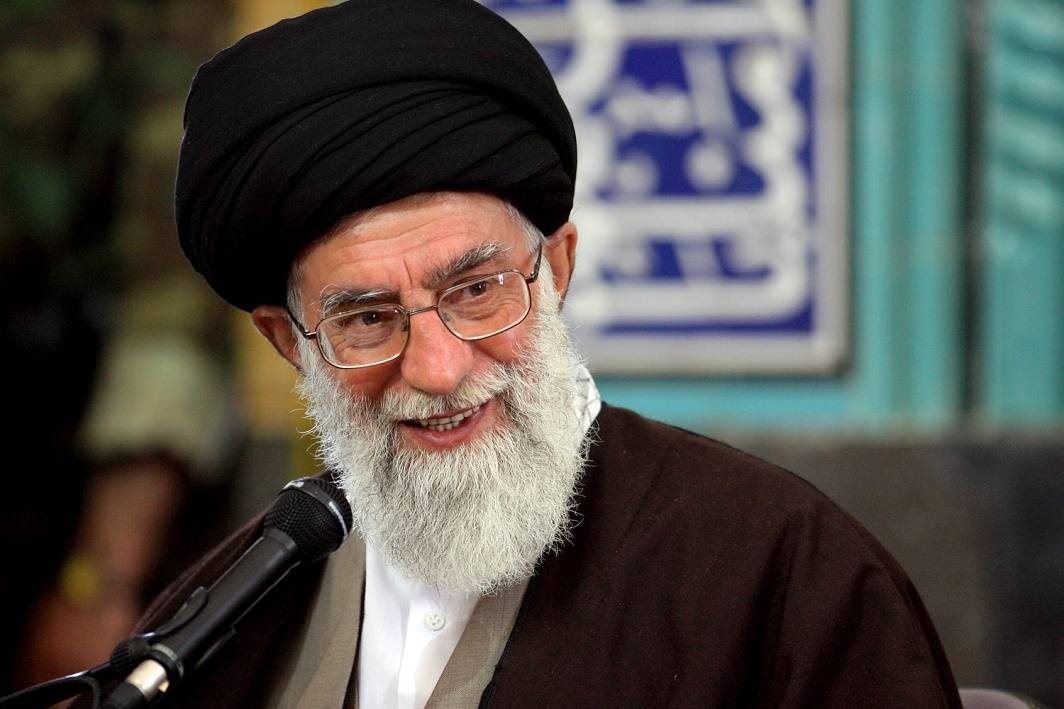
Reacting to the attacks on Syria, Iran’s Supreme Leader ayatollah Ali Khamenei, has condemned the joint airstrikes by the US, UK and France on Syria as “Crime”, describing the leaders of three western countries as “criminals.”
“I clearly declare that the US president, the French president and the UK prime minister are criminals and have committed a crime,” Khamenei said.
 The three countries, Ayatollah Khamenei said, “will achieve nothing and make no benefit, as they have been in Iraq, Syria and Afghanistan in the past few years, and committed such crimes but have not profited from them.”
Ayatollah Khamenei is considered to be most powerful leader in the region against US-Israel-Saudi Arabia and their allies’ designs in the region. Iran’s influence has been growing after defeat of terror groups in Iraq and Syria where Iranian military advisors have played important role.
Iran also supports Hamas and Hizbollah, the two most important resistance groups against Israel. Tehran also claims of morally supporting Yemen’s Houthi Ansarullah and the opposition groups in Bahrain.
The Russian military said on Saturday that the three countries fired 103 cruise missiles including Tomahawk missiles at Syria by the Syrian defense systems managed to intercept 71 of them.
Russian President Vladimir Putin severely condemned the attacks saying that the strikes violate the UN Charter and international law. He said that US launched “an aggression against a sovereign state which is at the forefront of the fight against terrorism.”
Israel’s Prime Minister Benjamin Netanyahu reiterated support to US President Donald Trump’s decision saying, “Israel’s support remains unchanged”. He said “A year ago I gave Israel’s total support for President Donald Trump’s decision to mobilize against the use of chemical weapons.”
Saudi Arabia’s foreign ministry issued a statement saying, “Saudi Arabia fully supports the strikes launched by the United States, France and Britain against Syria because they represent a response to the regime’s crimes,”
The statement further said that the strikes were prompted by the “Syrian regime’s use of chemical weapons against innocent civilians, including women and children.”
Turkey and Qatar have also supported the attack on Syria. The Turkish foreign ministry said, “We welcome this operation which has eased humanity’s conscience in the face of the attack in Douma,”
Qatar was the first country among Arab neighbours to react. An official statement expressed support for strikes to stop attacks by the Syrian regime against civilians.
However, Egypt’s foreign ministry expressed “deep concern” saying the strikes undermined the “safety of our brotherly Syrian people, and threatens the understandings reached regarding the de-escalation zones.”
Algerian Foreign Minister Ahmed Ouyahia said his country regretted that the strikes came “at a time when the international community was waiting for an inquiry team to be sent to verify” the chemical arms claims.
“These strikes will create an atmosphere which will weigh negatively on moves to resolve the Syrian crisis through a political settlement,” he said.
Meanwhile, UN Security Council has failed to adopt Russia’s draft resolution condemning the strikes on Syria. It received three votes in favour, eight votes against and four abstentions.
 The draft resolution, read by Russia’s Ambassador at the UN Vasily Nevenzya, condemned the military action and called on the three Western countries to “halt the aggression against the Syrian Arab Republic immediately and without any delay” and refrain from further use-of-force actions in violation of the UN Charter.
The UN Secretary General Antonia Guterres had earlier said “I urge all member states to show restraint in these dangerous circumstances and to avoid any acts that could escalate the situation and worsen the suffering of the Syrian people.”
CNN on Sunday uploaded a video showing the damages incurred on the alleged facility producing chemical weapons. However, Press TV video shows the same damaged structure claiming it to be a pharmaceutical plant producing anti-cancer drugs.
The airstrikes by US, Britain and France on Syria has also triggered wave of protests in several countries including US, Britain and France. Participants in the protests included Syrian refugees and the local citizens.





Latest world news
S Jaishankar says India is a natural option for Russia amid Europe tensions
External Affairs Minister S Jaishankar said India remained a natural option for Russia as Moscow increasingly turned towards Asia amid strained relations with Europe. He highlighted the continuity of India-Russia ties and their significance for the balance of power in Asia.


Latest world news
Putin praises PM Modi, says he has very good ideas on Ukraine war
Russian President Vladimir Putin has praised Prime Minister Narendra Modi for repeatedly raising the need to end the Ukraine war, describing his ideas for a settlement as “very good”.

Latest world news
S Jaishankar calls Pakistan a “serial practitioner of terrorism” at UN
S Jaishankar criticised Pakistan at the UN General Assembly, referring to a “serial practitioner of terrorism” and warning against attempts to normalise terrorism.


Dhruv Rathee gets fresh summons in 2018 BJP IT cell video case

Nobody can browbeat judiciary, Chief Justice warns over Rahul Gandhi’s march

India-US trade deal first phase finalised, drafting underway

Election Commission orders voter roll revision in 17 states, UTs

Actor Imran Khan asked to leave India after CJP protest

Delhi Police offers 11-person limit for CJP’s Connaught Place protest
Actor Imran Khan asked to leave India after CJP protest
Election Commission orders voter roll revision in 17 states, UTs
India-US trade deal first phase finalised, drafting underway
Nobody can browbeat judiciary, Chief Justice warns over Rahul Gandhi’s march

Afghan Men Try To Hang With The Jet Engine Of The Aircraft in Kabul- Afghanistan News – Kabul News
Trending Top 10 News: 10000 Crore Fine on Flipkart, Apple to Launch Unique Feature, Hdfc Bank Job Ad

Trending Top 10 News: Nokia 6310, Apple sales, Bachpan ka Pyar Video Kid, Dainik Bhaskar IT Raid

Trending Top 10 News: Canada bans Indian flights, Rain in Delhi NCR, AIMIM Twitter hacked, Raj Kundra case

Trending Top 10 News: Shein India, Apple New Service, Pocket Oxygen, Oppo Launched New Phone
-
 India News18 hours ago
Dhruv Rathee gets fresh summons in 2018 BJP IT cell video case
-
 India News15 hours ago
Nobody can browbeat judiciary, Chief Justice warns over Rahul Gandhi’s march
-
 India News10 hours ago
India-US trade deal first phase finalised, drafting underway
-
 India News8 hours ago
Election Commission orders voter roll revision in 17 states, UTs
-
 India News7 hours ago
Actor Imran Khan asked to leave India after CJP protest
-
 India News6 hours ago
Delhi Police offers 11-person limit for CJP’s Connaught Place protest
