
Latest world news
Dhaka Court Sentences 19 to Death For 2004 Attack On Sheikh Hasina


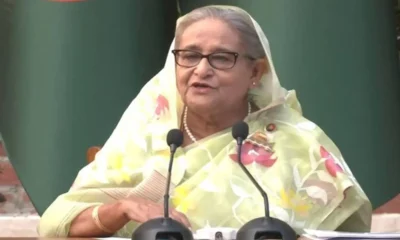
In a swift move, a Dhaka court has pronounced death penalty to 19 persons, including two former ministers and sentenced a top opposition leader to life imprisonment for their role in 2004 attack on opposition leader Sheikh Hasina, who holds PM office at present.
According to reports, Justice Shahed Nuruddin of special tribunal said, “They shall be hanged by their neck”. Life imprisonment is also awarded to Tarique Rahman, the exiled son of former Prime Minister Khaleda Zia, who is already languishing inside a Dhaka jail after her conviction in a corruption case.
The special tribunal’s order comes when country is poised for general election scheduled to be held by the end of the year.
According to Dhaka based The Daily Star, former State Minister Lutfozzaman Babar, former Deputy Minister Abdus Salam Pintu and 17 others were sentenced to death while BNP leader Tarique Rahman and 19 others were awarded life term imprisonment for the grenade attack on Awami League rally on August 21, 2004. The deadly attack had left 24 dead and hundreds injured.

Meanwhile, former Inspector General of Police — Ashraful Huda and Shahudul Haque — were given a total of four years’ imprisonment and fined Taka 50,000.
Read More: Bangladesh proposes India’s observer status at OIC
A total of 24 Awami League leaders and activists, including Mohila Awami League president Ivy Rahman, were killed and more than 300 others were injured in the deadly attack. Prime Minister Sheikh Hasina, who was the opposition leader in parliament at that time, narrowly escaped the attack.
The grenade attack was carried out during the tenure of the then BNP-Jamaat-led coalition government which was considered to be aimed at assassinating Hasina. The attack was allegedly masterminded by some BNP leaders, the report said.
The erstwhile government had allegedly made efforts to bury the case and protect the people involved in the attack by derailing the investigation.
But fresh investigation into the cases found the involvement of the militant outfit Harkat-ul-Jihad al-Islami (HUJI), influential leaders of the BNP and Jamaat, and a band of senior officials of the home ministry.
Read More: Rohingya exodus: Myanmar signs repatriation pact with Bangladesh
Earlier, wrapping up their arguments, the prosecution sought the highest punishment to all the accused, saying it has been able to prove all charges beyond reasonable doubt. However, defence counsels said the prosecution failed to produce evidence to prove the charges and sought acquittal of their clients.







Latest world news
S Jaishankar says India is a natural option for Russia amid Europe tensions
External Affairs Minister S Jaishankar said India remained a natural option for Russia as Moscow increasingly turned towards Asia amid strained relations with Europe. He highlighted the continuity of India-Russia ties and their significance for the balance of power in Asia.


Latest world news
Putin praises PM Modi, says he has very good ideas on Ukraine war
Russian President Vladimir Putin has praised Prime Minister Narendra Modi for repeatedly raising the need to end the Ukraine war, describing his ideas for a settlement as “very good”.

Latest world news
S Jaishankar calls Pakistan a “serial practitioner of terrorism” at UN
S Jaishankar criticised Pakistan at the UN General Assembly, referring to a “serial practitioner of terrorism” and warning against attempts to normalise terrorism.

Dhruv Rathee gets fresh summons in 2018 BJP IT cell video case

Nobody can browbeat judiciary, Chief Justice warns over Rahul Gandhi’s march

India-US trade deal first phase finalised, drafting underway

Election Commission orders voter roll revision in 17 states, UTs

Actor Imran Khan asked to leave India after CJP protest

Delhi Police offers 11-person limit for CJP’s Connaught Place protest
Actor Imran Khan asked to leave India after CJP protest
Election Commission orders voter roll revision in 17 states, UTs
India-US trade deal first phase finalised, drafting underway
Nobody can browbeat judiciary, Chief Justice warns over Rahul Gandhi’s march

Afghan Men Try To Hang With The Jet Engine Of The Aircraft in Kabul- Afghanistan News – Kabul News
Trending Top 10 News: 10000 Crore Fine on Flipkart, Apple to Launch Unique Feature, Hdfc Bank Job Ad

Trending Top 10 News: Nokia 6310, Apple sales, Bachpan ka Pyar Video Kid, Dainik Bhaskar IT Raid

Trending Top 10 News: Canada bans Indian flights, Rain in Delhi NCR, AIMIM Twitter hacked, Raj Kundra case

Trending Top 10 News: Shein India, Apple New Service, Pocket Oxygen, Oppo Launched New Phone
-
 India News17 hours ago
Dhruv Rathee gets fresh summons in 2018 BJP IT cell video case
-
 India News13 hours ago
Nobody can browbeat judiciary, Chief Justice warns over Rahul Gandhi’s march
-
 India News9 hours ago
India-US trade deal first phase finalised, drafting underway
-
 India News7 hours ago
Election Commission orders voter roll revision in 17 states, UTs
-
 India News6 hours ago
Actor Imran Khan asked to leave India after CJP protest
-
 India News5 hours ago
Delhi Police offers 11-person limit for CJP’s Connaught Place protest
