English हिन्दी
Connect with us

Latest world news

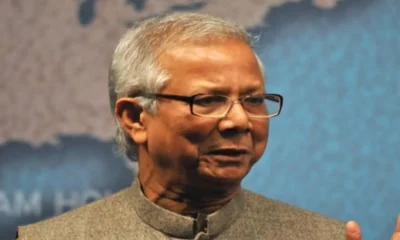
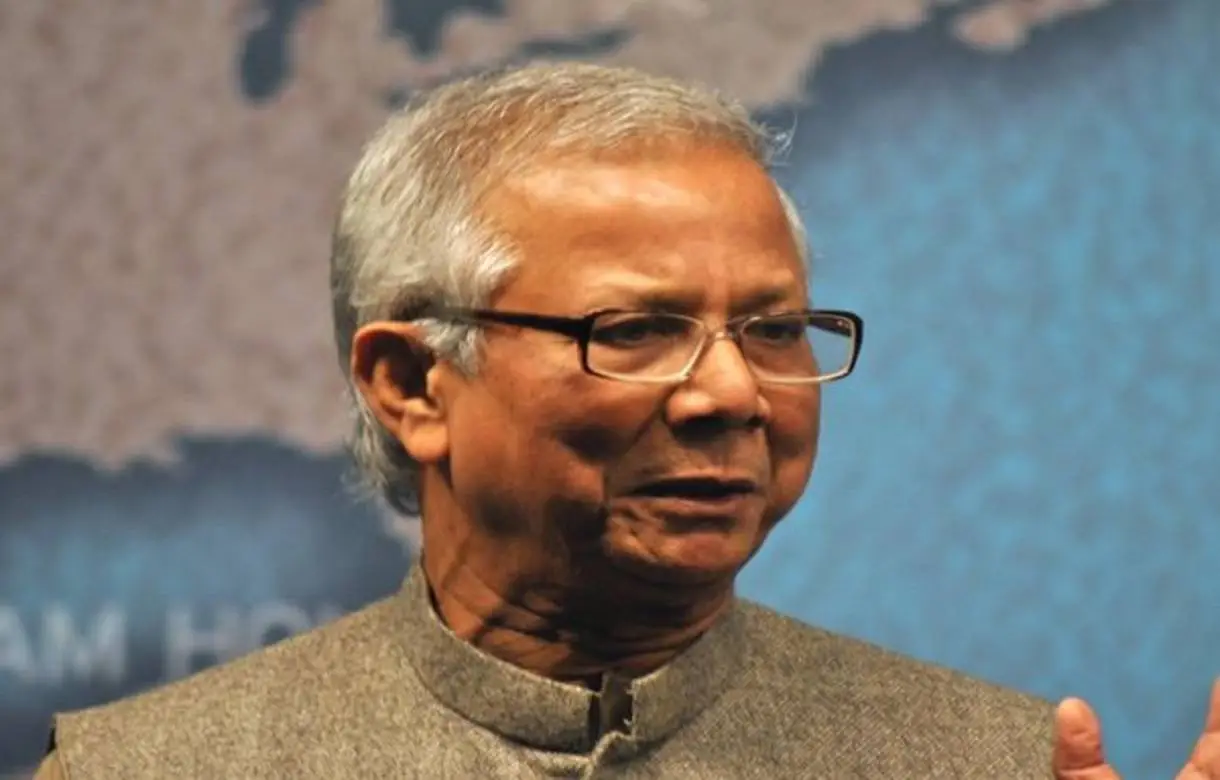
Muhammad Yunus references India’s Seven Sisters, China ties in farewell speech

Muhammad Yunus, in his farewell speech as Bangladesh’s chief adviser, stressed sovereignty in foreign policy, referenced India’s Seven Sisters and highlighted China-backed projects amid domestic criticism.

Published

on

Bangladesh’s outgoing Chief Adviser Muhammad Yunus used his farewell address to underline a sovereignty-focused foreign policy, making pointed references to India’s northeastern region and deepening ties with China at a time of mounting criticism at home.

Facing sustained scrutiny over his interim administration’s handling of democratic transition and minority protection, Yunus projected an assertive tone in his closing speech. He maintained that Bangladesh had restored its “sovereignty, dignity, and independence” in foreign affairs and was “no longer guided by others’ directives.”

His remarks were widely viewed as directed at India, Bangladesh’s largest neighbour, particularly after he referred to regional economic integration involving Nepal, Bhutan and the “Seven Sisters” — a term commonly used for India’s northeastern states.

Regional integration and economic vision

Yunus spoke about leveraging Bangladesh’s maritime access and positioning the country as a gateway to broader regional trade.

“Our open seas are not just borders—they are gateways to the global economy. With Nepal, Bhutan, and the Seven Sisters, this region has immense economic potential. Economic zones, trade agreements, and duty-free market access can establish us as a global manufacturing hub,” he said.

By grouping India’s northeastern states alongside sovereign nations within a shared economic framework, Yunus appeared to outline a regional model centred on Bangladesh’s ports and connectivity infrastructure. The formulation is likely to draw attention in New Delhi, which has invested significantly in connectivity projects through Bangladesh to better integrate its northeast with the rest of India.

His remarks suggested that future access and opportunity for the landlocked northeastern region could be shaped by Bangladesh’s strategic and economic decisions.

China factor and strategic balance

Yunus also emphasised what he described as a policy of “strategic balance,” highlighting expanding engagement with China, Japan, the United States and Europe.

He cited progress on China-backed initiatives, including the Teesta River project and a 1,000-bed international hospital in Nilphamari. The Teesta project is located near India’s strategically sensitive Siliguri corridor.

“We have also deepened cooperation with China. Significant progress has been made on the Teesta River project and a 1,000-bed international hospital in Nilphamari,” Yunus said.

Rather than directly addressing regional sensitivities, his speech underscored Bangladesh’s intent to pursue partnerships based on what he described as national interest and mutual respect.

Military modernisation and domestic criticism

The outgoing chief adviser also referred to military modernisation, stating that Bangladesh had begun strengthening its armed forces to “counter any aggression.” Though not directed at any specific country, the phrasing added to the speech’s firm tone.

Notably, Yunus did not directly address criticism over his government’s handling of communal tensions and minority protection during his 18-month tenure. His interim administration came to power following widespread unrest after years of former Prime Minister Sheikh Hasina’s rule.

Rights groups and minority representatives had earlier raised concerns about attacks on Hindu communities in several districts, including incidents of vandalism and intimidation. Critics have argued that the interim government’s response was uneven and that it fell short of fully restoring democratic confidence.

As Yunus exits office, his farewell address presented a narrative focused on foreign policy recalibration and national assertion, while leaving domestic controversies largely unaddressed.

Latest world news

India-bound tanker among 2 vessels seized by Iran’s Revolutionary Guards amid Hormuz tensions

Iran’s seizure of an India-bound tanker near the Strait of Hormuz signals rising maritime tensions and risks to global oil supply routes.

Published

on

Strait of Hormuz

Iran’s Islamic Revolutionary Guard Corps (IRGC) has seized two vessels near the strategically crucial Strait of Hormuz, with one of them reportedly bound for India, intensifying concerns over maritime security in the region.

The development comes amid escalating tensions linked to the ongoing confrontation involving Iran and the United States, which has already disrupted shipping routes and heightened risks for commercial vessels passing through the area.

According to reports, the vessels were intercepted by Iranian forces close to the Strait of Hormuz — a critical chokepoint through which a significant portion of the world’s oil supply transits. The move underscores growing instability in one of the busiest and most sensitive maritime corridors globally.

Separate reports indicate that multiple ships have faced attacks or interceptions in recent days, with at least two vessels taken into custody by Iranian authorities after being targeted near Iranian waters.

The incident follows a series of confrontations at sea, including gunfire and forced halts of commercial ships, as tensions remain high despite attempts at ceasefire arrangements.

The Strait of Hormuz has become a focal point of the broader conflict, with both military actions and retaliatory measures affecting shipping traffic. Any disruption in this region carries global implications, particularly for countries like India that depend heavily on energy imports passing through the route.

India has already been taking steps to safeguard its maritime interests, including enhanced monitoring and security measures for vessels navigating the region.

Continue Reading

Latest world news

Fresh tensions as Iran targets vessel despite ceasefire announcement

Iran fired at a vessel in the Strait of Hormuz shortly after a ceasefire announcement, raising concerns over regional stability.

Published

on

Attack on vessel highlights fragile situation in Strait of Hormuz despite renewed ceasefire push

Tensions in the Middle East escalated again after Iran opened fire on a commercial vessel in the Strait of Hormuz, just hours after US President Donald Trump announced a ceasefire extension.

According to maritime security officials, an Iranian Revolutionary Guard gunboat fired at a container ship early on April 22. The vessel was damaged in the incident, but no injuries or environmental damage were reported.

The attack comes amid already heightened tensions in the region, where the strategic Strait of Hormuz — a key global oil transit route — has seen severe disruptions in recent days.

Ceasefire efforts face immediate test

The firing incident occurred shortly after Trump signalled an extension of the ceasefire, reportedly aimed at creating space for renewed negotiations with Iran. However, the latest development has raised concerns about the durability of the truce.

Reports indicate that the Iranian action followed recent US military moves, including the seizure of vessels linked to Tehran and continued naval pressure in the region.

Shipping route remains volatile

The Strait of Hormuz remains a flashpoint, with shipping traffic significantly affected. In recent days, only a handful of vessels have been able to pass through the route, compared to normal volumes, leaving many ships stranded.

The waterway is critical for global energy supplies, handling a significant share of the world’s oil shipments. Any disruption has immediate implications for international markets.

No official response yet

Iran has not officially commented on the latest firing incident. Meanwhile, international observers and maritime agencies continue to monitor the situation closely, warning of risks to crew safety and global trade.

The latest escalation underscores the fragile nature of ongoing diplomatic efforts, with both sides yet to reach a stable agreement.

Continue Reading

Latest world news

Trump extends Iran ceasefire after Pakistan request, raises hopes for talks

The US extends its Iran ceasefire after Pakistan’s request, opening a window for diplomacy while tensions persist

Published

on

Donald Trump statement

The United States has extended its ceasefire with Iran, with former US President Donald Trump stating that the decision came after a request from Pakistan’s leadership. The move comes just hours before the truce was due to expire, offering a temporary pause in escalating tensions.

Trump said the extension is intended to provide Iran additional time to present a “unified proposal” for a broader peace agreement, signalling a shift towards diplomacy even as pressure on Tehran continues.

Pakistan steps in as mediator

Pakistan has played a key role in facilitating the ceasefire extension. Its leadership, including top civil and military figures, urged the US to delay further action and allow diplomatic efforts to continue.

The development positions Pakistan as an emerging mediator in the crisis, with efforts underway to encourage dialogue between Washington and Tehran. The country has also indicated willingness to support or host discussions aimed at de-escalation.

Pressure remains despite pause

Despite the extension of the ceasefire, the situation remains tense. The US has not rolled back its strategic posture in the region.

Military readiness continues, and restrictions such as the naval blockade linked to Iran remain in place. This indicates that while direct confrontation has been paused, broader pressure tactics are still active.

What Pakistan could gain

Pakistan’s involvement in the ceasefire process could bring several advantages.

First, it enhances the country’s global diplomatic standing by placing it at the centre of a major international issue. Acting as a mediator between two adversaries can improve its credibility on the world stage.

Second, stability in the region is directly beneficial for Pakistan’s economic interests, particularly given its reliance on energy supplies linked to the broader Middle East.

Finally, successful mediation could strengthen Pakistan’s strategic influence, giving it a more prominent role in future geopolitical developments.

Uncertain road ahead

While the ceasefire extension has reduced immediate risks, uncertainty remains over how the situation will evolve. Much will depend on whether Iran presents a proposal acceptable to the US and whether negotiations can move forward.

For now, the extension reflects a temporary shift away from confrontation, but the underlying tensions remain unresolved.

Continue Reading

Trending

© Copyright 2022 APNLIVE.com