English हिन्दी
Connect with us

India News

Vande Mataram to be played before national anthem under new government rules

The Centre has mandated that Vande Mataram be played before the national anthem at government events and schools, with standing compulsory and all six stanzas included.

Published

on

Vande Mataram

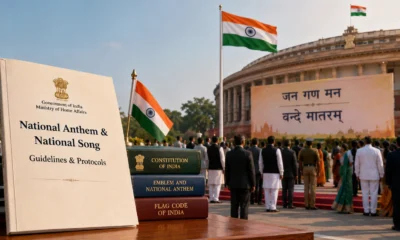
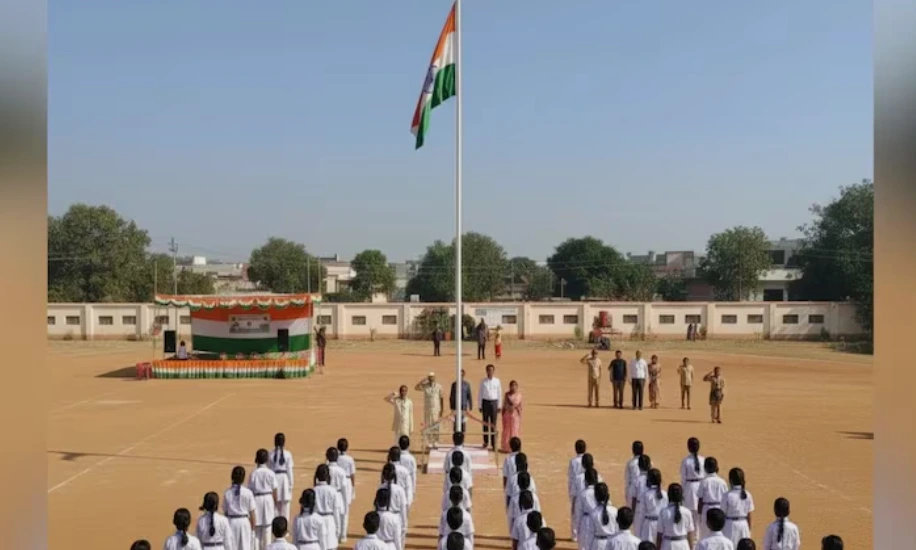
The Union Home Ministry on Wednesday issued fresh guidelines directing that the national song ‘Vande Mataram’ be played before the national anthem ‘Jana Gana Mana’ at all government events and in all schools across the country.

Under the new rules, individuals must stand when ‘Vande Mataram’ is played at official functions. The directive also expands the occasions on which the song will be performed, including civilian award ceremonies such as the Padma awards and events attended by the President, during both arrival and departure.

The guidelines further state that ‘Vande Mataram’ will be played in public spaces such as cinema halls. However, standing will not be mandatory in such instances.

Significantly, all six stanzas of the song will now be rendered, including four that were not used at national gatherings following a 1937 decision by the Congress leadership.

Legal backing and extension of protections

Last month, sources had indicated that the government was considering extending protocols applicable to the national anthem under the Prevention of Insults to National Honour Act to the national song.

Under this law, anyone who disrupts or prevents others from showing respect to the national anthem — and now the national song — can face imprisonment of up to three years.

Political backdrop to the directive

The move is expected to trigger political debate, especially after last year’s exchange between the ruling BJP and the Congress over the history of ‘Vande Mataram’.

Prime Minister Narendra Modi had accused former Prime Minister Jawaharlal Nehru of opposing the song on the grounds that it could “irritate Muslims”, alleging that this approach mirrored that of Muhammad Ali Jinnah. The BJP had also shared letters written by Nehru to support its position. The issue intensified during a parliamentary discussion marking the 150th anniversary of the song.

The four stanzas that were earlier excluded contain references to Hindu goddesses such as Durga, Kamala (Lakshmi) and Saraswati. In 1937, at a Congress session in Faizpur led by Nehru, it was decided that only the first two stanzas would be used at national gatherings. The rationale was that the later verses were viewed by some members of the Muslim community as exclusionary.

The BJP has argued that the earlier exclusions reflected a divisive approach and that dropping the stanzas contributed to the circumstances leading to Partition.

In response, Congress leaders have criticised the ruling party. Party president Mallikarjun Kharge described it as ironic that those claiming to defend nationalism had not historically sung ‘Vande Mataram’. Priyanka Gandhi Vadra, speaking in Parliament, accused the Prime Minister and the BJP of selectively quoting Nehru and presenting excerpts from his letters without context, and alleged political motives linked to the upcoming Assembly election in Bengal.

Historical context of the song

‘Vande Mataram’ was written on November 7, 1875, by Bengali author Bankim Chandra Chatterjee and later published in his 1882 novel ‘Anandmath’. The song became a rallying cry during India’s freedom movement.

Across its six stanzas, the composition portrays the nation as a mother figure, combining nurturing and protective imagery. The later verses specifically reference Hindu goddesses, which formed the basis of the 1937 decision to limit its official use to the first two stanzas.

With the new directive, the government has reinstated all six stanzas for official performance.

India News

Pawan Khera faces fresh setback as Supreme Court refuses relief in passport row case

Congress leader Pawan Khera faces fresh setback as Supreme Court refuses interim relief and directs him to seek bail from Guwahati High Court.

Published

on

Pawan Khera

Congress leader Pawan Khera suffered another legal setback on Friday after the Supreme Court of India declined to extend protection in a case linked to his remarks about Himanta Biswa Sarma’s wife.

A bench of the apex court refused to interfere with an earlier order that had stayed the transit anticipatory bail granted to Khera by the Telangana High Court. This decision leaves the Congress leader open to possible arrest by Assam Police in connection with the case.

During the hearing, Khera’s counsel sought interim protection, but the court declined the request and advised him to approach the appropriate court in Assam for relief. The bench clarified that the Guwahati High Court should decide any bail plea independently and on its merits.

“Am I a terrorist?” remark during hearing

While seeking protection, Khera’s legal team expressed concern over the urgency of the situation. In court, his counsel remarked, “Am I a terrorist?” highlighting the plea for temporary relief until a fresh bail application could be filed.

The Supreme Court also raised concerns over the submission of incorrect documents during the proceedings, adding another layer to the legal complications faced by the Congress leader.

Case linked to remarks on CM’s wife

The case stems from a press conference held earlier this month, where Khera made allegations regarding the citizenship status and financial assets of the Assam Chief Minister’s wife, Riniki Bhuyan Sharma.

He had claimed that she possessed multiple passports and owned undisclosed overseas properties. These allegations were strongly denied by the Chief Minister’s family, who termed them fabricated and misleading.

Legal battle intensifies

Earlier, the Telangana High Court had granted Khera temporary transit anticipatory bail, allowing him time to seek relief from a competent court in Assam. However, the Supreme Court stayed that order following a challenge by Assam authorities, escalating the legal battle.

With the latest ruling, Khera is now expected to move the Guwahati High Court for anticipatory bail as the case continues to unfold.

Continue Reading

India News

Congress suspends 5 Haryana MLAs over cross-voting in Rajya Sabha polls

Congress suspends five Haryana MLAs for cross-voting in Rajya Sabha elections, citing serious indiscipline and anti-party activities.

Published

on

The Congress has suspended five of its MLAs in Haryana for cross-voting during the recent Rajya Sabha elections, taking disciplinary action over what it described as “anti-party activities”.

The move came after the state unit reviewed the conduct of certain legislators during the polls, where some were found to have voted against the party’s authorised candidate.

Five MLAs suspended after disciplinary process

According to party sources, the MLAs were issued show-cause notices seeking an explanation for their actions. After reviewing their responses, the Congress disciplinary committee recommended suspension.

The decision was approved by the party leadership, including Congress president Mallikarjun Kharge, and has been implemented with immediate effect.

Party calls it ‘grave indiscipline’

Haryana Congress chief Udai Bhan said the action was necessary to uphold party discipline, stressing that defying the official party line during elections weakens organisational unity.

He said the party takes such violations seriously and will continue to act against any form of indiscipline.

Leadership backs strict action

Senior Congress leader and Leader of Opposition Bhupinder Singh Hooda supported the decision, saying it was taken after due consideration.

He noted that while Rajya Sabha elections are conducted through an open ballot system, allowing legislators some flexibility, the party retains the authority to initiate internal disciplinary action in cases of deviation.

Background

The action follows cross-voting reported during the recent Rajya Sabha elections in Haryana, which led to internal concerns within the party. The development has highlighted organisational challenges and prompted the leadership to take corrective steps to reinforce discipline.

Continue Reading

India News

Harivansh set to be elected Rajya Sabha Deputy Chairperson unopposed

Harivansh is set to be elected unopposed as Rajya Sabha Deputy Chairman after no opposition nominations were filed before the deadline.

Published

on

Former Rajya Sabha Deputy Chairman Harivansh is set to be re-elected to the same post unopposed in the election due to be held later today.
The date has been fixed by the Chairman under the relevant rules governing the conduct of business in the Upper House.
According to sources, the deadline for submitting motions for the election was 12 noon on April 16. A total of five notices were received within the stipulated time, all proposing Harivansh for the post.

Multiple nominations, single candidate
The motions were submitted by members across parties, including Jagat Prakash Nadda, Nitin Nabin, Nirmala Sitharaman, Sanjay Kumar Jha, and Jayant Chaudhary, each backed by seconding members.
All five motions explicitly state that Harivansh be chosen as the Deputy Chairman of the Rajya Sabha.

No opposition nomination filed

Notably, no motion was submitted by the Opposition before the deadline. This effectively clears the path for a unanimous election, as there is no contest for the position.
As per parliamentary procedure, motions will be taken up one by one. Once any one motion is adopted by the House, the remaining motions will not be put to vote.

Likely to be elected by voice vote
In line with established practice, the first motion — expected to be moved by Nadda — may be adopted through a voice vote. Following this, the Chairman will formally declare Harivansh as elected Deputy Chairman.
After the declaration, Harivansh will be escorted to the Chair by members from both the Treasury and Opposition benches, adhering to parliamentary convention.

Continue Reading

Trending

© Copyright 2022 APNLIVE.com