English हिन्दी
Connect with us

Latest world news

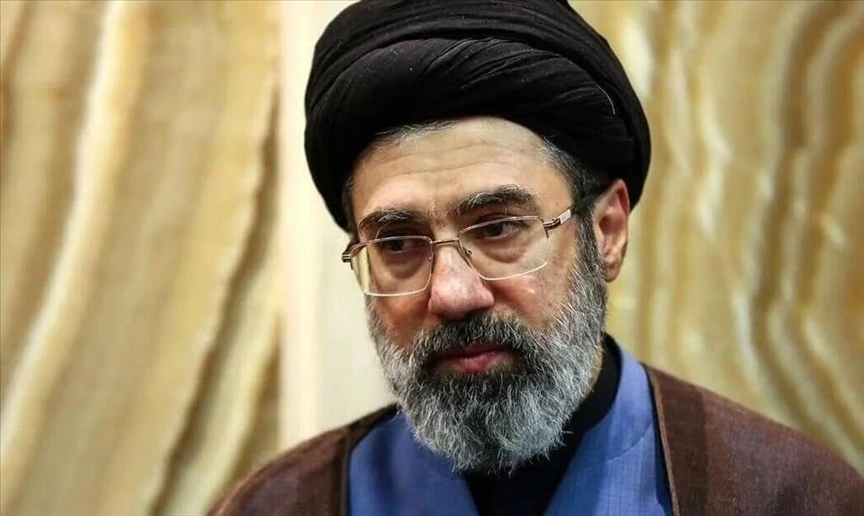
Mojtaba Khamenei named Iran’s new supreme leader after death of Ali Khamenei

Iran’s Assembly of Experts has selected Mojtaba Khamenei as the country’s new supreme leader following the death of Ali Khamenei amid escalating regional conflict.

Published

on

Mojtaba

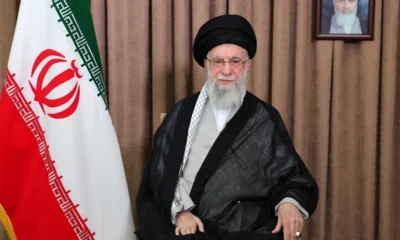
Mojtaba Khamenei has been appointed the new Supreme Leader of Iran, replacing his father Ali Khamenei, according to state media reports.

The decision was taken by the Assembly of Experts, an 88-member council responsible for selecting the country’s supreme leader. The body said it had chosen Mojtaba Khamenei through a decisive vote, naming him the third leader of the Islamic Republic.

Mojtaba Khamenei, a mid-ranking cleric with strong connections within Iran’s security establishment, had long been seen as a potential successor to his father. His influence within the powerful Revolutionary Guards and networks associated with his father’s office had made him a prominent figure in Iran’s political structure.

His appointment comes amid a sharp escalation in tensions in the region. Ali Khamenei was reportedly killed in strikes carried out during the ongoing conflict involving Iran, the United States and Israel. The situation has led to rising hostilities and military exchanges in recent days.

The role of supreme leader in Iran carries ultimate authority over key state institutions, including the military, judiciary and major political decisions.

The development may further strain relations between Tehran and Washington. Donald Trump recently said the United States should have a say in who leads Iran, a remark likely to draw criticism from Iranian authorities.

Meanwhile, fighting linked to the conflict has continued across the region. Strikes targeting infrastructure in Tehran have caused fires at fuel facilities, sending thick smoke into the sky and raising environmental concerns.

Iranian officials have condemned the attacks as dangerous escalation, while Israeli authorities have defended the strikes, saying the targeted facilities were connected to Iran’s military operations.

As the conflict continues, Iran’s new leadership now faces the challenge of navigating both internal political pressures and rising regional tensions.

Latest world news

US judge strikes down Donald Trump’s $100,000 H-1B visa fee, calls it unlawful

A federal judge in Boston has invalidated Donald Trump’s $100,000 fee on new H-1B visas, ruling that the measure was an unlawful tax imposed without authorization from Congress.

Published

on

A US federal judge has struck down President Donald Trump’s controversial $100,000 fee on new H-1B visas, ruling that the measure amounted to an unlawful tax that had not been authorised by Congress.

The decision was delivered by US District Judge Leo Sorokin in Boston in a case brought by 20 Democratic state attorneys general who challenged the fee announced by the Trump administration in September. The lawsuit argued that the sharp increase in visa costs would make it harder for employers to recruit highly skilled foreign professionals.

Court says fee exceeded presidential authority

In his ruling, Judge Sorokin rejected the administration’s argument that the fee was a lawful penalty under immigration law. Instead, he concluded that the charge functioned as a tax, which can only be imposed with congressional approval.

The court found that the president did not have the authority to introduce such a levy through executive action. The ruling invalidates the fee and prevents its enforcement.

H-1B programme widely used by employers

The H-1B visa programme is a key pathway used by US employers to hire foreign professionals in specialised fields. The programme issues 65,000 visas annually, along with an additional 20,000 visas for individuals holding advanced degrees. Approved visas are generally valid for three to six years.

Before the fee increase, employers typically paid between $2,000 and $5,000 in visa-related charges, depending on various factors. Trump’s policy raised the cost dramatically, drawing criticism from technology companies and other employers that rely on skilled international talent.

Fee saw limited uptake

Court filings showed that the higher fee significantly reduced demand for new H-1B applications. According to government submissions, US Citizenship and Immigration Services had received only 85 payments of the $100,000 fee by mid-February.

The Trump administration is expected to appeal the ruling, keeping the legal battle over the policy ongoing.

Continue Reading

Latest world news

Iran fires missiles at Israel for first time since April ceasefire, regional tensions flare

Iran launched a missile attack on Israel for the first time since the April ceasefire, raising fears of renewed conflict and prompting airspace restrictions in parts of the Middle East.

Published

on

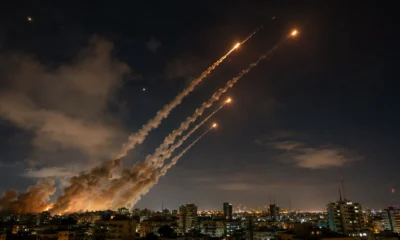
Iran launched missiles toward Israel in a significant escalation of tensions, marking its first direct missile attack on Israeli territory since a fragile ceasefire was reached in April. The development has raised concerns about the possibility of renewed conflict in the Middle East.

According to Israeli military officials, air defence systems were activated after missile launches were detected from Iran. Warning sirens sounded in several areas as authorities moved to intercept the incoming projectiles. Reports indicated that most, if not all, of the missiles were intercepted before causing major damage.

Attack follows tensions over Beirut strike

The missile launch came after heightened tensions linked to Israeli military operations in Beirut. Iranian officials accused Israel of crossing red lines through its actions in Lebanon and signalled that retaliation was inevitable.

Iran’s military and political leadership warned that further Israeli actions could trigger broader responses across the region. The attack is being viewed as one of the most serious challenges to the ceasefire arrangement that has largely held since April.

Regional airspace restrictions imposed

In response to the growing security concerns, Iraq and Syria moved to restrict or close portions of their airspace. Iran also implemented airspace-related measures as regional governments sought to prevent risks to civilian aviation amid fears of further military escalation.

The latest developments have disrupted travel routes and heightened alert levels across several Middle Eastern countries.

Israel warns of response

Israeli officials condemned the missile attack and signalled that a response could follow. Military leaders stated that Israel would act when authorised, while security forces remained on high alert amid concerns that additional attacks could occur.

Meanwhile, international diplomatic efforts are continuing to prevent a broader regional conflict. Several countries have urged restraint as fears grow that the latest exchange could undermine ongoing negotiations and destabilise an already volatile region.

Continue Reading

Latest world news

Vladimir Putin backs India’s independent foreign policy, warns against sanctions pressure

Russian President Vladimir Putin said sanctions threats against India would boomerang, praising PM Narendra Modi’s leadership and India’s commitment to pursuing its national interests.

Published

on

Vladimir Putin

Russian President Vladimir Putin has said that any sanctions threats directed at India would ultimately backfire, asserting that New Delhi has consistently acted in accordance with its national interests and is unlikely to change course under Prime Minister Narendra Modi’s leadership.

Speaking about India-Russia relations and New Delhi’s foreign policy approach, Putin praised India’s independent decision-making and emphasized that attempts to pressure the country over its ties with Moscow would not achieve the desired outcome. He suggested that any such measures would have negative consequences for those imposing them.

The Russian leader described India as a reliable partner and highlighted the strength of bilateral ties between the two countries. He also indicated that Russia does not view India’s growing engagement with other nations, including the United States, as a threat to its relationship with New Delhi.

Putin further praised India’s economic progress and reiterated confidence in the country’s ability to pursue policies based on its own priorities. His remarks come amid continuing global discussions over sanctions, geopolitical alignments and international partnerships.

The comments underscore Moscow’s efforts to reinforce its strategic partnership with India while highlighting Russia’s support for New Delhi’s independent foreign policy stance.

Continue Reading

Trending

© Copyright 2022 APNLIVE.com