English हिन्दी
Connect with us

India News

Deepika Padukone’s visit to JNU invites both praise and criticism

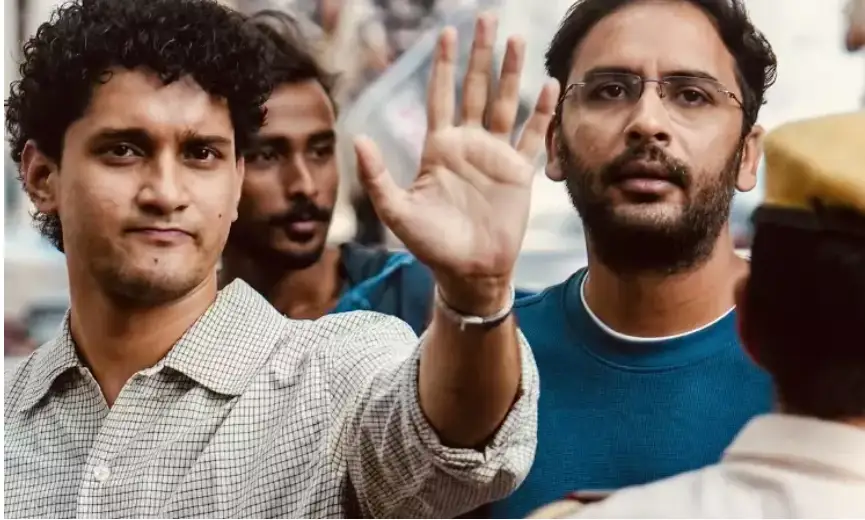
Actor Deepika Padukone’s visit to Delhi’s Jawaharlal Nehru Univeristy (JNU) last night drew a lot of attention. Hashtags ‘boycottchhapaak’ and ‘IStandwithDeepika’ started trending on Twitter as soon as she photographs of meeting with JNUSU president Aishe Ghosh started doing the rounds.

Published

on

Deepika Padukone at JNU protest

Actor Deepika Padukone’s visit to Delhi’s Jawaharlal Nehru Univeristy (JNU) last night drew a lot of attention. Hashtags ‘boycottchhapaak’ and ‘IStandwithDeepika’ started trending on Twitter as soon as she photographs of meeting with JNUSU president Aishe Ghosh started doing the rounds.

While BJP supporters and a few leaders also called for a boycott of her movies, Union minister Prakash Javadekar clarified that any common man has the right to express their opinion.”There can be no objection to it,” he added.

On Sunday evening, over 30 students and teachers, including Aishe Ghosh were attacked by masked miscreants who entered the university campus, armed with iron rods, sledgehammers and stones. The injured were later admitted to All India Institute of Medical Sciences.

According to reports, Padukone stayed on campus for about 10 minutes. The actor, however, didn’t speak to the media.

In an interview with India Today earlier, Padukone talked about the recent attacks, “I feel angry that this is happening but at the same time the fact that action has not been taken, this is what one needs to think about it,”.

Deepika Padukone was in Delhi to promote her upcoming film Chhapaak. The film, directed by Meghna Gulzar, is based on the life of acid attack survivor Laxmi Agarwal.

Minutes after her appearance at the protest, BJP’s Tajinder Pal Singh Bagga called for a boycott of her films. He urged his followers to boycott movies of Padukone for her support to TukdeTukdeGang and Afzal Gang.

BJP’s national spokesperson Nupur Sharma also tweeted on Deepika Padukone’s visit.

Economist and former chief economist of World Bank, Kaushik Basu saw Padukone’s visit to JNU as a ploy to drive ticket sales of her upcoming movie, Chhapaak.


BJP national spokeperson Sambit Patra took a veiled jibe at the actor’s move.

BJP leader Ram Kadam also condemned  the actor’s visit and deemed it as “unfortunate”. “It is unfortunate that Deepika Padukone visited JNU. We condemn this,” Kadam was quoted saying by ANI.

BJP leader Shahnawaz Hussain attacked the 34-year old actor, saying that her visit to the university reflected her “one-sided thinking”.

Madhya Pradesh BJP’s vice president, Rameshwar Sharma also took a jibe at the actor. Sharma said, “Deepika Padukone is standing with those who are anti-nationals.”

However, the actor’s presence at the protest also received admiration from activists, actors and journalists.

Many Bollywood personalities including Anurag Kashyap, Swara Bhasker, Varun Grover and Prakash Raj came out in Padukone’s support.


Journalist Rana Ayyub and Barkha Dutt also hailed the actor’s move.


This isn’t the first time that Padukone has faced opposition from right-wing organizations. For her movie 2018 period drama Padmavat, Padukone received death threats, where a political leader called for the beheading of the actor.

Chief ministers of BJP-ruled states such as Rajasthan, Madhya Pradesh, Uttar Pradesh and Gujarat had also called for a ban on the period drama.

India News

Nepal Floods: Rescue ops halted after barrier lake breaches in Tibet

Nepal temporarily halted rescue operations after a barrier lake upstream of the Gyirong border port in Tibet breached, raising fears of renewed flooding.

Published

on

Nepal has temporarily halted rescue operations after authorities received information that a water barrier on the Tibetan side of the border had breached, raising the risk of further flooding in the Himalayan region.

Police warned security personnel, rescue workers and members of the public involved in relief operations to remain alert and immediately move to safer locations.

The warning came two days after a glacial collapse triggered deadly flash flooding in Nepal, killing 469 people. Around 1,400 people are still missing, including hundreds of foreigners, according to the information provided by authorities.

Nepalese authorities stopped rescue operations for 90 minutes amid concerns that another wave of flooding could hit the area within hours.

Narendra Pariyar, the senior bureaucrat of Nepal’s Rasuwa district, said the water level in the river was rising. Helicopter rescue operations were also suspended, while residents were seen moving towards higher ground.

China pauses rescue operations in Tibet

China also suspended rescue operations in the affected area, citing the risk of renewed flooding.

A lake had formed near the China-Nepal border after large amounts of mud and debris accumulated following a mudslide. The lake began overflowing towards areas where rescue teams had been working.

Chinese authorities ordered rescue teams to remain on standby and withdraw one kilometre from the affected area as a precaution.

The developments came as hundreds of people remained missing in Tibet following the deadly mudslide.

Barrier lake raises fresh flood fears

The barrier lake formed after mud and debris hit the Gyirong border hub in Tibet on Wednesday. Aerial footage captured by a Chinese rescue team on Thursday showed brown water accumulating in a basin with no visible outlet.

The water had already covered bushes and trees and was pressing against a barrier made of debris and stones.

Earlier, rescuers and residents on the lower banks in Nepal had been advised to move to higher ground. Chinese personnel and vehicles were also moved away from the area as concerns grew over the possibility of the lake bursting.

Authorities were also concerned about potential secondary disasters, including mountain collapses and avalanches.

The renewed warning has added to the challenges facing rescue teams as Nepal continues efforts to locate those still missing after the devastating flash floods.

Continue Reading

India News

Raksha Bandhan rush chokes Delhi-Meerut Expressway, traffic crawls for hours

Heavy Raksha Bandhan traffic caused kilometre-long queues on the Delhi-Meerut Expressway and severe congestion across Ghaziabad.

Published

on

The Delhi-Meerut Expressway witnessed severe traffic congestion on Thursday evening, August 27, a day before Raksha Bandhan, as a large number of people travelled to their hometowns and relatives’ homes.

Traffic moved slowly for several kilometres, with some commuters reportedly stuck for nearly five to six hours. The congestion affected stretches of the expressway and other major roads in Ghaziabad.

The traffic was particularly heavy around Lal Kuan and towards Dasna. People travelling from Delhi and Noida added to the pressure on roads as they headed out ahead of the festival.

Commuters face long delays

The festive rush also affected people travelling within the city. Commuters returning from offices reported journeys taking two to three times longer than usual.

One commuter cited in the report said it took around 35-40 minutes to cover four kilometres on the Delhi-Meerut Expressway, compared with the usual 10-15 minutes.

Near Chhijarsi, passengers were also reportedly waiting for buses and other vehicles, with the traffic congestion making it difficult for vehicles to reach them.

Ghaziabad Police issues traffic helpline

Amid the congestion, Ghaziabad Police said traffic personnel were deployed at Lal Kuan to manage the situation. A traffic helpline number, 9643322904, was also issued for commuters.

Authorities had already put traffic measures in place ahead of Raksha Bandhan as increased movement was expected during the festival.

Alternative routes for commuters

For people travelling between Ghaziabad and Meerut, connectors before Dasna can be used to access the Eastern Peripheral Expressway and avoid the main congested stretch.

Commuters travelling from Delhi or Ghaziabad can also consider the old National Highway route through Muradnagar and Modinagar.

For those heading towards Meerut, the Namo Bharat train is another option. The NCRTC was operating additional services on August 27 and 28, with trains available at shorter intervals during the festive period.

Continue Reading

India News

Nepal flash floods kill 359, over 1,300 still missing, search continues for survivors

Nepal flash floods have killed at least 359 people and left more than 1,300 missing, with rescue and relief operations continuing across affected areas.

Published

on

The death toll from the deadly flash floods in Nepal has risen to at least 359, while more than 1,300 people remain missing, Nepali police said on Thursday as rescue teams continued searching for survivors.

The flash flood struck the Bhotekoshi River at around 9 am on Wednesday, causing widespread destruction across three districts. The disaster resulted in significant loss of life and left several people missing, including foreign tourists.

According to Nepalese officials, the flood rushed downstream after hitting the main market area, sweeping away people, animals, buildings and public infrastructure.

The powerful flow also damaged roads and bridges, disrupting key routes and complicating rescue and relief efforts.

288 Indians still missing

India’s Ministry of Foreign Affairs said 288 Indians remain missing following the disaster. Around 200 people undertaking the Mansarovar Yatra have also sought evacuation.

India has sent two military aircraft carrying 48 tonnes of relief supplies to flood-hit Nepal. The supplies include solar lamps, hygiene kits, more than eight tonnes of medicines and food.

Rescue and relief operations intensified

Nepal’s security forces have stepped up rescue and relief operations, deploying helicopters and ground teams to affected areas.

Authorities are providing medical assistance, temporary shelters, food, water and medicines to people affected by the floods.

The disaster has also highlighted the growing risks facing communities and infrastructure in the Himalayan region, where unstable ice systems can threaten settlements, infrastructure and water supplies.

A similar flash-flood disaster occurred in the region in August 2025 after a glacial lake in Tibet overflowed amid high temperatures. Nine people were killed in that incident, while critical infrastructure, including a bridge connecting Nepal and China, was damaged.

Continue Reading

Trending

© Copyright 2022 APNLIVE.com