English हिन्दी
Connect with us

India News

Stones thrown at police during demolition drive near Delhi mosque, five injured

An MCD demolition drive near the Syed Faiz Elahi mosque at Turkman Gate turned violent after residents allegedly pelted stones at officials, injuring five police personnel.

Published

on

Demolition near turkman gate

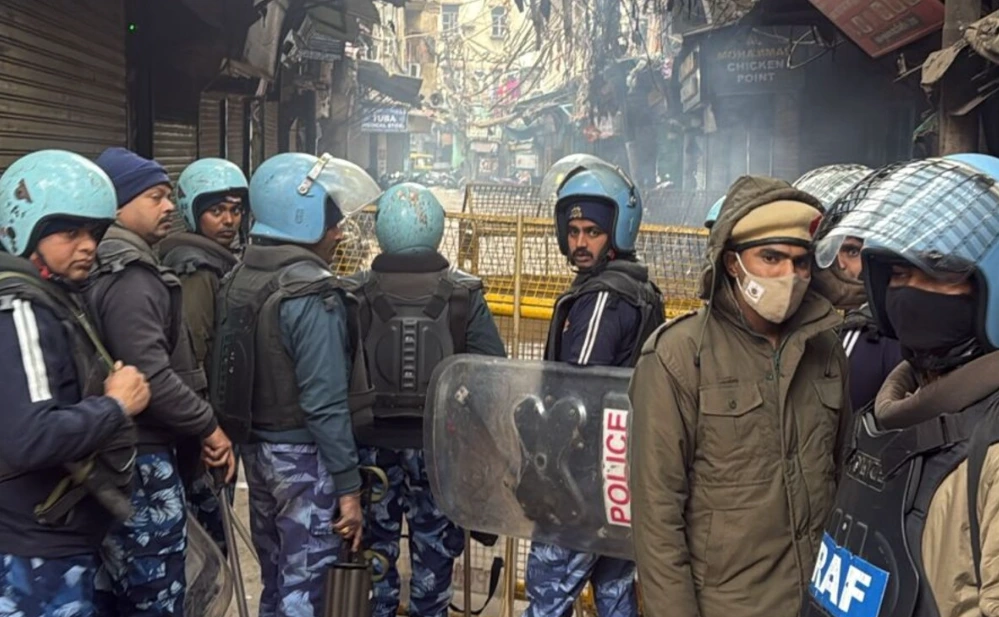
At least five police personnel were injured after an anti-encroachment drive near a mosque at Delhi’s Ramlila Ground area turned violent early Wednesday, officials said.

The clashes broke out when around 300 officials and workers of the Municipal Corporation of Delhi (MCD), supported by police personnel, were carrying out a demolition drive at land adjoining the Syed Faiz Elahi mosque and graveyard near Turkman Gate. The action was undertaken following directions issued by the Delhi High Court.

According to the police, a group of local residents began pelting stones at officials during the demolition, forcing security forces to use tear gas to disperse the crowd and bring the situation under control.

Police use tear gas as stone-pelting escalates

A senior police officer said that around 25 to 30 people were involved in stone pelting during the operation, resulting in injuries to five policemen. All injuries were reported to be minor.

The demolition drive was conducted during night hours to minimise inconvenience to the general public. During the operation, a banquet hall and a dispensary located on the encroached land were demolished.

Police officials said more than 100 video clips are being examined to identify those involved in the violence. Cases will be registered based on statements from injured police personnel and MCD workers.

Encroachment clearance linked to high court order

Officials deployed nearly 30 bulldozers and 50 dump trucks to remove unauthorised constructions from the area. The action follows a November 2025 Delhi High Court order that granted three months to the MCD and the Public Works Department to clear encroachments spread across 38,940 square feet near the Ramlila Ground at Turkman Gate.

In December, the civic body stated that all constructions beyond 0.195 acres were unauthorised and liable for demolition. Authorities maintained that no documents were produced to establish ownership or lawful possession of the encroached land by either the mosque’s managing committee or the Delhi Waqf Board. The 0.195-acre parcel under lease houses the mosque and is not part of the demolition action.

The encroachments reportedly included parts of a road, footpath, parking area, a baraat ghar and a private diagnostic centre.

High court seeks responses on plea challenging demolition

Meanwhile, the Delhi High Court on Tuesday issued notices to multiple authorities, including the MCD, Ministry of Urban Development, Delhi Development Authority, PWD and the Delhi Waqf Board, on a petition challenging the demolition order.

Justice Amit Bansal observed that the matter required consideration and directed the authorities to file their responses within four weeks. The case has been listed for further hearing on April 22.

The mosque’s managing committee, which filed the plea, argued that the land is a notified waqf property governed by the Waqf Act and falls under the exclusive jurisdiction of the Waqf Tribunal. The committee said it has no objection to the removal of encroachments but raised concerns regarding the functioning of the graveyard on the land.

The MCD reiterated that no action is being taken against the 0.195-acre land leased in February 1940.

India News

Under fire for donation theft, Ram temple trust calls for applications for CEO post

Published

on

By

The Shri Ram Janmabhoomi Teerth Kshetra Trust has invited applications for the post of its first Chief Executive Officer (CEO) to strengthen the administration of the Ram Temple in Ayodhya.

The Trust has set a July 18, 4 pm deadline for applications. This is the first time the Trust is appointing a CEO to oversee the temple’s day-to-day functioning.

The decision was taken under the leadership of Trust Chairman Mahant Nritya Gopal Das. The selected CEO will work under Trust General Secretary Champat Rai and will be responsible for managing the temple’s daily operations, supervising administrative departments, coordinating with officials, ensuring smooth arrangements for devotees, and maintaining transparency in the temple’s functioning.

The Trust notification said candidates applying for the post should be between 50 and 70 years of age and must have at least three years of experience in a senior administrative or leadership position. Applicants should also be practising Hindus and devotees of Lord Ram. To ensure a fair selection process, the Trust has formed a three-member committee to examine applications and recommend suitable candidates for the final appointment.

The move comes after the Trust decided to further strengthen its administrative system as the number of visitors to the Ram Temple continues to increase. In recent months, the temple administration has also focused on improving financial monitoring and overall management, making the appointment of a professional CEO an important step.

The Ram Temple in Ayodhya has emerged as one of India’s most prominent pilgrimage destinations since its inauguration. Every day, thousands of devotees visit the temple, creating the need for a dedicated executive to manage operations efficiently and ensure better services for pilgrims.

The Trust believes that appointing its first CEO will improve coordination, accountability, and administrative efficiency while supporting the temple’s future expansion plans. After the application deadline on July 18, the selection committee will review all applications before making its recommendation. The final appointment will be made by the Shri Ram Janmabhoomi Teerth Kshetra Trust, marking a significant milestone in the professional management of the Ram Temple.

The Trust has been at the receiving end of the public backlash following the theft of money and articles donated to the temple. Investigations are underway to find the real culprits.

Continue Reading

India News

Sonam Wangchuk’s health declines during hunger strike, actor Omi Vaidya calls for more popular support

Published

on

By

Actor Omi Vaidya, best known for playing Chatur Ramalingam in 3 Idiots, has appealed to people to support climate activist Sonam Wangchuk, whose health has reportedly deteriorated during his indefinite hunger strike on the Cockroach Janta Patry dais at Jantar Mantar in New Delhi.

Sharing a video message on Instagram, Vaidya referred to Wangchuk as the “real-life Phunsukh Wangdu,” the character in 3 Idiots inspired by the Ladakh-based innovator. He urged people not to remain silent and said, “Don’t let Phunsukh Wangdu die.” Calling Wangchuk’s work an inspiration, the actor appealed for greater support as concerns over the activist’s health continue to grow.

Recent updates from Wangchuk’s supporters indicate that his health has significantly declined after fasting for over two weeks. His blood glucose level reportedly dropped to 67 mg/ dL, and he has lost over 8 kg since beginning the indefinite hunger strike. The protest is aimed at drawing attention to environmental protection and governance-related demands concerning Ladakh.

Sonam Wangchuk, an engineer, education reformer and Ramon Magsaysay Award winner, is widely recognised as the real-life inspiration behind Wangdu, the iconic character played by Aamir Khan in Rajkumar Hirani’s 2009 film 3 Idiots. Although Wangchuk has previously distanced himself from direct comparisons with the character, his work in education and sustainable development has often been linked to the film.

Vaidya’s appeal has added a film industry voice to the growing concern over Wangchuk’s health. As his hunger strike continues, supporters and public figures have called for immediate attention to his condition and renewed dialogue over the issues he has raised. The protest is underway demanding Education Minister Dharmendra Pradhan resign over the NEETUG fiasco.


Continue Reading

India News

Ladakh may get Article 371-like safeguards, autonomous councils

Published

on

By

Laddakh Violence

The Central government is said to be working on a proposal to grant Ladakh a special governance framework similar to Article 371 of the Constitution.

The move is aimed at addressing the long-standing demands of the people of Ladakh for greater autonomy, protection of local culture, and stronger local self-governance after the region became a Union Territory in 2019.

According to the proposal, Autonomous Hill Development Councils (AHDCs) will be established in all seven districts of Ladakh. At present, only Leh and Kargil have elected hill councils. The expansion of these councils is expected to ensure balanced development, improve local administration, and give residents of every district a greater role in decision-making.

The Centre is also planning to create a Union Territory-level elected body that will coordinate the functioning of all district councils. This institution is expected to have powers related to planning, development, finance, and administration, helping improve governance across Ladakh while maintaining coordination with the Union Territory administration.

Article 371 is a special provision in the Constitution that gives some states extra rights to protect their culture, local traditions, land, and ensure better administration based on their unique needs. While Ladakh is not expected to receive Article 371 in its existing form, the government is considering a customized framework with similar constitutional protections suited to the region’s geographical and social conditions.

The proposal comes after several rounds of discussions between the Centre, the Ladakh administration, and representatives of civil society. Local groups have been demanding constitutional safeguards to protect the region’s fragile environment, tribal identity, employment opportunities, and control over land resources.

If approved, the Ladakh Autonomous Hill Development Council Act will be amended, followed by the delimitation of constituencies before elections are held for the newly-created councils. The proposal is currently under consideration.

The initiative is expected to strengthen grassroots democracy, promote inclusive development, and provide Ladakh with greater administrative autonomy while remaining a Union Territory.

Continue Reading

Trending

© Copyright 2022 APNLIVE.com