English हिन्दी
Connect with us

India News

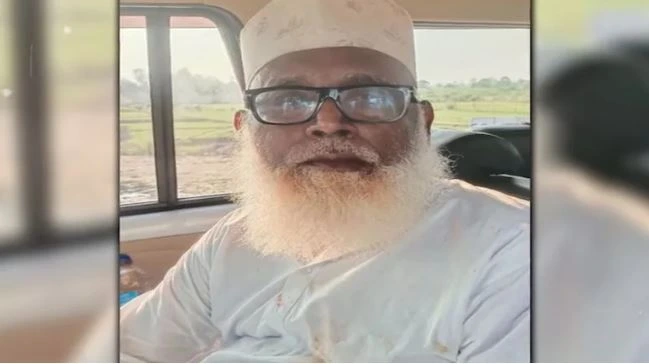
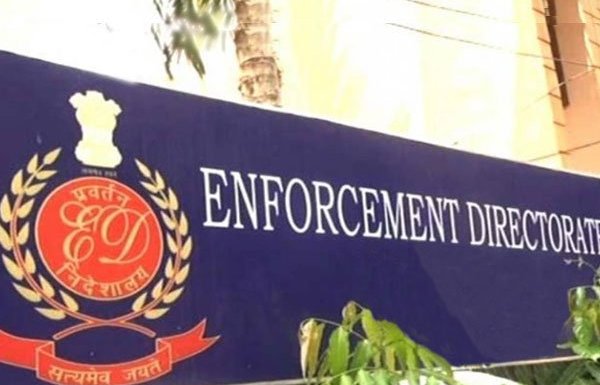
ED conducts raids at 14 locations in Chhangur Baba conversion case over alleged foreign funding

Published

on

Changur baba

The Enforcement Directorate (ED) on Wednesday launched a large-scale search operation at 14 locations, including Uttar Pradesh and Maharashtra, in connection with the high-profile religious conversion case involving Jamaluddin alias Chhangur Baba. The raids are part of an ongoing investigation into alleged money laundering, foreign funding misuse, and large-scale unlawful religious conversions.

The agency’s early morning operation—covering 12 sites in Utraula, Balrampur district, and two locations in Mumbai—aims to track financial trails linked to Chhangur Baba, whose activities are under the scanner for potentially disturbing communal harmony and national security.

Probe into Rs 106 crore in foreign funds

According to officials, the ED recently registered an Enforcement Case Information Report (ECIR) under the Prevention of Money Laundering Act (PMLA) against Chhangur Baba. The agency is probing suspected foreign contributions amounting toRs106 crore received through 40 different bank accounts—mainly from Middle Eastern countries.

These funds are suspected to have been funneled into orchestrated mass religious conversions and unlawful constructions, bypassing regulatory approvals and legal requirements.

ED steps up scrutiny, seeks details from local authorities

As part of its probe, the ED has sent formal communication to the Superintendent of Police, ATS Lucknow, and the District Magistrate of Balrampur to obtain certified FIR copies, property records, and details of individuals and organisations linked to Chhangur Baba. Multiple banks have also been contacted to share statements from accounts flagged in the FIR.

Chhangur Baba, a resident of Madhupur in Balrampur district, was arrested along with his associate Neetu alias Nasreen on July 5 from a hotel in Lucknow. Both are in the custody of the ATS till July 16.

Properties under demolition, assets under lens

District authorities have reportedly initiated demolition of structures allegedly constructed illegally by Chhangur Baba and his associates. These include portions of his residence in Madhupur and other commercial properties acquired without necessary land use approvals.

Officials allege that Baba’s network, operating from the Chand Auliya Dargah, systematically targeted economically disadvantaged groups, including Scheduled Castes and Hindus, through psychological influence, religious discourses, and a publication titled Shijra-e-Tayyaba. His activities allegedly coerced individuals into conversion, enabling the acquisition of wealth and influence through fraudulent means.

ED intensifies efforts under PMLA and FCRA violations

The ED’s current focus is on tracing the origin and utilisation of the foreign funds suspected to have been received in violation of the Foreign Contribution (Regulation) Act (FCRA) and the PMLA. More raids and financial audits are likely in the coming days as investigators analyse bank transactions and asset records.

India News

Give all tickets to Muslim women, Amit Shah says, attacking Akhilesh Yadav on sub-quota demand

A sharp exchange between Amit Shah and Akhilesh Yadav in Parliament over sub-quota for Muslim women highlights key divisions on women’s reservation implementation.

Published

on

A heated exchange broke out in Parliament during discussions on the women’s reservation framework, with Union Home Minister Amit Shah and Samajwadi Party chief Akhilesh Yadav locking horns over the demand for a sub-quota for Muslim women.

The debate unfolded as the government pushed forward key legislative measures to implement 33% reservation for women in the Lok Sabha and state assemblies.

Akhilesh Yadav argued that the proposed reservation must ensure representation for women from marginalised communities, including Other Backward Classes (OBCs) and Muslim women. He said that without such provisions, large sections could remain excluded from political participation.

He also questioned the timing of the bill, alleging that the Centre was avoiding a caste census. According to him, a census would lead to renewed demands for caste-based reservations, which the government is reluctant to address.

Government rejects religion-based quota

Responding to the demand, Amit Shah made it clear that reservation based on religion is not permitted under the Constitution.

He stated that any proposal to provide quota to Muslims on religious grounds would be unconstitutional, firmly rejecting the idea of a separate sub-quota for Muslim women within the broader reservation framework.

The government has maintained that the existing framework already includes provisions for Scheduled Castes (SC) and Scheduled Tribes (ST) women within the overall reservation structure.

Wider political divide over implementation

The issue of sub-categorisation within the women’s quota has emerged as a major flashpoint, even as most opposition parties broadly support the idea of women’s reservation.

Samajwadi Party leaders reiterated that their support for the bill depends on inclusion of OBC and minority women, while the government continues to defend its constitutional position.

The debate is part of a broader discussion during the special Parliament session, where multiple bills linked to delimitation and implementation of the women’s quota are being taken up.

Continue Reading

India News

No state will lose a seat, Centre assures as delimitation debate takes centre stage in Parliament

Parliament’s special session begins with key focus on implementing women’s reservation and delimitation, setting the stage for major electoral changes.

Published

on

Parliament

A special session of Parliament commenced on Thursday, with the Centre set to take up crucial legislation related to women’s reservation and delimitation of constituencies. The session, scheduled over three days, is expected to witness intense debate as the government pushes forward its legislative agenda.

At the centre of discussions is the proposal to operationalise the women’s reservation law, which seeks to allocate 33 percent of seats in the Lok Sabha and state assemblies to women. The law, passed earlier, requires enabling provisions before it can be implemented.

The rollout of the reservation is closely tied to the delimitation exercise — a process that redraws parliamentary constituencies based on updated population data. The implementation is expected only after the next census and delimitation process are completed.

The government is aiming to put in place the framework so that the reservation can be enforced in future elections, likely around 2029.

Delimitation and numbers at play

Delimitation is a key aspect of the proposed changes, as it will determine how seats are redistributed and which constituencies are reserved. The exercise is expected to reflect population shifts and may also involve an increase in the total number of Lok Sabha seats.

This linkage has made the issue politically sensitive, with several opposition parties backing women’s reservation in principle but raising concerns over how and when delimitation will be carried out.

Political reactions and expected debate

The session is likely to see sharp exchanges between the government and opposition. While there is broad agreement on increasing women’s representation, disagreements remain over the timing, process, and potential political implications of the delimitation exercise.

Some leaders have argued that delimitation could significantly alter the balance of representation among states, making it a contentious issue beyond the women’s quota itself.

The government, however, has framed the move as a step toward strengthening women’s participation in governance and ensuring more inclusive policymaking.

Continue Reading

India News

Delimitation and women’s quota bills set to be tabled in Parliament today, key numbers explained

The Centre will table key bills on women’s reservation and delimitation, proposing a major expansion of Lok Sabha and changes in seat allocation based on updated census data.

Published

on

Lok Sabha

The Centre is set to introduce a set of crucial bills in Parliament aimed at implementing women’s reservation and redrawing electoral constituencies, marking a major shift in India’s political framework.

According to details accessed from official drafts, three separate legislations are expected to be tabled during the ongoing session. These include a constitutional amendment to operationalise 33% reservation for women, a delimitation bill to redraw constituencies, and changes to laws governing Union Territories.

The move is seen as a coordinated effort to align women’s reservation with a fresh delimitation exercise based on updated population data.

How the numbers may change

One of the most significant proposals is the expansion of the Lok Sabha. The draft legislation suggests increasing the maximum strength of the House to around 815 members, with up to 35 seats allocated to Union Territories.

Currently, the Lok Sabha has 543 elected members. The increase is aimed at ensuring proportional representation after decades of population changes across states.

The proposed delimitation exercise would rely on the latest available census figures, likely the 2011 Census, replacing the long-standing reliance on 1971 data.

Women’s reservation linked to delimitation

The proposed framework makes it clear that the 33% reservation for women in Parliament and state assemblies will only be implemented after the delimitation process is completed.

The reservation is expected to apply across general, Scheduled Caste, and Scheduled Tribe seats, with constituencies being rotated periodically to ensure broader representation.

The reform is likely to come into effect ahead of the 2029 general elections, depending on the completion of the delimitation exercise.

Why delimitation is central to the plan

Delimitation has remained frozen for decades, leading to imbalances in representation due to population growth, migration, and urbanisation.

The new bill proposes setting up a Delimitation Commission, which would be tasked with redrawing constituency boundaries and reallocating seats based on updated population data.

This process is expected to significantly alter the political map of the country and could trigger debates over regional representation.

Continue Reading

Trending

© Copyright 2022 APNLIVE.com