English हिन्दी
Connect with us

India News

His Holiness the 14th Dalai Lama: a Nobel Laureate and The Guru of Euphemisms

Published

on

His Holiness the 14th Dalai Lama: a Nobel Laureate and The Guru of Euphemisms
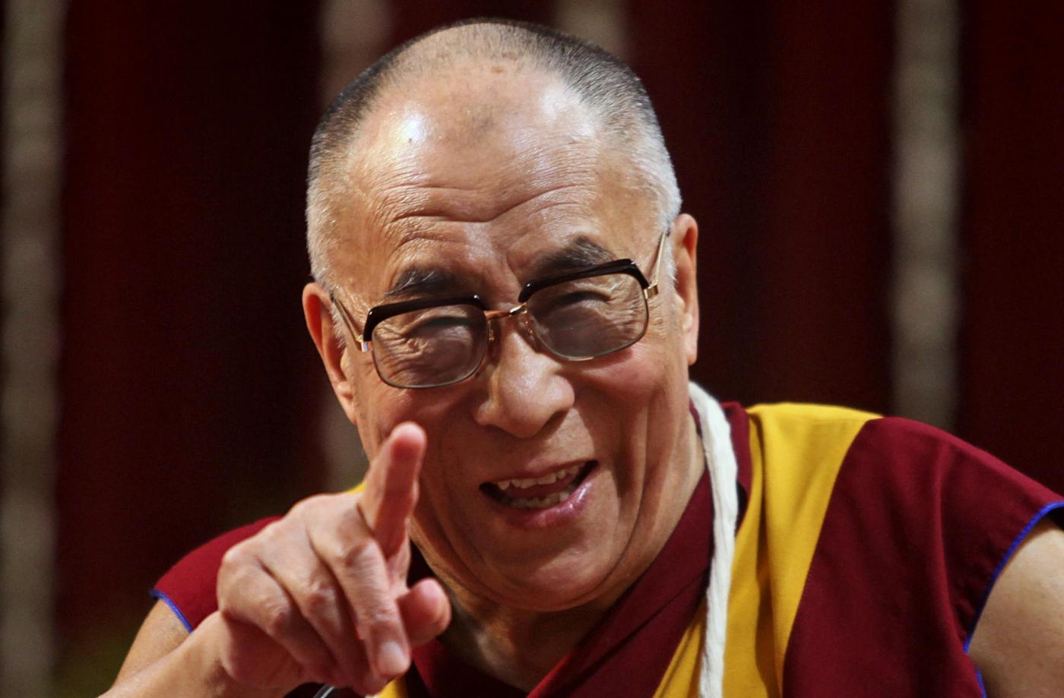
[vc_row][vc_column][vc_column_text]His Holiness the Dalai Lama is mellowed, mild-tempered and content to be just a ‘Son of India’.

~By Dilip Bobb

There is something almost childlike about the Dalai Lama which tends to dilute the gravity and importance of the words he is speaking. He tends to break out into a giggling fit whenever he detours into one of his humorous asides, which is fairly often. He will grab the arm of the person sitting next to him and you almost expect him to start throwing high fives with those sharing the dais. It would not seem out of place. For all his stature as a Nobel Laureate and the 14th Dalia Lama, the prefix of His Holiness, and the respect, even reverence, with which he is greeted by everyone, from commoner to celebrity, he exudes an earthy, infectious charm that is both endearing and astute.  Yesterday, watching him speak at the Rajendra Mathur Memorial Lecture organised by the Editors Guild of India, the Tibetan spiritual leader’s quirky characteristics and choice of words, replete with harmless homilies, is perhaps a persona he has been forced to assume. It is one that makes him the guru of euphemisms.

For all his elevated spiritual status and enviable global profile, the Dalai Lama knows he walks a political and diplomatic tightrope every day of his life. His presence in India is a constant source of friction between New Delhi and Beijing and India often uses him as a tool, giving him permission to visit areas that it knows will act like a red flag to the bull in the China shop. His recent visit to the Tawang monastery in Arunachal Pradesh is a prime example. On New Delhi’s part, it was deliberate provocation and sent the Chinese ballistic, with dire warnings and reminders of China’s military prowess. Yet, at yesterdays lecture, meant to be on the media and ethics, HH mentioned the Tawang visit only to emphasise the fact that he was growing old and that his ‘creaking knees’ had given him problems, which was why he opted to sit and deliver his lecture.  He was equally at pains to remind the audience – a mix of journalists, Tibetan groupies, and diplomats from various missions in Delhi – that he was now ‘retired’ and had no official or political role.

Having made the point, from then on, it was vintage Dalai Lama, mixing bromides with borderline politics, chiding and yet praising the media, and right through, knowing he is a guest, albeit an honoured one, of the Indian government, giving fulsome praise to Indian democracy and its stabilizing influence in the region.  He started by glancing down at the dignitaries seated in the front row – senior retired Indian diplomats and ex National Security Advisors — and greeted them with a cheery ‘hello, lots of  old friends’, adding that ‘this looks like a reunion.’’ These were people who had dealt with him in their official capacity so the bonhomie was explainable. His lecture, as is his wont, wanders from the topic listed, but if you listen closely enough, there are always hidden gems. The venue of the lecture gave him cause for some diversions. It was at the Nehru Memorial, which was where India’s first prime minister stayed while in office. HH mentioned the numerous times he had visited Nehru and their discussion about China, hinting that they did not always part in a friendly manner.  “Prime Minister Jawaharlal Nehru laid the foundation for the welfare of Tibetans in exile in India. It is only in India that all the major religious traditions exist side by side. Sometimes problems takes place, not unusual as so many varieties of traditions live here. But it is here alone that all live in full freedom,” he said. The euphemism was not lost. “Some problems’’ was his way of downplaying worrisome trends in favour of the bigger picture.

So was the case with his views on the media, where he remarked, almost as an afterthought, that “propaganda makes things complicated”, and that the media is to blame for the ‘sharp rhetoric’. He had delivered a short speech by his standards – maybe his health and his 82 year old body was to blame — after which he threw the floor open to questions, with, inevitably, the first one being on the face off between New Delhi and Beijing. His criticism of the media being responsible for the heated rhetoric was spot on, and suggests that his mind is as sharp as ever, and that he does indeed watch a lot of television news.  The other questions on China also showed why he is the guru of euphemisms. He praised President Xi Jinping for his fight against corruption, but then drew some blood by remarking that he could not stay in a place where there was no freedom (Tibet), and preferred the ‘heat of India.’ Right through the event, he kept referring to himself as a  “Son of India”, well aware that his speech, in a room full of journalists, would be given widespread coverage.

Yet, what the lecture and Q and A session suggested was that we could be seeing the last of the man who has served as an inspiration for resistance movements across the world, and the start of another – a return to the Dalai Lama’s original role – purely as a spiritual leader. He made it clear that there was no urgency to select the next Dalai Lama and indicated that the process of finding his successor, who might as well be a woman, will begin in the next two to three years. More important was his assertion that the next Dalai Lama may not have a political role to play in future and that China should not worry about his role or that of his successors.  There is no longer a wolf in sheep’s clothing. There is only the sheep.[/vc_column_text][/vc_column][/vc_row]

India News

Amit Shah counters delimitation concerns, says southern states to gain Lok Sabha seats

Amit Shah assures Parliament that southern states will gain Lok Sabha seats after delimitation, countering opposition criticism during the women’s reservation debate.

Published

on

Amit Shah

Union Home Minister Amit Shah on Thursday addressed concerns over the proposed delimitation exercise, asserting in the Lok Sabha that southern states will not lose representation but instead see an increase in their number of seats.

His remarks came during a heated debate linked to the implementation of women’s reservation, where opposition parties have raised fears that population-based delimitation could reduce the political weight of southern states.

Shah rejected these claims, calling them misleading, and said the proposed framework ensures fairness while expanding the overall strength of the Lok Sabha.

Seat count to rise with expansion of Lok Sabha

The government has indicated that the total number of Lok Sabha seats could increase significantly as part of the delimitation process. In this expanded House, the combined representation of southern states is expected to rise from 129 seats at present to around 195 seats.

Shah emphasised that no state will lose seats in absolute terms, and the exercise is designed to reflect population changes while maintaining balance across regions.

State-wise projections shared in Parliament

During his address, Shah also provided indicative figures for individual southern states, suggesting notable increases in representation. According to the projections:

  • Tamil Nadu could see its seats rise substantially
  • Kerala, Telangana, and Andhra Pradesh are also expected to gain additional seats
  • Karnataka’s representation may increase as well

These figures were presented to counter the argument that delimitation would disproportionately favour northern states.

Political debate intensifies over linkage with women’s quota

The delimitation exercise has been closely linked to the rollout of women’s reservation, which proposes one-third seats for women in Parliament and state assemblies.

Opposition leaders have questioned this linkage, arguing that tying reservation to delimitation could delay its implementation and raise federal concerns. Some leaders have also warned that the move could impact national unity if apprehensions among states are not addressed.

The government, however, maintains that the reforms are necessary to ensure equitable representation and to align the electoral system with demographic realities.

Centre dismisses ‘false narrative’ on southern states

Shah reiterated that concerns about southern states losing influence are unfounded. He said the delimitation process will increase representation across regions and described the criticism as a “false narrative” aimed at creating confusion.

The issue is expected to remain a key flashpoint as Parliament continues discussions on the women’s reservation framework and related legislative changes.

Continue Reading

India News

PM Modi assures no discrimination in women’s quota, delimitation debate intensifies in Parliament

PM Narendra Modi has assured that women’s reservation will be implemented without discrimination, amid a heated debate over delimitation in Parliament.

Published

on

PM modi

Prime Minister Narendra Modi has assured that there will be no discrimination in the implementation of women’s reservation, as Parliament witnessed a sharp debate over the proposed linkage between the quota and delimitation exercise.

During the ongoing special session, the government reiterated its commitment to ensuring fair representation while addressing concerns raised by opposition parties regarding the timing and structure of the legislation.

The proposed framework aims to reserve 33 percent of seats for women in the Lok Sabha and state assemblies. However, its implementation is tied to a fresh delimitation exercise, which is expected after the next census.

Opposition questions timing and intent

Opposition leaders have raised concerns that linking the women’s quota to delimitation could delay its implementation. They argue that the process of redrawing constituencies may push the actual rollout further into the future.

The issue has triggered a broader political confrontation, with multiple parties questioning whether the move could alter representation across states.

Some critics have also alleged that the delimitation exercise could disproportionately benefit certain regions based on population, a charge the government has rejected.

Government reiterates commitment to fair implementation

Responding to these concerns, the Centre has maintained that the reforms are necessary to ensure accurate and updated representation based on population data.

Leaders from the ruling side have repeatedly emphasized that the process will be carried out transparently and without bias. The assurance that there will be “no discrimination” is aimed at addressing fears among states and opposition parties.

The debate marks a key moment in Parliament, with both sides engaging in intense exchanges over one of the most significant electoral reforms in recent years.

Continue Reading

India News

Give all tickets to Muslim women, Amit Shah says, attacking Akhilesh Yadav on sub-quota demand

A sharp exchange between Amit Shah and Akhilesh Yadav in Parliament over sub-quota for Muslim women highlights key divisions on women’s reservation implementation.

Published

on

A heated exchange broke out in Parliament during discussions on the women’s reservation framework, with Union Home Minister Amit Shah and Samajwadi Party chief Akhilesh Yadav locking horns over the demand for a sub-quota for Muslim women.

The debate unfolded as the government pushed forward key legislative measures to implement 33% reservation for women in the Lok Sabha and state assemblies.

Akhilesh Yadav argued that the proposed reservation must ensure representation for women from marginalised communities, including Other Backward Classes (OBCs) and Muslim women. He said that without such provisions, large sections could remain excluded from political participation.

He also questioned the timing of the bill, alleging that the Centre was avoiding a caste census. According to him, a census would lead to renewed demands for caste-based reservations, which the government is reluctant to address.

Government rejects religion-based quota

Responding to the demand, Amit Shah made it clear that reservation based on religion is not permitted under the Constitution.

He stated that any proposal to provide quota to Muslims on religious grounds would be unconstitutional, firmly rejecting the idea of a separate sub-quota for Muslim women within the broader reservation framework.

The government has maintained that the existing framework already includes provisions for Scheduled Castes (SC) and Scheduled Tribes (ST) women within the overall reservation structure.

Wider political divide over implementation

The issue of sub-categorisation within the women’s quota has emerged as a major flashpoint, even as most opposition parties broadly support the idea of women’s reservation.

Samajwadi Party leaders reiterated that their support for the bill depends on inclusion of OBC and minority women, while the government continues to defend its constitutional position.

The debate is part of a broader discussion during the special Parliament session, where multiple bills linked to delimitation and implementation of the women’s quota are being taken up.

Continue Reading

Trending

© Copyright 2022 APNLIVE.com