English हिन्दी
Connect with us

Latest Politics News

At Princeton University, RaGa lauds NaMo’s Make in India but criticizes its implementation

Published

on

At Princeton University, RaGa lauds NaMo’s Make in India but criticizes its implementation
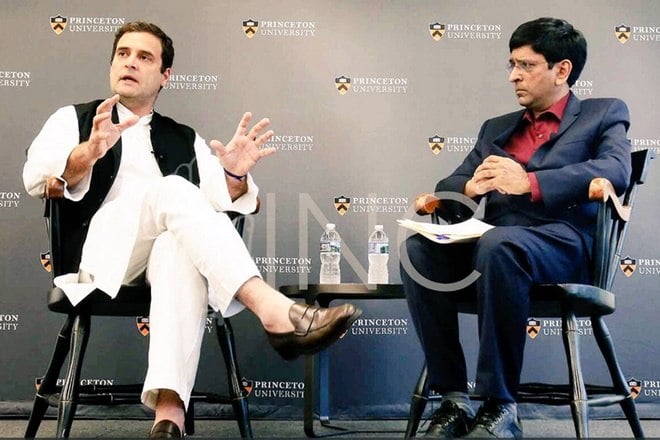
[vc_row][vc_column][vc_column_text]Congress VP says anger building up in India against Modi government for failing to deliver on promise of generating employment

Days after he lashed out at Prime Minister Narendra Modi’s government on its failure to resuscitate India’s economy while addressing students at the University of California, Berkeley, Congress vice president Rahul Gandhi, on Tuesday, gave a back handed compliment to the Indian Premier over his Make-in-India campaign.

Interacting with students at the prestigious Princeton University’s Woodrow Wilson School in New Jersey, Gandhi conceded that he appreciated Modi’s Make-in-India initiative but promptly qualified his praise by asserting that the scheme wasn’t targeting the right sector of India’s economy.

“I like the Make-in-India concept but they are not targeting whom they should. My implementation and focus would be slightly different,” the Congress vice president said, while adding: “PM Modi feels large businesses should be targeted. I feel medium and small companies should be targeted. That is where the jobs are going to come from.”

In a rare display of the political intellect that he is seldom credited to have, Gandhi used Modi’s flagship scheme to highlight how even a good program could fail to achieve desired results if it targets the wrong sector.

Gandhi used the Make-in-India scheme to underscore the government’s failure in creating jobs – a major promise that Modi and his BJP had made during the Lok Sabha poll campaign in 2014 – and said that “there is anger building up in India right now” over the Centre’s inability in creating employment opportunities.

Gandhi sought to draw a parallel between the elevation of Modi and India’s Prime Minister and Donald Trump as President of the United States by asserting that the aspiration of the youth to get proper employment is what contributed in a big way to the meteoric political rise of the two leaders.

“I think the central reason why Modi arose and to an extent why Trump came, is the question of jobs in India and in the US. There is a large part of our population that simply does not have jobs and cannot see a future. And, so they are feeling pain and have supported these type of leaders.”

The Nehru-Gandhi scion who had attracted massive criticism from the BJP last week when he told students at Berkeley that India functions through its dynasts, chose to stay focused on issues related to job creation and aspirations of the youth during his interaction at Princeton.[/vc_column_text][vc_raw_html]JTIwJTNDYmxvY2txdW90ZSUyMGNsYXNzJTNEJTIydHdpdHRlci10d2VldCUyMiUyMGRhdGEtbGFuZyUzRCUyMmVuJTIyJTNFJTNDcCUyMGxhbmclM0QlMjJlbiUyMiUyMGRpciUzRCUyMmx0ciUyMiUzRVdBVENIJTNBQ29uZ3Jlc3MlMjBWUCUyMFJhaHVsJTIwR2FuZGhpJTI2JTIzMzklM0JzJTIwaW50ZXJhY3Rpb24lMjAlMjZhbXAlM0IlMjBRJTI2YW1wJTNCQSUyMGF0JTIwJTNDYSUyMGhyZWYlM0QlMjJodHRwcyUzQSUyRiUyRnR3aXR0ZXIuY29tJTJGUHJpbmNldG9uJTIyJTNFJTQwUHJpbmNldG9uJTNDJTJGYSUzRSUyNiUyMzM5JTNCcyUyMENlbnRyZSUyMGZvciUyMEludGVybmF0aW9uYWwlMjBTZWN1cml0eSUyMFN0dWRpZXMlMjAlM0NhJTIwaHJlZiUzRCUyMmh0dHBzJTNBJTJGJTJGdHdpdHRlci5jb20lMkZoYXNodGFnJTJGUkdpblVTJTNGc3JjJTNEaGFzaCUyMiUzRSUyM1JHaW5VUyUzQyUyRmElM0UlM0NhJTIwaHJlZiUzRCUyMmh0dHBzJTNBJTJGJTJGdC5jbyUyRnJpc2F1OWZpZGolMjIlM0VodHRwcyUzQSUyRiUyRnQuY28lMkZyaXNhdTlmaWRqJTNDJTJGYSUzRSUzQyUyRnAlM0UlMjZtZGFzaCUzQiUyMENvbmdyZXNzJTIwJTI4JTQwSU5DSW5kaWElMjklMjAlM0NhJTIwaHJlZiUzRCUyMmh0dHBzJTNBJTJGJTJGdHdpdHRlci5jb20lMkZJTkNJbmRpYSUyRnN0YXR1cyUyRjkxMDMxMjM2MzI2OTY2MDY3MiUyMiUzRVNlcHRlbWJlciUyMDIwJTJDJTIwMjAxNyUzQyUyRmElM0UlM0MlMkZibG9ja3F1b3RlJTNFJTBBJTNDc2NyaXB0JTIwYXN5bmMlMjBzcmMlM0QlMjIlMkYlMkZwbGF0Zm9ybS50d2l0dGVyLmNvbSUyRndpZGdldHMuanMlMjIlMjBjaGFyc2V0JTNEJTIydXRmLTglMjIlM0UlM0MlMkZzY3JpcHQlM0U=[/vc_raw_html][vc_column_text]Just as he had candidly admitted at UC, Berkeley that the Congress had become “arrogant” in 2012, Gandhi once again made an introspective remark, claiming that his party was “unable” to deliver on the front of creating employment but said that the same was now true of the Modi government.

The attack was in a way an escalation of what Gandhi had said at Berkeley a few days ago. “Currently, we are not producing enough jobs… 30,000 new youngsters are joining the job market every single day and yet the government is only creating 500 jobs a day. And this doesn’t include the massive pool of already unemployed youngsters,” Gandhi had said earlier.

On Tuesday, the Congress vice president added the facet of disenchantment among the youth against the Modi regime to his argument. “Those same people who got angry with us because we couldn’t deliver on those 30,000 jobs (a day) are going to get angry with Modi. The central question is resolving that problem. My main issue with Modi is that he diverts that issue and points the finger somewhere else instead of saying ‘listen we have a problem’,” Gandhi said.

The Congress vice president identified “the politics of polarisation” as a central challenge for India. “In the 21st century, if you leave some people out of your vision, you are asking for trouble. New ideas would come, new different visions would develop. So, to me, central challenge in India is politics of polarisation where you pit one community against other and you create spaces for other people to come in,” he said.

“There is a belt of 100 million tribal people who do not feel comfortable with the vision (of the BJP). There are a number of States in India, which don’t want a single vision forced down their throat. There are minority communities, they do not feel that they are the part of the vision. So that’s where the real danger is,” Gandhi added.[/vc_column_text][/vc_column][/vc_row]

India News

New UP Congress chief Aradhana Mishra backs stronger alliance with SP 

Newly appointed UP Congress chief Aradhana Mishra said the party would strengthen its alliance with the Samajwadi Party ahead of the 2027 Assembly election.

Published

on

Newly appointed Uttar Pradesh Congress president Aradhana Mishra, also known as Mona, has said the party will take its alliance with the Samajwadi Party forward with full strength ahead of the 2027 Uttar Pradesh Assembly election.

Mishra, the daughter of Congress MP Pramod Tiwari, has been given the responsibility of leading the party’s state unit as Congress prepares for the assembly polls due in around six months, according to the report.

Speaking about Samajwadi Party chief Akhilesh Yadav, Mishra described the SP as a strong partner of the Congress in the INDIA bloc.

“The Samajwadi Party is a partner of ours in the INDIA bloc, and a strong one at that,” she said, while praising the way Akhilesh Yadav has strengthened his party.

Aradhana Mishra backs Congress-SP alliance

Mishra referred to the performance of the INDIA bloc in the 2024 Lok Sabha election in Uttar Pradesh while discussing the alliance’s prospects for the next assembly election.

The INDIA bloc won 43 of Uttar Pradesh’s 80 Lok Sabha seats in the 2024 election, according to the report.

Mishra said the alliance had stopped the BJP’s advance in Uttar Pradesh in the 2024 Lok Sabha election and expressed confidence that the partnership would produce results in the 2027 Assembly election.

“We will take this alliance forward with full strength,” she said.

The new state Congress chief will also have to advance seat-sharing discussions with the Samajwadi Party. The report said Congress wants a larger share of seats, while the SP has not indicated a willingness to give ground, arguing that it is in a stronger position in the state.

Congress announces new UP team

The leadership change is part of a wider organisational reshuffle by the Congress in Uttar Pradesh.

Along with appointing Mishra as state Congress president, the party named Rajya Sabha MP Imran Masood as working president. Chaudhary Virendra Singh was appointed Leader of the Congress Legislature Party.

Devinder Nishad and Alok Prasad were also appointed senior vice presidents of the Uttar Pradesh Congress Committee.

The new appointments bring different social groups into prominent positions in the state organisation. Mishra is a Brahmin, Masood is a Muslim and Rajendra Pal Gautam, the Congress’ AICC in-charge of Uttar Pradesh, is a Dalit, the report said.

Mishra, however, said the Congress does not practise caste or religion-based politics.

She said the party wanted to strengthen the country, protect the Constitution and build a strong alternative ahead of the 2027 election.

Mishra’s challenge ahead of 2027 polls

As the new Uttar Pradesh Congress chief, Mishra will be responsible for strengthening the party’s organisation in the state while also taking forward its alliance with the Samajwadi Party.

The Congress and SP are part of the INDIA bloc in Uttar Pradesh. With seat-sharing discussions ahead of the 2027 Assembly election, Mishra’s comments indicate that the Congress intends to continue working with the Samajwadi Party.

The appointment of Mishra comes alongside other organisational changes aimed at preparing the party for the upcoming assembly election.

Continue Reading

India News

BJP may drop over 100 UP MLAs, focus shifts to voters and fix internal rifts 

The BJP is considering major changes to its Uttar Pradesh candidates, with more than 100 sitting MLAs potentially facing ticket cuts as the party works to address internal rifts and voter concerns.

Published

on

BJP

The BJP is preparing a major organisational and electoral strategy in Uttar Pradesh ahead of the 2027 Assembly election, with the party considering dropping more than 100 sitting MLAs from its candidate list.

The proposed changes are part of a broader effort to address internal differences within the party, strengthen its organisation and reconnect with voters across the state.

BJP’s plan for Uttar Pradesh

The party’s strategy involves reviewing the performance and prospects of its sitting legislators before deciding on candidates for the next Assembly election. More than 100 MLAs could potentially be denied tickets as part of the exercise.

The focus is also on resolving internal rifts and improving coordination within the organisation. The BJP is looking to address issues that emerged during the 2024 Lok Sabha election and strengthen its connect with voters.

The party’s review comes as it prepares for the 2027 Uttar Pradesh Assembly election, where it will seek to strengthen its position across the state.

Focus on internal differences and voters

Along with changes to its pool of candidates, the BJP is working on repairing differences within the organisation.

The party’s strategy places emphasis on reconnecting with voters and understanding issues at the ground level. Leaders and workers are expected to focus on strengthening the party’s presence among voters as preparations for the Assembly election continue.

The approach reflects the BJP’s effort to draw lessons from its performance in the 2024 Lok Sabha election and make organisational changes ahead of the next major electoral contest in Uttar Pradesh.

Candidate changes under consideration

The possibility of dropping over 100 sitting MLAs would represent a significant change in the BJP’s candidate strategy in the state. However, the final decision on individual tickets will depend on the party’s assessment and the selection process.

The BJP is therefore combining a review of its sitting legislators with efforts to resolve internal differences and rebuild its connection with voters as it prepares for the 2027 polls.

Continue Reading

India News

PM Modi speaks to Trump, reviews India-US trade and defence ties

Prime Minister Narendra Modi spoke with US President Donald Trump and reviewed India-US bilateral cooperation, including trade and defence.

Published

on

Prime Minister Narendra Modi spoke with US President Donald Trump on Wednesday and reviewed key areas of India-US bilateral cooperation, including trade and defence.

The conversation came as the two countries continue discussions on strengthening their broader partnership, with economic and strategic issues forming an important part of the engagement.

Modi, Trump discuss key areas of bilateral cooperation

During the phone conversation, Modi and Trump reviewed cooperation between India and the United States across several areas.

Trade and defence were among the key subjects discussed by the two leaders. Their conversation also covered energy and emerging technologies, reflecting the broad scope of the India-US partnership.

The two leaders also discussed issues linked to regional and global peace and security.

India-US trade talks continue

The conversation took place amid ongoing trade discussions between India and the United States.

India’s Commerce and Industry Minister Piyush Goyal is visiting the US from September 29 to October 5 for discussions related to an interim trade agreement and the possibility of a broader bilateral trade deal.

The talks are aimed at advancing trade engagement between the two countries as officials work towards an agreement that is described as balanced and mutually beneficial.

Defence and strategic cooperation

Defence cooperation was another area reviewed by Modi and Trump during their conversation.

India and the US have developed broader cooperation across defence and strategic sectors, and the latest discussion included the two countries’ continuing engagement in this area.

Energy and emerging technologies were also part of the leaders’ discussion, underlining the range of issues covered during the phone call.

Modi-Trump discuss regional and global issues

Beyond bilateral matters, Modi and Trump also discussed regional and global peace and security.

The conversation comes as India and the US continue to engage on issues extending beyond their bilateral relationship.

The latest phone call is part of the continuing engagement between the two leaders on strengthening cooperation across trade, defence and other areas of mutual interest.

Continue Reading

Trending

© Copyright 2022 APNLIVE.com