English हिन्दी
Connect with us

Latest Politics News

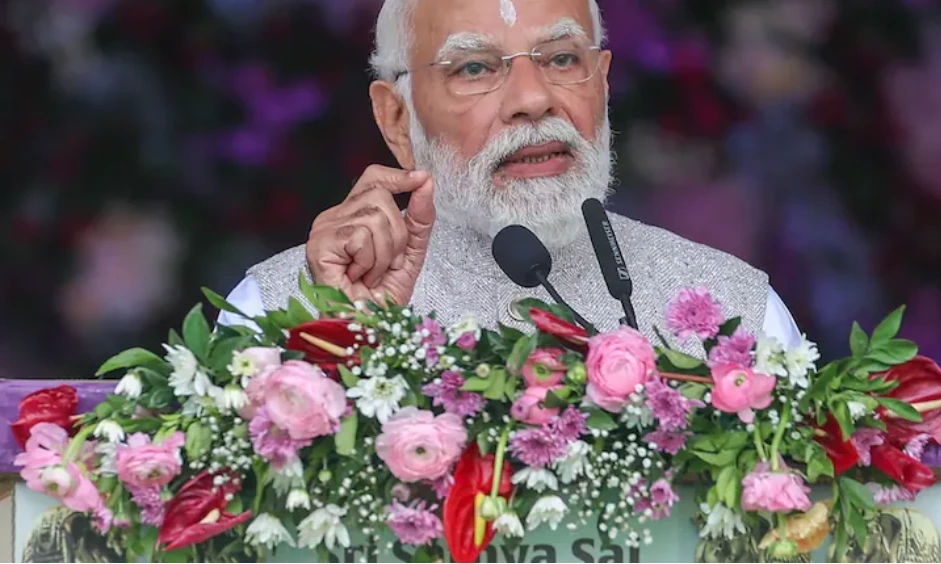
Prime Minister Narendra Modi says Congress has destroyed Gujarat and entire country at rally in Gujarat

Modi also added that the current generation has not seen scarcity because of the hard work of the previous generation.

Published

on

Narendra Modi

Prime Minister Narendra Modi has been rallying in several states in Gujarat ahead of the assembly elections and has come out yet again and targeted the grand old party and stated that Congress’s model has destroyed not only Gujarat but also India. The allegations by the PM come ahead of the elections due next month in Gujarat.

The Prime minister, while addressing a rally in Mehsana, hit out at Congress and stated that the Congress model represents nepotism, casteism, sectarianism, and vote bank politics. He further added that the grand old party is infamous for indulging in vote bank politics and creating rifts between people to retain power.

This model by the Congress party has not only destroyed Gujarat but also India as well alleged the Prime Minister in his address. Aside from the staunch attack on the grand old party, PM Modi also stated that Gujarat has changed a lot in the last 2 decades and further highlighted that the generation of today does not realize the scarcity Gujarat faced earlier.

Modi also added that the current generation has not seen scarcity because of the hard work of the previous generation.
Prime Minister Narendra Modi will be addressing more rallies ahead of the assembly elections in Dahod, Vadodara and Bhavnagar on Wednesday.

Read Also: Shiv Sena’s Aaditya Thackeray meets Tejashwi Yadav in Patna ahead of Lok Sabha Elections 2024 | WATCH

Congress’s rally in Gujarat

As for BJP’s counterpart in the Gujarat elections, the grand old party saw Rahul Gandhi taking a break from his Bharat Jodo Yatra to campaign for the party ahead of the state polls. Rahul Gandhi in his recent rally in Surat had also targeted the ruling party of Gujarat.

Congress MP Rahul Gandhi while talking about the Morbi Bridge accident stated and highlighted the arrest of the watchmen posted at the Morbi bridge and further alleged that the real culprits in the case were not arrested because they had links to the BJP.

Gandhi further added that reflected on his learnings from his ongoing Bharat Jodo Yatra and added that the BJP calls the tribal people forest dwellers and alleged that the BJP alienates the tribal communities from development and growth. He further remarked that BJP do not want you to live in cities, see your children becoming engineers or doctors, learn to fly planes, or speak English.

Gujarat elections

Gujarat will hold elections next month which will conduct voting in two-phases on December 1 and 5. The incumbent BJP are in high hopes to retain power in Gujarat as the state being the stronghold of the party. Whereas, the Congress party are seeking to change the voting trends in Gujarat and remove the ruling party from power.

BJP leader accused of torturing family, forcing them to sign property papers at gunpoint in Uttar Pradesh

Anupamaa: Rupali Ganguly’s performance in recent episode leaves fans teary-eyed | WATCH

India News

Yogi Adityanath’s do namoone remark sparks Akhilesh Yadav’s jab on BJP infighting

Yogi Adityanath’s ‘do namoone’ comment in the UP Assembly has been countered by Akhilesh Yadav, who termed it a confession of BJP’s internal power struggle.

Published

on

Yogi Adityanath

Uttar Pradesh Chief Minister Yogi Adityanath’s recent “do namoone” comment in the state Assembly has triggered a sharp political exchange, with Samajwadi Party chief Akhilesh Yadav turning the remark into an attack on the Bharatiya Janata Party’s alleged internal discord.

The comment was made during a heated Assembly discussion on allegations of codeine cough syrup smuggling in Uttar Pradesh. Opposition members had accused the state government of inaction, claiming that timely steps could have saved the lives of several children. Rejecting the allegation outright, Adityanath said that no child in the state had died due to consumption of the cough syrup.

While responding to the opposition benches, the Chief Minister made an indirect jibe, saying there were “two namoone”, one in Delhi and one in Lucknow. Without naming anyone, he added that one of them leaves the country whenever there is a national debate, and suggested that a similar pattern applied to the Samajwadi Party leadership. The remark was widely interpreted as being aimed at Leader of Opposition Rahul Gandhi and Akhilesh Yadav, a former Uttar Pradesh chief minister and current Lok Sabha MP

Akhilesh Yadav calls remark a ‘confession’

Akhilesh Yadav responded swiftly on social media, calling Adityanath’s statement a “confession” that exposed an alleged power struggle within the BJP. He said that those holding constitutional posts should maintain decorum and accused the ruling party of bringing its internal disputes into the public domain. Yadav posted his response shortly after the Chief Minister shared a video clip of the Assembly remarks online.

The Samajwadi Party has, on several occasions, claimed that there is a tussle between the Uttar Pradesh government and the BJP’s central leadership. Party leaders have cited the appointment of deputy chief ministers and certain bureaucratic decisions as evidence of attempts to curtail the Chief Minister’s authority.

Adityanath has consistently dismissed these claims, maintaining that he holds the post because of the party’s trust in him. The latest exchange has once again brought the narrative of BJP infighting into political focus, even as both sides continue to trade barbs ahead of key electoral contests

Continue Reading

India News

Sonia Gandhi calls weakening of MGNREGA a collective moral failure, targets Centre in op-ed

Sonia Gandhi has accused the Centre of weakening MGNREGA, calling it a collective moral failure with serious consequences for crores of working people.

Published

on

Sonia Gandhi

Congress Parliamentary Party chairperson Sonia Gandhi has sharply criticised the Central government over what she described as the steady dismantling of rights-based legislation, with a particular focus on the Mahatma Gandhi National Rural Employment Guarantee Act (MGNREGA).

In a recent opinion article published in a leading English daily, Sonia Gandhi argued that MGNREGA was envisioned as more than a welfare measure. She said the rural employment scheme gave legal backing to the constitutional right to work and was rooted in Mahatma Gandhi’s idea of Sarvodaya, or welfare for all.

Calling its weakening a serious failure, she wrote that the decline of MGNREGA represents a “collective moral failure” that will have lasting financial and human consequences for crores of working people across India. She stressed that safeguarding such rights-based frameworks is crucial at a time when, according to her, multiple protections are under strain.

Concerns raised over education, environment and land laws

Sonia Gandhi also flagged concerns beyond rural employment. Referring to education policy, she claimed that the Right to Education has been undermined following the National Education Policy 2020, alleging that it has led to the closure of around one lakh primary schools across the country.

On environmental and land-related legislation, she stated that the Forest Rights Act, 2006, was weakened through the Forest (Conservation) Rules, 2022. According to her, these changes removed the role of the gram sabha in decisions related to the diversion of forest land.

She further alleged that the Right to Fair Compensation and Transparency in Land Acquisition, Rehabilitation and Resettlement Act has been significantly diluted, while adding that the National Green Tribunal has seen its authority reduced over the years.

Warning on agriculture and food security laws

Touching upon agriculture reforms, Sonia Gandhi referred to the now-repealed three farm laws, claiming they were an attempt to deny farmers the right to a minimum support price. She also cautioned that the National Food Security Act, 2013, could face similar threats in the future.

Reiterating her central argument, she urged unity to protect statutory rights, stating that the erosion of such laws has implications that extend well beyond policy, affecting livelihoods and dignity on the ground.

Continue Reading

India News

Renaming MGNREGA removes core spirit of rural employment law, says Shashi Tharoor

Published

on

Shashi Tharoor

Congress MP Shashi Tharoor has strongly criticised the renaming of the Mahatma Gandhi National Rural Employment Guarantee Act (MGNREGA), saying the move strips the rural employment programme of its core essence. His remarks came after Parliament cleared the Viksit Bharat Guarantee for Rozgar and Ajeevika Mission (Gramin) Bill, also referred to as the VB-G RAM G Bill.

Speaking to media, Tharoor said the decision to remove Mahatma Gandhi’s name from the scheme “takes out the heart” of the rural employment programme that has been in place for years. He noted that the identity and philosophy associated with Mahatma Gandhi were central to the original law.

Tharoor also objected to the way the new name was framed, arguing that it unnecessarily combined multiple languages. He pointed out that the Constitution envisages the use of one language in legislation, while the Bill’s title mixes English and Hindi terms such as “Guarantee”, “Rozgar” and “Ajeevika”, along with the conjunction “and”.

‘Disrespect to both names’

The Congress leader said that inserting the word “Ram” while dropping Mahatma Gandhi’s name amounted to disrespecting both. Referring to Mahatma Gandhi’s ideas, Tharoor said that for Gandhi, the concepts of Gram Swaraj and Ram Rajya were inseparable, and removing his name from a rural employment law went against that vision.

He added that the name of Lord Ram could be used in many contexts, but questioned the rationale behind excluding Mahatma Gandhi from a programme closely linked to his philosophy of village self-rule.

Protests over passage of the Bill

The VB-G RAM G Bill was passed by the Lok Sabha on December 18 and cleared by the Rajya Sabha in the early hours of December 19 amid protests from Opposition members. Several MPs opposed the manner in which the legislation was pushed through, with scenes of sloganeering and tearing of papers in the House.

Outside Parliament, members of the Trinamool Congress staged a sit-in protest near Samvidhan Sadan against the passage of the Bill. Congress also announced nationwide protests earlier this week, accusing the government of weakening rights-based welfare schemes.

Despite opposition criticism, the government has maintained that the new law will strengthen rural employment and livelihood security. The Bill raises the guaranteed employment from 100 days to 125 days per rural household and outlines a 60:40 cost-sharing formula between the Centre and states, with a higher central share for northeastern, Himalayan states and certain Union Territories.

Continue Reading

Trending

© Copyright 2022 APNLIVE.com