English हिन्दी
Connect with us

India News

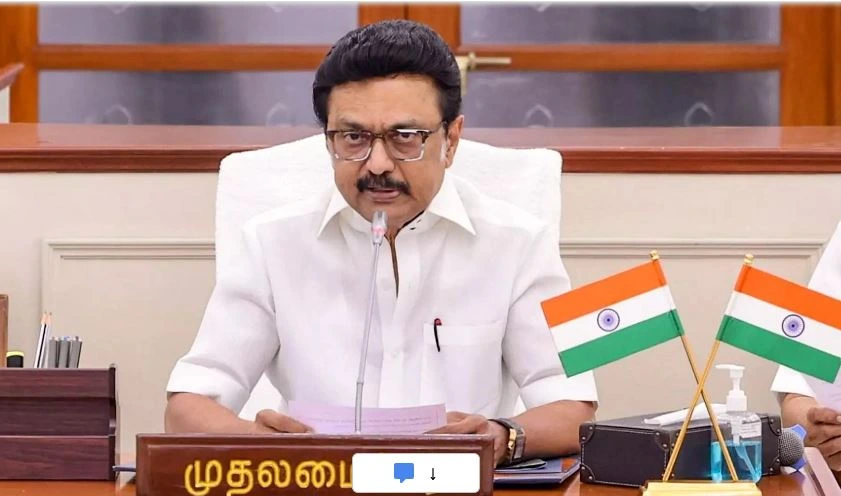
Vijay accuses Stalin of vendetta over Karur stampede, DMK counters

Vijay alleged political vendetta by CM MK Stalin over the Karur stampede deaths, while DMK leaders countered that he must accept responsibility for ignoring police warnings.

Published

on

MK Stalin

Actor-turned-politician Vijay, in his first public reaction since the Karur rally stampede that killed 41 people, alleged that Tamil Nadu Chief Minister MK Stalin and the ruling DMK were targeting his party out of political vendetta.

Vijay alleges conspiracy, vows to continue political journey

In a sombre video message released four days after the incident, the Tamilaga Vettri Kazhagam (TVK) chief said his party had followed all safety protocols. He dismissed allegations that TVK failed to manage crowd safety, claiming the rally was held at a designated safe location.

“Chief Minister sir, if you have revenge plans, do anything to me. Don’t touch my leaders,” Vijay said, adding that cases filed against his functionaries and supporters were unjustified. He also stressed that his political journey would continue with “renewed vigour.”

DMK responds sharply

The DMK hit back, accusing Vijay of deflecting responsibility. Party spokesperson A Saravanan questioned the delayed response, calling his video “a script.” Senior leaders A Raja and Kanimozhi also held Vijay accountable, citing police advice that was allegedly ignored by TVK organisers.

A Raja went further, suggesting Vijay’s decision to leave the venue during the chaos “showed a guilty conscience.” Kanimozhi added that police had warned against stopping Vijay’s campaign bus near the venue but the advice was disregarded.

Criminal cases against TVK leaders

The police have filed multiple cases linked to the stampede. A party functionary, Mathiyazhagan, was arrested on serious charges including attempt to murder and culpable homicide not amounting to murder. TVK’s General Secretary N ‘Bussy’ Anand and Joint General Secretary Nirmal Sekar also face charges, while Vijay himself has been booked for a “deliberate display of power” by delaying his arrival to build crowd frenzy.

“My heart is full of pain,” says Vijay

Expressing grief, Vijay said, “The people who died came out of their love for me. I am indebted to them.” He explained that he avoided returning to the venue after being escorted away as his presence might have triggered further panic.

He questioned why the tragedy unfolded specifically in Karur, noting that TVK rallies in other districts had passed without incident. Karur is politically significant, being represented in the state assembly by DMK’s V Senthil Balaji, currently embroiled in corruption allegations.

Political backdrop

The stampede has intensified the rivalry between TVK and DMK ahead of next year’s polls. Vijay has categorically ruled out any alliance with Stalin’s party, branding the DMK his “political enemy” and the BJP his “ideological enemy.”

India News

Union budget 2026 to be presented on Sunday with special trading session

The Union Budget 2026 will be presented on a Sunday for the first time in over two decades, with NSE and BSE announcing special trading sessions for the day.

Published

on

Nirmala Sitharaman

For the first time in more than two decades, the Union Budget will be presented on a Sunday. Finance Minister Nirmala Sitharaman is scheduled to table the Union Budget for 2026 in the Lok Sabha on February 1 at 11 am, even as the day is usually observed as a holiday for government offices and financial markets.

February 1 falls on a Sunday this year, raising questions about market operations and investor response. To ensure uninterrupted trading and immediate market reaction to budget announcements, stock exchanges have announced special arrangements for the day.

Markets to remain open on budget day

Both the National Stock Exchange and the Bombay Stock Exchange have confirmed that markets will remain open on February 1. The NSE has announced a special trading session, with the pre-open market scheduled from 9 am to 9:08 am, followed by normal trading hours from 9:15 am to 3:30 pm.

The BSE has also declared the day a special trading day, with regular market hours applicable. Trading is expected to continue across equity, derivatives, and futures and options segments.

What the Sunday budget means for investors

A weekend budget presentation is seen as offering certain advantages for market participants. With trading active on the same day, investors will be able to respond to policy announcements immediately rather than waiting for the next working day.

The Sunday timing also gives investors, analysts, and financial institutions additional time to go through detailed proposals, including tax changes, fiscal deficit targets, and sector-wise allocations. The extended window for analysis may help reduce sharp, headline-driven reactions and encourage more informed decision-making.

With fewer competing developments on a non-working day, budget announcements are also expected to receive more focused attention from markets and stakeholders.

Parliamentary schedule and key milestones

The Economic Survey is expected to be tabled on January 29, ahead of the budget presentation. The Budget Session of Parliament began on January 28 with the President’s address to a joint sitting of the Lok Sabha and Rajya Sabha.

The upcoming budget will mark Nirmala Sitharaman’s ninth consecutive Union Budget. It will also be India’s 80th budget since Independence. Since 2017, Union Budgets have been presented at 11 am on February 1, following a timing change introduced during the tenure of former finance minister Arun Jaitley.

Continue Reading

India News

Union Budget 2026: Why Budget announcements matter for stock market direction

With markets open on Budget day, Union Budget 2026 is set to influence stock movements as investors track growth measures, taxation changes and the fiscal deficit.

Published

on

Stock market

The Union Budget remains one of the most closely watched events in India’s financial calendar, with stock markets often reacting sharply to policy signals. This year, trading will continue on Budget day — February 1 — despite it falling on a Sunday, allowing investors to respond immediately to announcements.

Finance Minister Nirmala Sitharaman will present her ninth consecutive Union Budget, an event that is expected to set the tone for market sentiment in the near term.

Growth-focused policies and investor sentiment

Equity markets generally respond positively when the Budget outlines steps aimed at supporting economic growth. Measures such as infrastructure spending, business-friendly reforms or incentives for key industries tend to improve investor confidence.

When such policies signal long-term expansion, markets often factor in stronger earnings prospects, leading to upward movement in stock prices.

Consumer spending and sectoral gains

Budget proposals that increase disposable income can also influence market behaviour. Tax relief measures, direct support schemes or efforts to manage inflation may leave households with more spending power.

Higher consumer spending typically benefits sectors such as retail, automobiles and fast-moving consumer goods, with increased demand often reflected in company valuations.

Tax changes and market participation

Tax-related announcements play a crucial role in shaping investment decisions. Lower taxes for individuals or businesses can support consumption and profitability, encouraging further investment activity.

At the same time, changes to capital gains or dividend taxation directly affect investor behaviour. Favourable tax treatment can lead to higher participation in equity markets, while tighter taxation may weigh on sentiment.

Fiscal deficit remains a key indicator

Markets also keep a close watch on the fiscal deficit — the difference between government spending and revenue. A higher deficit can raise concerns around increased borrowing, inflationary pressure and interest rates, all of which may affect corporate performance.

Conversely, a controlled deficit is often seen as a sign of fiscal discipline, helping strengthen confidence among investors.

Continue Reading

India News

Why India’s Union Budget is now presented on February 1

India shifted the Union Budget date from late February to February 1 in 2017 to give ministries and taxpayers more time before the new financial year begins.

Published

on

Nirmala Sitharaman

The Union Budget is among the most closely followed annual exercises in India, setting out the government’s revenue plans and spending priorities for the coming financial year. While it is now presented every year on February 1, this was not always the norm.

For decades, India followed a British-era tradition of presenting the Union Budget on the last working day of February. This meant that once Parliament approved the proposals, ministries, businesses and taxpayers had very little time to prepare before the new financial year began on April 1.

In many cases, by the time the Budget proposals were implemented, the financial year had already started. This resulted in delays in rolling out government schemes, policy changes and tax measures.

Why the date was advanced

The practice changed in 2017, when then finance minister Arun Jaitley presented the Union Budget on February 1 for the first time. The idea was to provide adequate time for ministries and departments to finalise spending plans and ensure smoother execution from the beginning of the financial year.

Since then, the February 1 presentation has continued, allowing stakeholders across sectors more time to adjust to new tax rules and policy decisions before April.

Budget timing also saw a shift

The Union Budget has seen changes not only in date but also in timing. Until 1999, the Budget was traditionally presented at 5 pm, another colonial-era legacy.

That year, then finance minister Yashwant Sinha moved the presentation to 11 am. The shift was aimed at improving media coverage and enabling wider public engagement with Budget announcements on the same day.

Legal challenge and Supreme Court view

The decision to advance the Budget date also faced legal scrutiny. A petition was filed in the Supreme Court arguing that an earlier Budget presentation could give the Centre an opportunity to announce voter-friendly measures ahead of state elections.

The Supreme Court dismissed the plea, observing that the Union Budget concerns the entire country and is not linked to individual state elections. The bench held that the frequency of state polls could not obstruct the functioning of the central government.

Continue Reading

Trending

© Copyright 2022 APNLIVE.com