English हिन्दी
Connect with us

Top Stories

Sri Lanka declares state of emergency as President Rajapaksa flees country

Prime Minister’s spokesperson Dinouk Colombage told the media that the country is in the worst situation ever as it is witnessing an economic, fuel, and financial crisis.

Published

on

sri lanka crisis

The ongoing crisis in Srilanka left the country in a state of emergency. This comes hours after when president Gotabaya Rajapaksa fled the country.

While confirming the news, spokesman for Prime Minister Ranil Wickremesinghe, Dinouk Colombage told the media that the country is in the worst situation ever as it is witnessing an economic, fuel, and financial crisis. He said the development comes after when a huge crowd of protesters stormed the president’s residence, asking for his resignation.
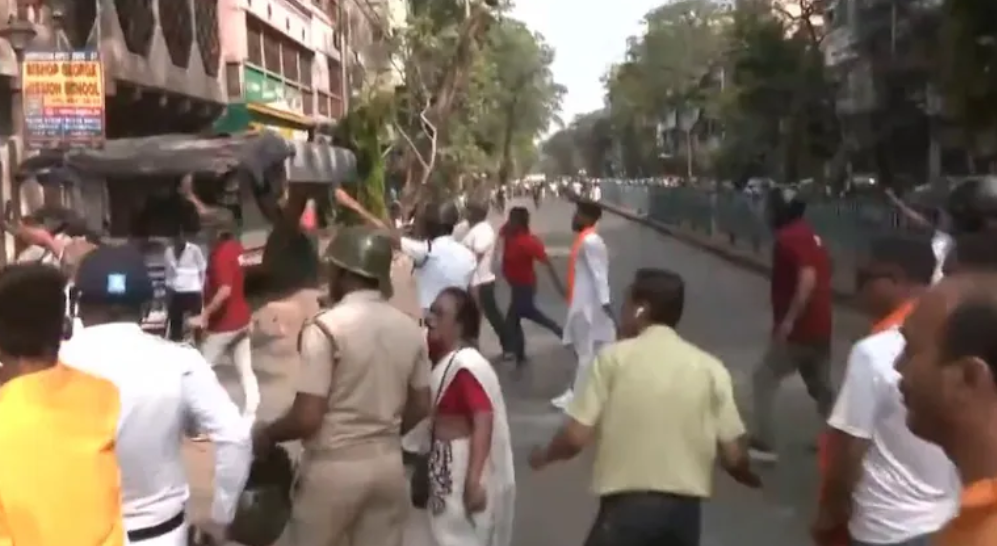
Country police also said that they are trying hard to calm the protesters but kept on falling as the number of objectors in the country grew by passing each hour. Police said they have imposed an indefinite curfew in the entire Western Province including the capital Colombo to control the panic situation.

Read Also: CNG, PNG prices hiked by Rs 4 per kg, Rs 3 per cubic meter in Mumbai, check CNG prices in Delhi, NCR and other cities

How the crisis in Sri Lanka unfolded?

Earlier, in March 2022, a huge protest begin in Sri Lanka against president Gotabaya Rajapaksa’s government for mismanagement of the economy, severe inflation, daily blackouts, shortage of fuel, domestic gas and other daily essentials.

On April 1, President Rajapaksa announced a temporary state of emergency in the country and asked security forces to arrest and detain suspects who are trying to disturb the peace in the name of protests.

Seeing the sudden change in the country, almost all of Sri Lanka’s cabinet decided to resign, leaving the president and his brother Mahinda alone. After losing the parliamentary majority, former allies ask him to quit his top position.

https://twitter.com/GillianMcKeith/status/1545696610184822784?s=20&t=BezVb5iKUh_Z3uqD_Gv4Lg

On July 9, the president fleed his official residence in Colombo hours after agitated protestors gathered. His security personnel took him to an undisclosed location. Later, the multiple footage went viral on social media platforms where demonstrators were seen jumping in the pool and exploring the whole president’s residence.

Angry protesters also set PM Wickremesinghe’s residence on fire on the same day.

PM Narendra Modi asks Bihar opposition leader Tejashwi Yadav to lose some weight

Madhya Pradesh: Villagers capture 13 feet long crocodile in belief that reptile swallowed 7-year-old boy, know what happened next

India News

India marks 77th Republic Day with grand parade at Kartavya Path

India marked its 77th Republic Day with a grand parade at Kartavya Path, highlighting military strength, cultural unity and international participation.

Published

on

Kartavya Path on Republic Day 2026

India is celebrating its 77th Republic Day today with a ceremonial parade at Kartavya Path in New Delhi, presided over by President Droupadi Murmu. European Council President Antonio Costa and European Commission President Ursula von der Leyen are attending the celebrations as chief guests.

Kartavya Path, stretching from Rashtrapati Bhavan to the National War Memorial, has been extensively decorated to reflect India’s journey as a republic. This year’s celebrations also mark the 150-year legacy of the national song Vande Mataram, blending historical symbolism with contemporary national achievements.

According to the Defence Ministry, the parade highlights India’s developmental progress, military capabilities, cultural diversity, and participation from citizens across the country.

Parade begins with tribute at National War Memorial

The Republic Day parade began at 10:30 am and is scheduled to run for around 90 minutes. Prime Minister Narendra Modi first visited the National War Memorial, where he laid a wreath to honour fallen soldiers. He then proceeded to the saluting dais at Kartavya Path along with other dignitaries.

President Murmu arrived at the venue in the traditional buggy, accompanied by the two chief guests and escorted by the President’s Bodyguard, the senior-most regiment of the Indian Army.

Following the unfurling of the national flag, the national anthem was played along with a 21-gun salute using indigenously developed 105 mm light field guns. The salute was presented by the 1721 Ceremonial Battery of the 172 Field Regiment.

Cultural performances and parade leadership

More than 100 cultural artists are participating in the parade, performing on the theme ‘Vividata Mein Ekta – Unity in Diversity’. The musical presentation reflects India’s cultural richness and national unity.

The parade is being commanded by Lieutenant General Bhavnish Kumar, General Officer Commanding, Delhi. Major General Navraj Dhillon, Chief of Staff at Headquarters Delhi, is serving as the Parade Second-in-Command.

Gallantry award winners and EU participation

Recipients of India’s highest gallantry awards are also part of the parade. These include Param Vir Chakra awardees Subedar Major (Honorary Captain) Yogendra Singh Yadav (retired) and Subedar Major Sanjay Kumar, along with Ashoka Chakra awardees Major General CA Pithawalia (retired) and Colonel D Sreeram Kumar.

An European Union contingent is participating with four flag bearers on three gypsies. The group is carrying the flags of the European Union, the European Union Military Staff, EU Naval Force Atalanta, and EU Naval Force Aspides.

First-ever phased battle array display

For the first time, the Indian Army is showcasing a phased battle array format during the parade, including aerial elements. The reconnaissance component includes the 61 Cavalry in combat uniform, followed by the high mobility reconnaissance vehicle — India’s first indigenously designed armoured light specialist vehicle.

Aerial support is being provided by the indigenous Dhruv advanced light helicopter and its armed variant, Rudra, underlining India’s growing defence self-reliance.

Continue Reading

Latest world news

Trump warns Canada of 100% tariffs over proposed China trade deal

Donald Trump has warned Canada it will face 100% tariffs on exports to the US if it proceeds with a trade agreement with China.

Published

on

donald trump

US President Donald Trump has threatened to impose sweeping tariffs on Canadian imports if Ottawa goes ahead with a trade agreement with China, escalating tensions over trade and supply chain concerns.

In a post on Truth Social, Trump strongly criticised Canadian Prime Minister Mark Carney, warning that Canada would face serious consequences if it allowed itself to be used as a transit point for Chinese products entering the United States.

Trump said that if Canada believed it could become a “drop off port” for Chinese goods bound for the US, it was “sorely mistaken”. He added that any such agreement with China would immediately trigger a 100 per cent tariff on all Canadian goods and products imported into the United States.

The remarks underline Washington’s growing concerns about China’s trade practices and its efforts to prevent indirect entry of Chinese products through third countries.

Canada, meanwhile, has been working to reduce its dependence on the US market. The country recently announced a “landmark deal” with China as part of a new strategic partnership aimed at expanding trade ties beyond North America.

The proposed partnership has now drawn sharp scrutiny from the US, with Trump signalling that any move seen as undermining American trade interests would be met with aggressive tariff action.

Continue Reading

India News

India to start first commercial semiconductor chip production in 2026, says Ashwini Vaishnaw

India is on track to begin its first commercial semiconductor chip production in 2026, with pilot production already underway and investments nearing $90 billion, according to Union Minister Ashwini Vaishnaw.

Published

on

Union Electronics and Information Technology Minister Ashwini Vaishnaw on Friday said India remains on schedule to begin commercial semiconductor chip production in 2026, in line with the targets outlined under the India Semiconductor Mission launched in January 2022.

Speaking to media, the minister said the government had committed to starting commercial production within five years of the mission’s launch and that the timeline is being met.

“The first commercial production will begin in 2026. Four semiconductor plants are expected to start operations this year, while pilot production has already begun at three plants in 2025,” Vaishnaw said.

Semiconductor ecosystem taking shape

The minister said India’s semiconductor ecosystem is developing rapidly, with global equipment manufacturers setting up operations in the country and a strong materials manufacturing base emerging alongside.

He added that the talent pipeline is progressing faster than expected. Against a target of training 85,000 skilled professionals over 10 years, India has already trained around 65,000 people in just four years, he said.

Vaishnaw noted that several milestones under the first phase of the Semiconductor Mission are either on track or ahead of schedule, reflecting growing confidence in India’s manufacturing ambitions.

Investments near $90 billion, more expected

On the investment front, the minister said total investments in the semiconductor sector have reached close to USD 90 billion so far. He added that committed investments could rise to around USD 150 billion as India approaches the upcoming AI Impact Summit scheduled to be held in New Delhi from February 16 to 20.

According to Vaishnaw, global semiconductor players are increasingly supportive of India’s efforts and are keen to participate in the country’s expanding chip manufacturing ecosystem.

ASML equipment for Dholera fab

Highlighting the importance of advanced manufacturing technology, Vaishnaw spoke about his visit to Veldhoven in the Netherlands, where he visited the headquarters of ASML, the world’s leading supplier of lithography equipment used in semiconductor manufacturing.

He said lithography remains the most complex and precision-intensive process in chip production and confirmed that India’s upcoming semiconductor fabrication facility in Dholera, Gujarat, will use equipment supplied by ASML.

Vaishnaw said the interest of global equipment manufacturers in India reflects the country’s strong design capabilities, large talent pool and consistent policy environment.

India’s progress in AI and global confidence

The minister also highlighted India’s growing role in artificial intelligence, stating that the country is developing strength across multiple layers of the AI stack, including applications, sovereign models, chips and infrastructure.

He said global industry leaders expressed strong confidence in India’s semiconductor and AI journey during discussions at the World Economic Forum in Davos, with many indicating their willingness to contribute to India’s long-term goals.

The India Semiconductor Mission, approved by the Union Cabinet in December 2021 with an outlay of Rs 76,000 crore, aims to support semiconductor fabrication, display manufacturing and chip design, and position India as a global hub for electronics manufacturing and innovation.

Continue Reading

Trending

© Copyright 2022 APNLIVE.com