English हिन्दी
Connect with us

Top Stories

Murder over BGMI: UP boy kills 6-year-old to frame grandfather who had objected to his playing battle royale game

The game isn’t as vicious as a few toxic players have made it.

Published

on

Battle royale mobile games like PUBG Mobile (known locally as BGMI) have been making headlines for quite some time now, obviously for negative reasons. The game isn’t as vicious as a few toxic players have made it. In India, the crimes related to PUBG are manifold. One such incident is emerging from Uttar Pradesh’s Deoria, where a 20-year-old boy killed a six-year-old boy to frame his grandfather, who used to stop him from playing BGMI.

The six-year-old, identified as Sanskar Yadav, used to take tuition from Arun’s grandfather, Narsingh Sharma. So, on Wednesday evening, after tuition, the boy did not come home, and when his parents went to Sharma’s residence to figure it out, they were informed that Sanskar had not shown up for tuition. Soon after, the family lodged an FIR and started looking for the boy.

Read Also: Former Japanese PM Shinzo Abe dies at 67, he was shot at earlier today

The police later found his books and notebooks scattered in a field near Sharma’s house. One of the copies also had a letter demanding a ransom of Rs 5 lakhs for his release. Later, the police took the writing samples of family members and neighbours and Arun Sharma’s handwriting matched that of the ransom note writer, who was later taken into police custody and interrogated.

On interrogation, Arun revealed that his father used to scold him every time he used to play PUBG/BGMI and often refused to give him money. Miffed by him, he kidnapped Sanskar with the intention of implicating his grandfather.

According to the reports, Arun kidnapped him, sealed his lips with adhesive to prevent him from screaming and asking for help, and then strangled him to death. Later, he dumped the boy’s body in the toilet outside their home.

The police seized the accused’s mobile phone and sent it for forensic examination. The police have also detained Arun under the charges of murder, kidnapping for ransom, and causing of the disappearance of evidence.

Haryana BJP IT cell in-charge removed for 2017 controversial tweets targeting Prophet Muhammad, Islam

Kaali row: After backing Mahua Moitra, Shashi Tharoor says whatever he tweeted is his personal opinion

Latest world news

Iran strike on Qatar LNG hub raises concerns for India’s energy security

Iran’s missile strike on Qatar’s LNG facility has disrupted global supply chains, posing risks for India’s energy imports and pricing.


Published

on

Heightened tensions in the Middle East have begun to ripple across global energy markets after Iran launched a missile strike on Ras Laffan, Qatar’s largest liquefied natural gas (LNG) facility. The attack has intensified fears of prolonged supply disruptions and rising fuel costs, with countries like India expected to feel the impact sharply.

The Gulf region has emerged as the focal point of escalating hostilities, with Iran targeting energy infrastructure and US-linked assets following strikes by the United States and Israel. The latest attack on Qatar’s key LNG hub has reportedly forced a complete halt in production at the facility, which is among the largest of its kind globally.

Qatar is a major LNG exporter and ranks alongside the United States, Australia and Russia in global supply. The disruption is not an isolated incident. Earlier in March, missile strikes on Qatari gas fields had already compelled QatarEnergy to suspend operations temporarily. These developments are linked to retaliatory actions following an Israeli strike on Iran’s South Pars gas field, part of the world’s largest natural gas reserve.

The broader conflict has also affected maritime activity in the Strait of Hormuz, a critical route that carries nearly one-fifth of the world’s oil supply. With rising threats to shipping, tanker movement has slowed significantly, pushing global oil and gas prices higher.

The situation has further escalated with continued strikes and counterstrikes across the region. Reports indicate heavy casualties in Iran, while missile and drone attacks continue to target strategic assets. The conflict, now in its third week, has effectively turned key shipping lanes into high-risk zones, with hundreds of cargo vessels stranded near major Gulf ports.

Impact on India

India is particularly vulnerable to these disruptions due to its reliance on imported natural gas. Around 50 percent of the country’s gas demand is met through imports, with Qatar accounting for a significant share.

According to energy economist Kirit Parikh, India sources roughly 40 percent of its LNG imports from Qatar, translating to about 20 percent of its total gas consumption. Any prolonged disruption could therefore strain domestic supply.

India’s current daily natural gas consumption stands at about 189 million metric standard cubic meters per day (MMSCMD), with nearly half met through domestic production. However, a portion of imported supply—estimated at 47.4 MMSCMD—has already been affected due to force majeure conditions.

In response, state-run gas companies have started sourcing LNG cargoes from alternative suppliers. However, such arrangements are likely to come at higher costs, adding pressure on industries dependent on gas, particularly the power sector.

Experts suggest that if the crisis persists, India may need to rationalise gas consumption, prioritising essential sectors while cutting usage in others.

Continue Reading

India News

Deve Gowda hits back at Kharge’s married PM jibe, calls congress tie-up abusive relationship

HD Deve Gowda rebuts Mallikarjun Kharge’s remarks, saying JD(S) did not desert Congress and was forced to exit an “abusive” alliance.
Published

on

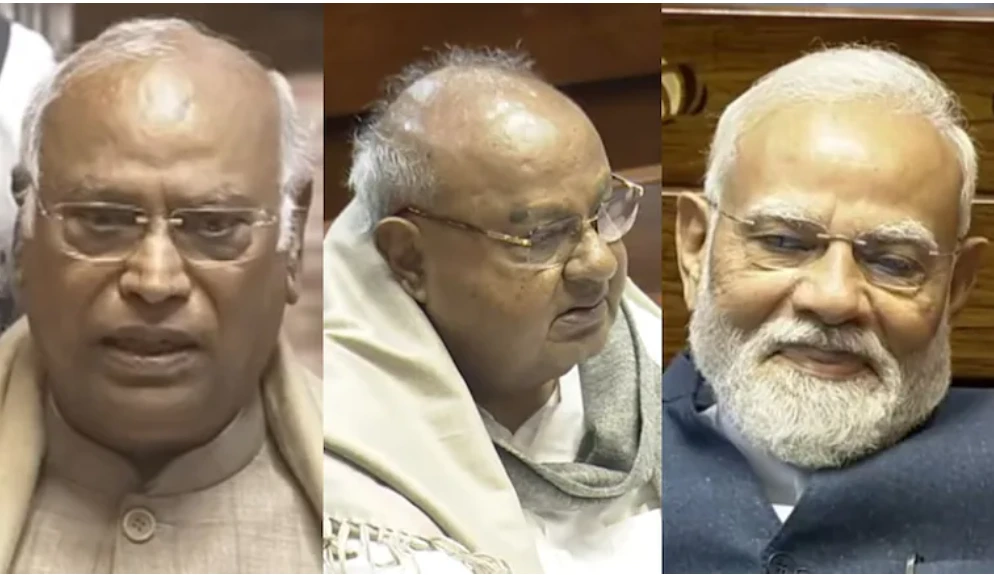
Former Prime Minister H. D. Deve Gowda has responded sharply to remarks made by Congress president Mallikarjun Kharge in the Rajya Sabha, rejecting the suggestion that he chose to align with Prime Minister Narendra Modi over the Congress.

War of words in rajya sabha

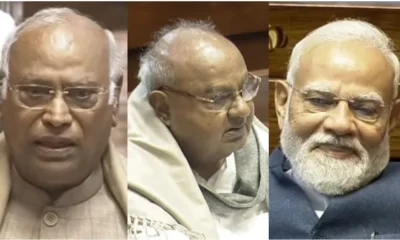
During his farewell speech in the Upper House, Kharge made a light-hearted remark about Deve Gowda’s political journey, saying he had “dated” the Congress but ultimately “married” Modi. The comment drew laughter across the House, including from the Prime Minister, who was present at the time.

Kharge also noted his long association with Deve Gowda, saying he had known him for over five decades but was unsure why the Janata Dal (Secular) leader shifted alliances.

Deve gowda’s ‘forced marriage’ reply

In a statement issued later, Deve Gowda said he was not present in the House when the comment was made as he had left for Bengaluru for Ugadi celebrations. Responding in similar metaphorical language, he said his association with the Congress was a “forced marriage” that eventually turned into an “abusive relationship.”

He asserted that his party did not leave the Congress alliance, but was instead compelled to move on after being sidelined.

Reference to 2018 karnataka alliance

Deve Gowda also revisited the 2018 Karnataka political developments, stating that the Congress leadership, including Ghulam Nabi Azad, had proposed his son H. D. Kumaraswamy as Chief Minister. He claimed he had instead suggested Kharge’s name, in the presence of leaders like Siddaramaiah.

Despite this, Kumaraswamy eventually took charge as Chief Minister after the Congress-JD(S) alliance formed the government.

Alliance collapse and aftermath

The coalition government collapsed in 2019 after multiple MLAs from both parties defected, leading to the fall of the government. Deve Gowda alleged that the Congress failed to act against those responsible for triggering the defections.

He maintained that the breakdown of the alliance left JD(S) with no option but to seek a “more stable” political partnership later.

Political context

Deve Gowda briefly served as Prime Minister following the 1996 Lok Sabha elections, heading a United Front government supported by the Congress. His party later allied with the Congress in Karnataka in 2018 before parting ways after the coalition government’s collapse.

Continue Reading

India News

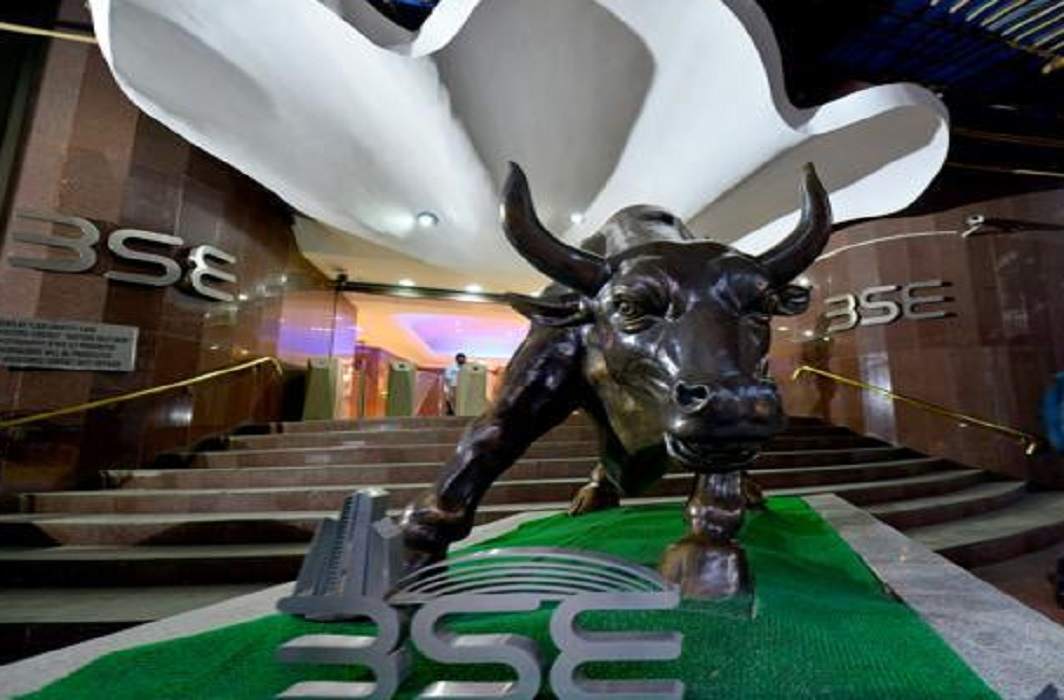
Markets tumble as oil crosses $110, sensex falls over 1,900 points

Markets opened sharply lower with Sensex plunging over 1,900 points as crude oil crossed $110 and global factors weighed on sentiment.

Published

on

Sensex

Indian stock markets opened sharply lower on Thursday, snapping a three-session gaining streak, as rising global crude oil prices and geopolitical tensions weighed heavily on investor sentiment.

Benchmark indices witnessed a gap-down opening, with the Sensex plunging over 1,900 points at the open, while the Nifty dropped more than 450 points. The decline follows reports of Iran targeting key energy infrastructure in the Gulf region, pushing Brent crude oil prices above the $110 per barrel mark.

At around 9:17 AM, the Sensex was trading at 75,235.05, down by 1,469.08 points. Meanwhile, the Nifty stood at 23,291.85, slipping 485.95 points.

Oil spike, global cues pressure equities

The surge in crude oil prices is a major concern for Indian markets, as higher oil costs can widen the current account deficit and fuel inflation. This often leads to cautious investor behaviour and triggers selling in equities.

Adding to the negative sentiment, the US Federal Reserve maintained its interest rates at current levels. Stable rates in the US tend to keep bond yields attractive, which can result in foreign institutional investors (FIIs) pulling money out of emerging markets like India.

Early indicators had already pointed to a weak start. GIFT Nifty futures were trading at 23,324, down 453 points, signalling a negative opening for domestic indices.

Expert view signals sectoral shift

According to InvestorAi’s strategic outlook, there has been a noticeable shift in market positioning towards IT large-cap stocks. The move reflects a preference for companies with stable earnings visibility, especially those earning in dollars amid a weakening rupee.

The analysis highlights that IT exporters benefit from currency depreciation, as revenues are largely dollar-denominated while costs remain in rupees. However, the outlook remains sensitive to crude prices. A sustained rise above $110 could force policy tightening and impact valuations.

Key stocks in focus

Among the top conviction picks highlighted:

  • Mphasis seen as a strong mid-cap IT play with AI and cloud exposure
  • Wipro emerging as a turnaround candidate with improving margins
  • TCS acting as a sector bellwether reflecting broader IT trends
  • PB Fintech offering a high-margin digital growth story
  • KEI Industries representing domestic infrastructure and electrification demand

What investors should watch

Market participants are closely tracking the rupee’s movement against the US dollar. A sustained breach beyond 90.5–91 levels could further support IT stocks but may also signal broader macroeconomic stress.

Additionally, crude oil prices and geopolitical developments will remain key triggers for market direction in the near term.

Continue Reading

Trending

© Copyright 2022 APNLIVE.com