English हिन्दी
Connect with us

Top Stories

Jaunpur: Man reaches police station late night to lodge FIR against America | WATCH

However, the police sent him home after somehow convincing him.

Published

on

Jaunpur man

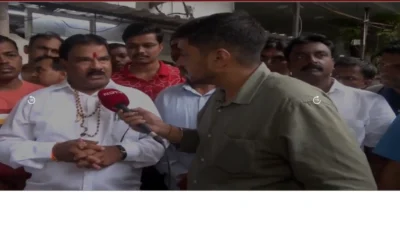
A Jaunpur man has reached the police station late night to register an FIR against America.

A video of his interaction with a police officer is doing rounds on social media.

In the video, the man can be seen claiming that Lord Vishnu has constructed heaven under the land but America invaded and captured it by force. He claimed that he could see the movements under the soil with the help of Lord Shiva’s third eye.

Yogendra Yadav, a resident from Jaunpur created a ruckus late at night when he reached the police station to lodge FIR against America for invading India.

He also said he had done continue prayers for 22 years. In response to it, the God has given him a superpower to see the moments under the land, he said in the viral video in which he can be seen talking to a police officer.

In the video, Yadav also claimed that the power of earth has been reducing everyday and once the power ends the earth will be collapsed in the water inside the death.

However, the police sent him home after somehow convincing him.

India News

Chandrashekhar Azad to be CM candidate of alliance with Owaisi for Uttar Pradesh elections

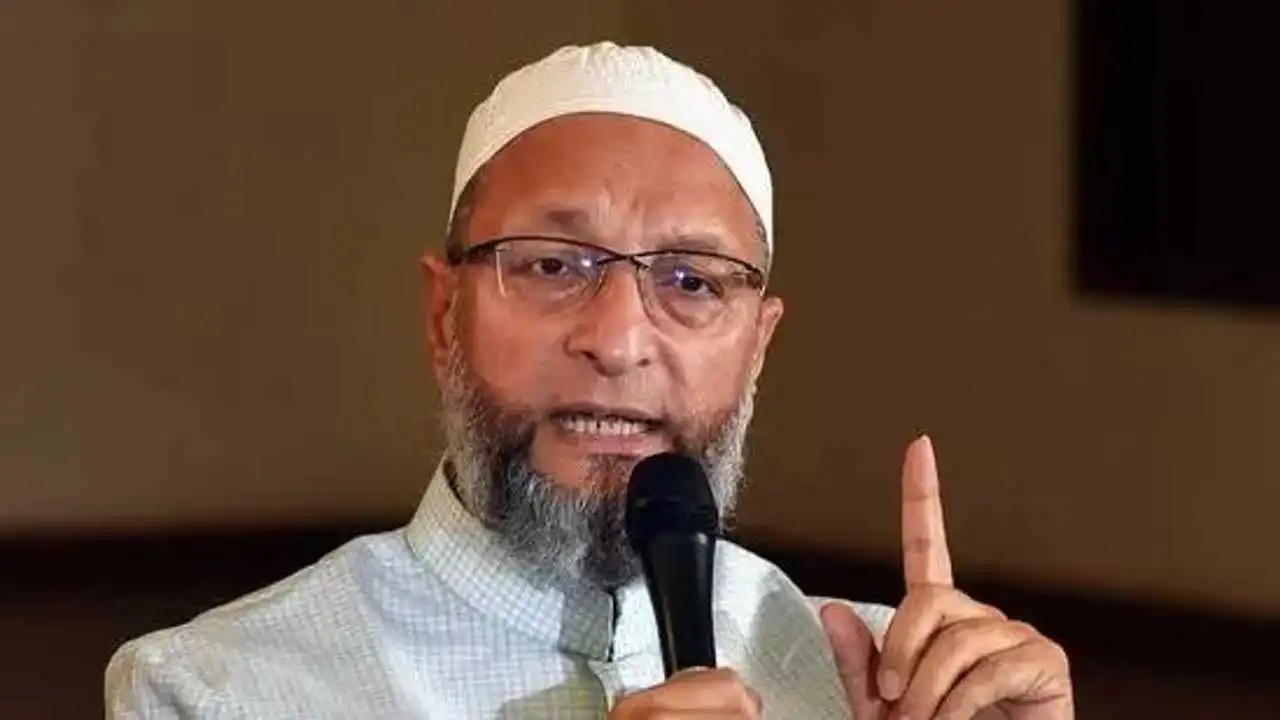
Asaduddin Owaisi and Chandrashekhar Azad have joined hands ahead of the 2027 Uttar Pradesh Assembly elections, bringing together the AIMIM and Azad Samaj Party in an effort to consolidate Dalit and Muslim voters.

Published

on

Asaduddin Owaisi’s All India Majlis-e-Ittehadul Muslimeen (AIMIM) and Chandrashekhar Azad’s Azad Samaj Party (Kanshi Ram) have joined hands ahead of the 2027 Uttar Pradesh Assembly elections, seeking to emerge as a third political force and draw support from sections of Muslim and Dalit voters.

As part of the alliance, Owaisi declared Chandrashekhar Azad as the alliance’s Chief Ministerial face for the 2027 Uttar Pradesh Assembly elections.

Owaisi had been seeking a place in the Opposition alliance for months and had even issued ultimatums to the Samajwadi Party and Congress. However, his efforts did not find takers.

The alliance brings together AIMIM’s focus on Muslim political representation and the Azad Samaj Party’s outreach among Dalit voters. Both parties are seeking to establish a political formation outside the BJP-led NDA and the Samajwadi Party-led opposition.

Why Owaisi and Chandrashekhar Azad joined hands

Uttar Pradesh AIMIM president Shaukat Ali said the party approached Chandrashekhar Azad after its efforts to reach an understanding with the Samajwadi Party, Congress and Bahujan Samaj Party did not succeed.

Ali said AIMIM wanted a broader alliance to prevent the BJP from returning to power in Uttar Pradesh for a third consecutive term.

He also criticised the Samajwadi Party-Congress alliance, questioning its prospects in the next Assembly elections.

Chandrashekhar Azad, the Lok Sabha MP from Nagina, said the partnership would focus on empowering young people, farmers and weaker sections of society.

He also raised concerns over employment opportunities, demonetisation and issues affecting educated youth from Dalit and backward communities.

What the alliance means for Akhilesh Yadav’s PDA strategy

Muslims account for around 20 per cent of Uttar Pradesh’s population, while Dalits constitute approximately 21 per cent.

Samajwadi Party chief Akhilesh Yadav has used the PDA formulation to bring together backward classes, Dalits and minorities. The AIMIM-Azad Samaj Party alliance is seeking support among two important sections of this broader social grouping.

Muslims account for around 20 per cent of Uttar Pradesh’s population, while Dalits constitute approximately 21 per cent.

What the parties’ previous election performance shows

Both AIMIM and the Azad Samaj Party have struggled to establish a significant presence in Uttar Pradesh Assembly elections.

In the 2022 Assembly elections, AIMIM contested more than 90 seats but secured less than 0.5 per cent of the total votes. The Azad Samaj Party contested more than 100 seats and received approximately 0.13 per cent of the votes.

Chandrashekhar Azad, however, won the Nagina Lok Sabha constituency in 2024, giving his party its first elected representative in Parliament.

The alliance is now attempting to combine AIMIM’s support among sections of Muslim voters with Azad’s outreach among Dalit communities.

Its electoral prospects will depend on the seat-sharing arrangement, local leadership and whether the two parties can translate their combined social outreach into electoral support.

SP leaders respond to the alliance

Samajwadi Party MP from Ayodhya, Awadhesh Prasad, dismissed the electoral significance of the AIMIM-Azad Samaj Party alliance. He said that people in Uttar Pradesh had lost faith in the BJP government and described Akhilesh Yadav as the only leader capable of removing the BJP from power in 2027.

The alliance’s formation could therefore become an important factor in the political discussions ahead of the 2027 Assembly elections, particularly because both leaders are seeking support among communities that the Samajwadi Party also hopes to bring together through its PDA formulation.

Continue Reading

Latest world news

India, Canada discuss trade pact to boost bilateral commerce

India and Canada discussed advancing negotiations on a proposed Comprehensive Economic Partnership Agreement aimed at expanding trade, investment and market access between the two countries.
Published

on

India canada trade pacts

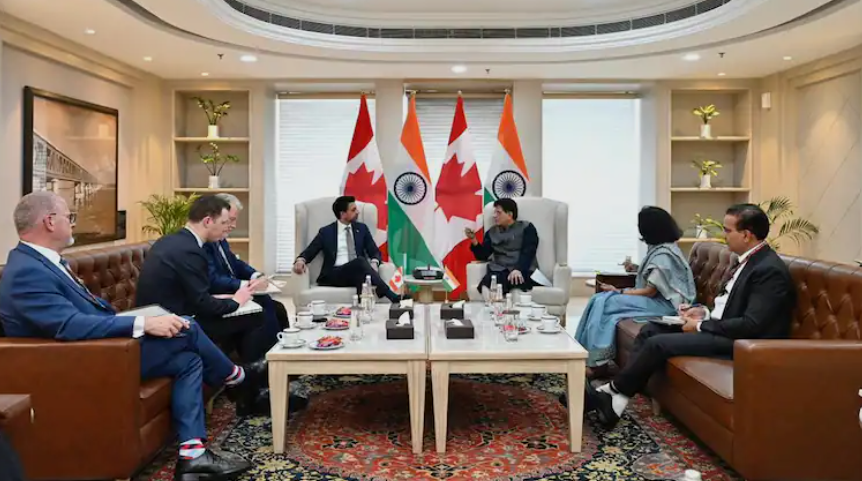
India and Canada discussed advancing negotiations on a proposed trade agreement as the two countries seek to strengthen their economic and commercial ties.

Commerce and Industry Minister Piyush Goyal met Canada’s Minister of International Trade Maninder Sidhu, who is leading a Canadian delegation to India. The discussions focused on advancing negotiations for the proposed India-Canada Comprehensive Economic Partnership Agreement (CEPA).

The proposed pact is aimed at creating greater market access and opening up new opportunities for trade and investment between the two countries.

India-Canada CEPA talks

Both sides discussed the importance of a balanced and mutually beneficial agreement that can make use of the complementary strengths of the two economies.

The discussions also focused on deepening commercial engagement and creating new opportunities for businesses in both countries.

Goyal said the two sides reaffirmed their commitment to taking the India-Canada economic partnership to a higher level, with CEPA serving as a catalyst for deeper commercial engagement.

India and Canada are working towards concluding the CEPA negotiations by the end of 2026.

India-Canada trade

The proposed CEPA is aimed at improving market access and creating opportunities across sectors while strengthening the broader economic relationship between India and Canada.

The agreement is expected to provide greater opportunities for businesses in both countries and support deeper trade and investment ties.

Continue Reading

India News

Air pollution as big a health emergency as COVID, says former WHO chief Soumya Swaminathan

Former WHO Chief Scientist Dr Soumya Swaminathan said air pollution should be treated with the same urgency as COVID, highlighting its effects on children, pregnancy and multiple organs.

Published

on

air pollution

Air pollution should be treated as a major public health emergency requiring an urgent and coordinated response, former World Health Organisation (WHO) Chief Scientist Dr Soumya Swaminathan has said.

In an exclusive interview, Dr Swaminathan compared the scale of the air pollution health crisis with COVID and said its effects can extend across the body, including the brain, lungs and cardiovascular system. She also highlighted links between pollution exposure and conditions such as asthma and diabetes.

Why air pollution needs a COVID-like response

Dr Swaminathan said COVID triggered an immediate public response because it was sudden, visible and associated with an unknown virus. Air pollution, by contrast, is often less visible and its effects accumulate over time.

She said people may become accustomed to pollution because it is not always visible, particularly outside the winter months. But she stressed that prolonged exposure can still cause serious health damage.

She called for the issue to receive an “equal, urgent, coordinated and scientific” response, similar to the approach taken during the COVID crisis.

PM2.5 poses risks from pregnancy to childhood

Dr Swaminathan also highlighted concerns about exposure to fine particulate matter, particularly PM2.5, among pregnant women and children.

According to her, these tiny particles can enter the lungs and bloodstream and may also reach the placenta. She pointed to higher rates of premature births and low birth weight among babies born in areas where mothers are exposed to high levels of air pollution.

She also said children are particularly vulnerable because their brains and other organs are developing rapidly. Children breathe faster than adults, and those growing up in heavily polluted areas can have smaller lungs, she said.

Why AQI may not tell the full health story

Dr Swaminathan suggested moving beyond the conventional Air Quality Index (AQI) towards an Air Quality Health Index (AHQI).

The proposal would place greater emphasis on how individual pollutants affect different groups of people. She noted that the dominant pollutant can vary from one city to another, while its health impact may also differ for groups such as pregnant women and children.

The current AQI uses eight major pollutants as parameters: PM10, PM2.5, ozone, sulphur dioxide, nitrogen dioxide, carbon monoxide, lead and ammonia. The overall AQI is determined by the highest pollutant sub-index.

Swaminathan does not favour shutting schools

On protecting children from polluted air, Dr Swaminathan said she was not in favour of simply closing schools.

She argued that children from poorer families may continue breathing polluted air at home, while also losing access to education, social interaction and midday meals.

Instead, she suggested making school environments cleaner. Her proposals included installing air purifiers in classrooms, providing pick-and-drop bus facilities and encouraging older children to wear masks when outdoors.

Five measures suggested to tackle pollution

Dr Swaminathan outlined five key measures for addressing the pollution crisis:

  1. Launch a national clean air programme, which she suggested could be called the “Swachh Vaayu Abhiyan”.
  2. Prepare a costed, long-term plan with sustained investment and study lessons from countries such as China.
  3. Establish empowered leadership and accountability for tackling air pollution.
  4. Create a panel of experts to develop a science-based, multi-sectoral and multi-year plan.
  5. Put health at the centre of air pollution policy.

She also supported treating the right to clean air as a basic public health entitlement, linking it to the constitutional right to life.

Dr Swaminathan’s central argument was that air pollution should no longer be treated as a slow-moving or routine environmental problem, but as a serious health crisis requiring sustained action.

Continue Reading

Trending

© Copyright 2022 APNLIVE.com