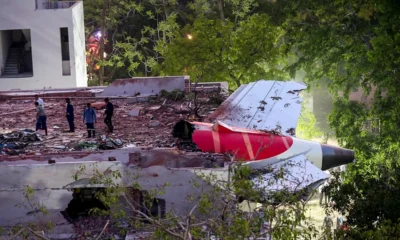
[vc_row][vc_column][vc_column_text]The Ethiopian Airlines crash that killed all 157 persons, including four Indians, on board, the second instance of a Boeing 737 Max 8 aircraft going down in five months, has raised serious concerns about its safety worldwide.
While India and some others have ordered extra precautions and stricter safety norms, a number of others like China have taken Boeing 737s off flight operations after the two air disasters. On October 29 last year, a MAX 8 operated by Indonesian Lion Air went down into the Java Sea after loss of control shortly after takeoff from Jakarta. On Sunday, March 10, a Nairobi-bound jet of the same make operated by Ethiopian Airlines crashed minutes after it had become airborne in Addis Ababa. A total of 346 people were killed in the two accidents.
Some detect similarities between the two accidents. While experts are yet to determine even a preliminary cause for the plane going down in Addis Ababa, the events preceding the crash of another aircraft of the same model have raised the red flag:
– both airliners went down minutes after takeoff.
– in both cases, the pilots are reported to have requested a return to the airport after takeoff, suggesting problems with control.
In India, the Directorate General of Civil Aviation (DGCA) said that only very experienced pilots are to operate Boeing 737 Max aircraft and ordered additional checks for the planes.
A day after the fatal crash of a Boeing’s 737 MAX aircraft in Ethiopia, DGCA yesterday (Monday, March 11) ordered additional maintenance checks for the planes operating in the country and said a review found no significant concern related to the model.
The DGCA directed Indian carriers to ensure that pilots have 1,000 hours and co-pilots 500 hours of flying experience on the 737 MAX 8.
A senior civil aviation ministry official told news agency PTI that it would discuss with the DGCA on the action that needs to be taken with regard to 737 MAX aircraft.
Full service carrier Jet Airways and low-cost carrier SpiceJet own and operate these aircraft in India. SpiceJet told NDTV that it is operating all 13 of its 737 MAX 8 planes. Jet Airways, which has five such aircraft, said it is not flying any of them currently.
While Jet Airways has placed orders for 225 737 MAX planes with Boeing and some have already been delivered, SpiceJet, which has embarked on ambitious expansion plans, has a deal with Boeing for up to 205 aircraft, including at least 155 737 MAX 8 planes, reported NDTV.
Boeing said on Monday the investigation into the Ethiopian Airlines crash is in its early stages and there is no need to issue new guidance to operators of its 737 MAX 8 aircraft based on the information it has so far.
The 737 MAX 8 is a new model from the US aircraft manufacturer’s best-selling 737, which has been operating since 1967. More than 350 Boeing 737-MAX planes have been delivered and more than 5,000 have been ordered worldwide since 2017.
Boeing has been criticised for not informing airlines in detail about how to override problematic software on the flight control system of the 737 MAX aircraft. The new software is part of an automatic system designed to ensure that the aircraft does not stall, in other words, lose it ability to remain flying.
Boeing was quoted by reports as saying that the 737 MAX 8 was “as safe as any airplane that has ever flown the skies.”
How other countries reacted
Singapore’s aviation regulator on Tuesday completely banned the use of Boeing 737 MAX aircraft in the country’s airspace. The civil aviation authority of Singapore (CAAS) said it was “temporarily suspending operation of all variants of the Boeing 737 MAX aircraft into and out of Singapore” in light of the two recent accidents.
Beijing Monday ordered domestic airlines to suspend operation of the Boeing 737 MAX 8, citing the two crashes. Noting “similarities” between the two incidents, China’s civil aviation administration said operation of the model would only resume after “confirming the relevant measures to effectively ensure flight safety”.
China is a hugely important market for the US aircraft company, accounting for about one-fifth of worldwide deliveries of Boeing 737 MAX models.
Indonesia said it was grounding its 11 jets of the 737 MAX 8 type. Inspections of the aircraft would start Tuesday and the planes would remain grounded until they were cleared by safety regulators, Director General of Air Transport Polana Pramesti told reporters.
South Korea’s transport ministry said that the two Boeing 737 MAX 8 planes operated by the country’s budget airline Eastar Jet would be grounded pending an inspection.
The Mongolian civil aviation authority said on Facebook it had ordered the state carrier MIAT Mongolian Airlines to ground the sole Boeing 737 MAX 8 aircraft in its fleet.
Ethiopian Airlines said on Monday it had grounded its Boeing 737 MAX 8 fleet “until further notice”. “Although we don’t yet know the cause of the accident, we have to decide to ground the particular fleet as an extra safety precaution,” said the state-owned carrier, Africa’s largest.
South African airline Comair said it had “decided to remove its 737 MAX from its flight schedule”.
Cayman Airways said it would suspend flights for its two 737 MAX 8 planes “until more information is received”, CEO Fabian Whorms said.
Brazil’s Gol Airlines said it was temporarily suspending its commercial operations with the plane. Aeromexico, which has six 737 MAX 8s in its fleet, also announced that it was grounding the aircraft.
Pilots from Argentina’s Aerolineas Argentinas have refused to fly the jet.
The US Federal Aviation Administration said it would take “immediate” action if there were safety concerns. Southwest Airlines, which operates 34 of the 737 MAX 8 planes, said: “We remain confident in the safety and airworthiness of our fleet of more than 750 Boeing aircraft.”
A person with knowledge of the matter told AFP that American Airlines planned to continue operating its two dozen 737 MAX 8s.
Russian airline S7 said it was closely following the crash investigation and was in contact with Boeing, but had received no instructions to stop flying the 737 MAX 8.
The CEO of Turkish Airlines, which flies 11 Boeing 737 MAX 8 aircraft, said in a tweet that the carrier would fly the planes as scheduled, adding the airline is in touch with Boeing and that passenger security was paramount.
Air Italy said it would follow all directives “to ensure the maximum level of safety and security”. In the meantime, the planes remained in the air.
Icelandair operates three Boeing 737 MAX 8. Its operations chief told Frettabladid newspaper it would be “premature” to link the crashes in Ethiopia and Indonesia together. This could change depending on the outcome of an ongoing probe but “for now, there is no reason to fear these machines”.
Norwegian Air Shuttle, which operates 18 Boeing 737 MAX 8 aircraft, said it would keep them in the air.
Airline flydubai said it was “monitoring the situation” and that it was “confident in the airworthiness of our fleet”.
Oman Air said it was in contact with Boeing “to understand if there are any implications for other airlines operating the same model”.
[/vc_column_text][/vc_column][/vc_row]