
Latest world news
Israel-Iran tension escalates in Munich Security Conference


The situation in Middle East has once again escalated with Israeli PM Banjamin Netanyahu displaying piece of an alleged Iranian drone (downed by Israel a week ago) in Munich Security Conference which was responded by Iranian foreign minister Javad Zarif dismissing the allegations it as a “cartoonish circus, which does not even deserve a response” on Monday .
Jerusalem Post reports, Netanyahu brandished a piece of the Iranian unmanned aerial vehicle that Israel downed a week ago after it entered Israel’s airspace and warned Iran “not to test Israel’s resolve.”
Netanyahu said Zarif “lies with eloquence” and warned the conference participants saying that Zarif will “brazenly deny Iran’s nefarious involvement in Syria”.
Netanyahu further said, “Iran also denies that it committed an act of aggression against Israel last week, that it sent a drone into our airspace to threaten our people.” He pulled out the alleged Iranian prop from behind the podium and held it up with one hand.
“Well, here is a piece of that Iranian drone, or what’s left of it after we shot it down. I brought it here so you can see for yourself. Mr. Zarif, do you recognise this? You should. It’s yours,” Netanyahu said.
He said “Israel will not allow the regime to put a noose of terror around our neck.”We will act if necessary not just against Iran’s proxies but against Iran itself,” he added.
Netanyahu also tried to convince the conference participants against Iran nuclear deal. He said that the inspection regime is incompletely insufficient. He said that at the end of 10 years agreement time Iranians will have an “open highway” to build not only one nuclear device, but an entire nuclear arsenal.
He pleaded saying “they should be stopped and slammed with the most crippling sanctions to prevent them from continuing the development of these [nuclear] delivery systems, these guns”.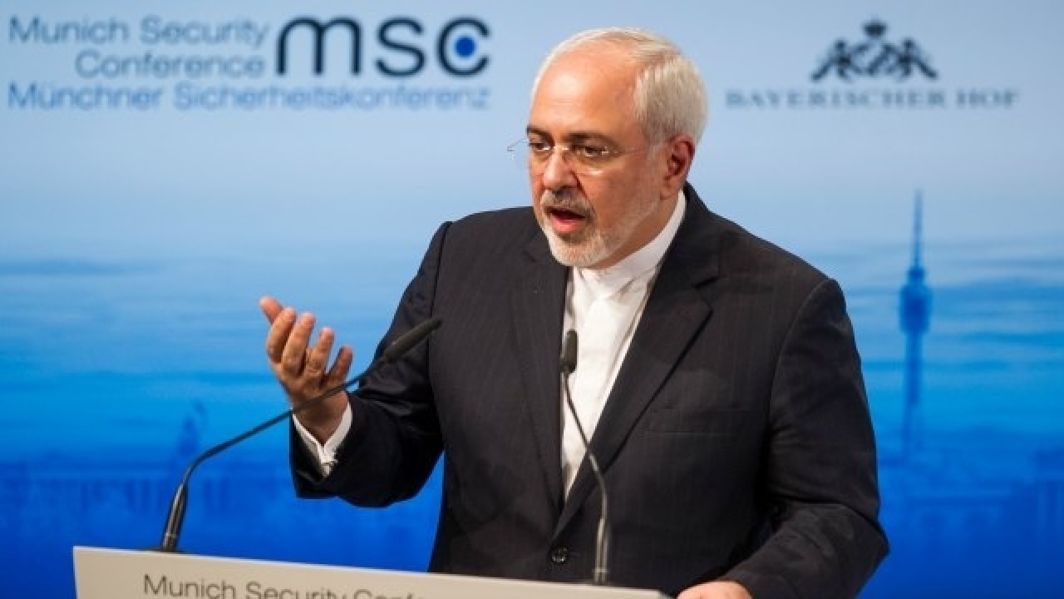
Furthermore, Israeli PM said that the countries of the world “would have to decide whether they prefer dealing with the US or with Iran, which- despite the fact it has some 80 million people as compared to Israel’s 8.5 million- has an economy about the size of Israel’s.
Iranian foreign minister Javad Zarif, was among the audience who dismissed Netanyahu’s allegations. He said it as a “cartoonish circus, which does not even deserve a response”.
Zarif also said that the recent shooting down of an Israeli F-16 after it bombed an Iranian site in Syria had shattered Israel’s so-called invincibility.”
Meanwhile, Mohsen Rezaie, the secretary of Iran’s expediency council, while speaking to Fars News Agency, warned Israel threatening to raze Tel Aviv if Benjamin Netanyahu followed through on its recent threat.
He said, “About Netanyahu’s unwise words, I should say that if they carry out the slightest unwise move against Iran, we will level Tel Aviv to the ground and will not give any opportunity to Netanyahu to flee.”
In 1979, the year when Islamic revolution succeeded in removing Pahlavi dynasty, Iran had closed down Israel’s embassy in Tehran and gave it to the representatives of Palestinian people. Relations with US were also severed when revolutionary students captured their embassy in Tehran and detained US diplomats for 444 days.
The Friday prayers in Tehran and other cities are marked with anti Israel and anti-US slogans round the year. Iran played important role in defeating Daesh (IS) in Iraq and Syria.




Latest world news
Magnitude 7 earthquake strikes Russia’s Kamchatka Peninsula
A magnitude 7 earthquake struck Russia’s Kamchatka Peninsula region on Friday. The initial report placed the earthquake at a depth of 140 kilometres.


Latest world news
S Jaishankar says India is a natural option for Russia amid Europe tensions
External Affairs Minister S Jaishankar said India remained a natural option for Russia as Moscow increasingly turned towards Asia amid strained relations with Europe. He highlighted the continuity of India-Russia ties and their significance for the balance of power in Asia.

Latest world news
Putin praises PM Modi, says he has very good ideas on Ukraine war
Russian President Vladimir Putin has praised Prime Minister Narendra Modi for repeatedly raising the need to end the Ukraine war, describing his ideas for a settlement as “very good”.


Election Commission orders voter roll revision in 17 states, UTs

Delhi Police offers 11-person limit for CJP’s Connaught Place protest

Actor Imran Khan asked to leave India after CJP protest

Mallikarjun Kharge’s ‘Your Friends’ jab at Rahul Gandhi over congress exits

Delhi deploys 25,000 personnel, installs CCTV cameras ahead of CJP march

Magnitude 7 earthquake strikes Russia’s Kamchatka Peninsula
Delhi deploys 25,000 personnel, installs CCTV cameras ahead of CJP march
Mallikarjun Kharge’s ‘Your Friends’ jab at Rahul Gandhi over congress exits
Delhi Police offers 11-person limit for CJP’s Connaught Place protest
Actor Imran Khan asked to leave India after CJP protest

Afghan Men Try To Hang With The Jet Engine Of The Aircraft in Kabul- Afghanistan News – Kabul News
Trending Top 10 News: 10000 Crore Fine on Flipkart, Apple to Launch Unique Feature, Hdfc Bank Job Ad

Trending Top 10 News: Nokia 6310, Apple sales, Bachpan ka Pyar Video Kid, Dainik Bhaskar IT Raid

Trending Top 10 News: Canada bans Indian flights, Rain in Delhi NCR, AIMIM Twitter hacked, Raj Kundra case

Trending Top 10 News: Shein India, Apple New Service, Pocket Oxygen, Oppo Launched New Phone
-
 India News22 hours ago
Election Commission orders voter roll revision in 17 states, UTs
-
 India News20 hours ago
Delhi Police offers 11-person limit for CJP’s Connaught Place protest
-
 India News22 hours ago
Actor Imran Khan asked to leave India after CJP protest
-
 India News9 hours ago
Mallikarjun Kharge’s ‘Your Friends’ jab at Rahul Gandhi over congress exits
-
 India News9 hours ago
Delhi deploys 25,000 personnel, installs CCTV cameras ahead of CJP march
-
 Latest world news8 hours ago
Magnitude 7 earthquake strikes Russia’s Kamchatka Peninsula
