
Latest world news
Palestinians to US: Don’t shut our mission, will cease all links with Washington


[vc_row][vc_column][vc_column_text]Saudis working to implement Israel-US plan in Palestine
Palestinian officials have threatened to cease all communications with Trump administration if it closes down their diplomatic mission in Washington. The mission known as General Delegation of People’s Liberation of Palestine to the US is situated some 5 km from the White House.
Senior Palestinian negotiator Saeb Erekat said on Saturday, “We will put on hold all our communications with this American administration.” He added that the decision was “very unfortunate and unacceptable,” and accused Washington of giving in to Israeli pressure.
He further noted that “we are trying to cooperate to achieve the ultimate deal.”
The Palestinian reaction came after US State Department threatened to close the Palestinians’ diplomatic office in Washington unless they enter into direct, meaningful negotiations with Israel.
According to AFP, the Palestinian foreign minister Riyad Al Malki said that US State Department had sent a letter to Palestinian Authority two days ago saying that Secretary of State Rex Tillerson had not found enough reasons to keep the office open.
He was quoted saying, “This has not happened in the past, and we have demanded clarifications from the State Department and the White House. They told us that there would be a meeting of senior legal experts on Monday. Then they would give a clear answer.” He also also said that they “will not accept any extortion or pressure.”
The Palestinian threat came on the day when Lebanese PM Saad Hariri has arrived in Paris from Saudi Arabia.
The issue of Israel’s expanding illegal settlements on Palestinian land is considered to be the most vexed issues of the region. Israel does not heed to UN resolutions asking to halt further expansion of its illegal settlements.
US President Donald Trump has recently said that he wants to work towards “the toughest deal of all” for resolving the Israel-Palestine issue in the Middle East.
While addressing UN General Assembly in September, Donald Trump said, “I think we have a pretty good shot – maybe the best shot ever – and that’s what we’re looking to do. I certainly will devote everything within my heart and within my soul to get that deal made.”
There are reports of renewed Saudi Arabian pressure on Palestinian President Mehmoud Abbas to accept the American formula. Abbas was suddenly summoned to Ryadh in the first week of November, around the same time when Lebanese PM Saad Hariri was asked to reach Riyadh.
Mehmoud Abbas obeyed the instruction and travelled to Saudi Arabia having a stopover in Cairo to meet President Abdel Fattah al-Sissi. Palestinian President met with King Salman and Crown Prince Mohammed Bin Salman in Riyadh.
According to November 6 report published by Israeli newspaper Haaretz, “The visit was not planned but after being in touch yesterday, it was decided that Abbas would make a quick visit to Saudi Arabia.”
The daily had articulated that “Saudis are also likely to raise the issue of Iran’s involvement with Palestinians, particularly in light of senior Hamas officials’ recent trip to Iran and after Hezbollah Chief Hassan Nasrallah cited a united front between Iran, Hamas and Hezbollah.”
The Palestinians are under pressure to start direct and meaningful talks with Israel. Washington says that Trump administration has 90 days to determine if Palestinians are in “direct and meaningful negotiations with Israel.” If so, the mission will be reopened.
Hanan Ashrawi, the member of PLO executive committee has said that the US was “disqualifying itself as a peace broker in the region” with its refusal to extend the law.
“Conditioning the renewal of the waiver on the Palestinians’ sticking to ‘direct and meaningful negotiations with Israel’ is actually superfluous since negotiations are nonexistent, and the current US administration has yet to present any kind of peace initiative,” she said.
According to a State Department official, Palestinian President Mahmoud Abbas has crossed the line in September when he called for an International Criminal Court (ICC) to investigate and prosecute Israeli crimes.
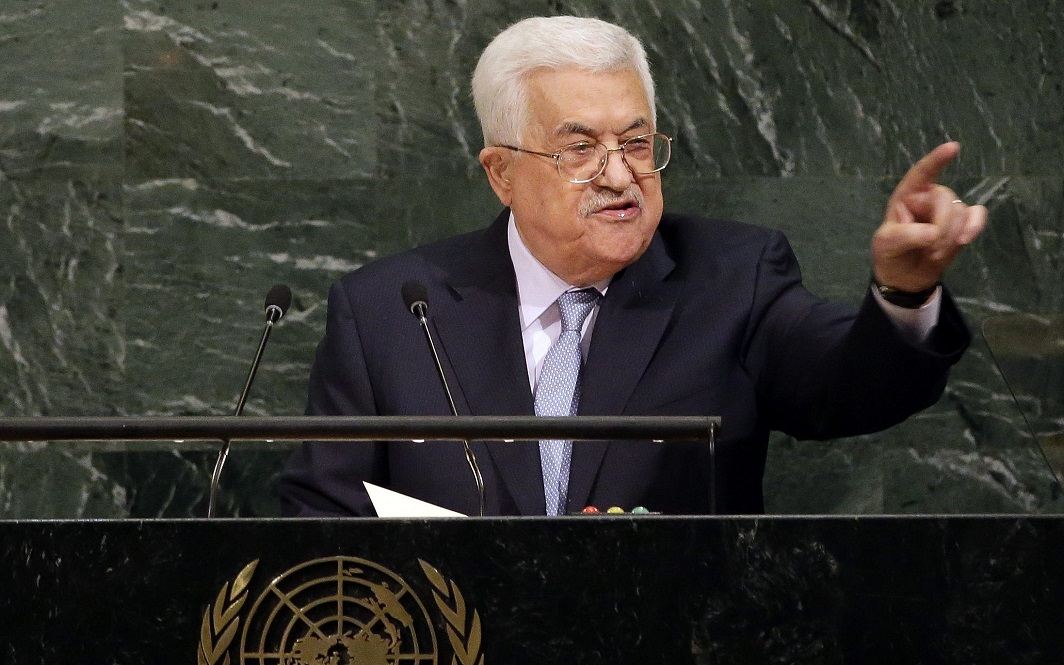
While speaking at UNGA in September, Palestinian President Mehmoud Abbas had called for the ICC to “open an investigation and to prosecute Israeli officials for their involvement in settlement activities and aggressions against our people.”
Less than a month ahead of Donald Trump’s inauguration in January this year, the UN Security Council had adopted a resolution calling on Tel Aviv to “immediately and completely cease all settlement activities in the occupied Palestinian territories, including East Jerusalem”.
More than six lakh Israelis live in 230 illegal settlements in the Palestinian territories of the West Bank and East Jerusalem. These settlements have been built after 1967.
Palestinians want the West Bank as part of a future independent Palestinian state, with East Jerusalem as its capital.
In 2014, the last round of Israeli-Palestinian talks was collapsed because of the major sticking points about the Israel’s continued settlement expansion.[/vc_column_text][/vc_column][/vc_row]





Latest world news
Magnitude 7 earthquake strikes Russia’s Kamchatka Peninsula
A magnitude 7 earthquake struck Russia’s Kamchatka Peninsula region on Friday. The initial report placed the earthquake at a depth of 140 kilometres.


Latest world news
S Jaishankar says India is a natural option for Russia amid Europe tensions
External Affairs Minister S Jaishankar said India remained a natural option for Russia as Moscow increasingly turned towards Asia amid strained relations with Europe. He highlighted the continuity of India-Russia ties and their significance for the balance of power in Asia.

Latest world news
Putin praises PM Modi, says he has very good ideas on Ukraine war
Russian President Vladimir Putin has praised Prime Minister Narendra Modi for repeatedly raising the need to end the Ukraine war, describing his ideas for a settlement as “very good”.


India-US trade deal first phase finalised, drafting underway

Election Commission orders voter roll revision in 17 states, UTs

Actor Imran Khan asked to leave India after CJP protest

Delhi Police offers 11-person limit for CJP’s Connaught Place protest

Mallikarjun Kharge’s ‘Your Friends’ jab at Rahul Gandhi over congress exits

Magnitude 7 earthquake strikes Russia’s Kamchatka Peninsula

Delhi deploys 25,000 personnel, installs CCTV cameras ahead of CJP march
Mallikarjun Kharge’s ‘Your Friends’ jab at Rahul Gandhi over congress exits
Delhi Police offers 11-person limit for CJP’s Connaught Place protest
Actor Imran Khan asked to leave India after CJP protest

Afghan Men Try To Hang With The Jet Engine Of The Aircraft in Kabul- Afghanistan News – Kabul News
Trending Top 10 News: 10000 Crore Fine on Flipkart, Apple to Launch Unique Feature, Hdfc Bank Job Ad

Trending Top 10 News: Nokia 6310, Apple sales, Bachpan ka Pyar Video Kid, Dainik Bhaskar IT Raid

Trending Top 10 News: Canada bans Indian flights, Rain in Delhi NCR, AIMIM Twitter hacked, Raj Kundra case

Trending Top 10 News: Shein India, Apple New Service, Pocket Oxygen, Oppo Launched New Phone
-
 India News23 hours ago
India-US trade deal first phase finalised, drafting underway
-
 India News21 hours ago
Election Commission orders voter roll revision in 17 states, UTs
-
 India News20 hours ago
Actor Imran Khan asked to leave India after CJP protest
-
 India News19 hours ago
Delhi Police offers 11-person limit for CJP’s Connaught Place protest
-
 India News8 hours ago
Mallikarjun Kharge’s ‘Your Friends’ jab at Rahul Gandhi over congress exits
-
 India News7 hours ago
Delhi deploys 25,000 personnel, installs CCTV cameras ahead of CJP march
-
 Latest world news7 hours ago
Magnitude 7 earthquake strikes Russia’s Kamchatka Peninsula
