English हिन्दी
Connect with us

Latest world news

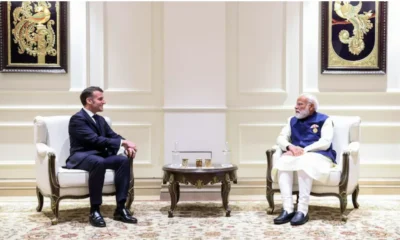
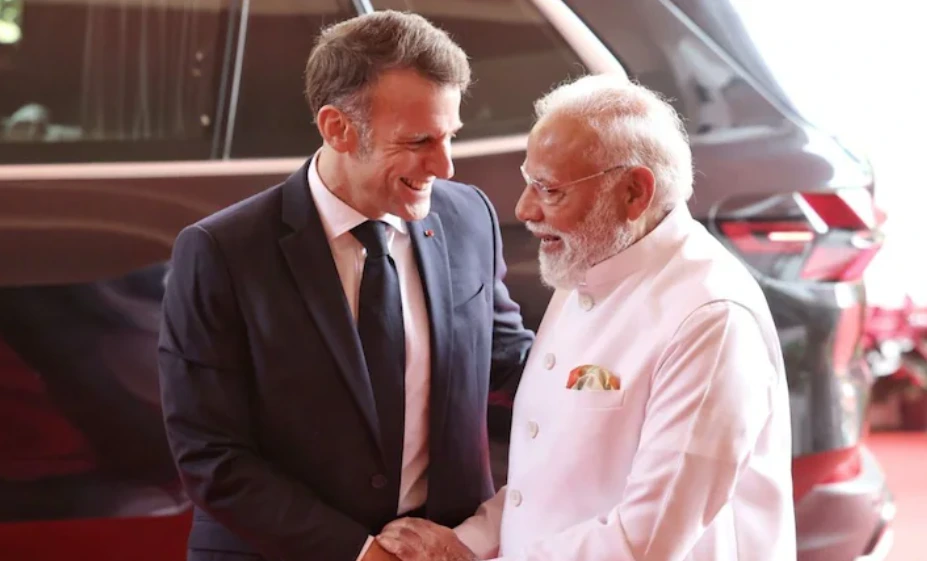
PM Modi announces Special Global Strategic Partnership between India and France

PM Modi announced a Special Global Strategic Partnership between India and France after bilateral talks with President Emmanuel Macron during his official visit to India.

Published

on

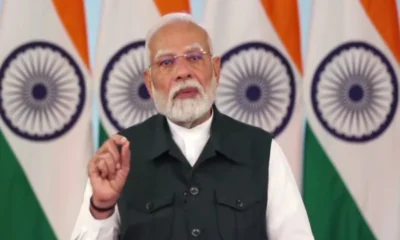
Prime Minister Narendra Modi on Monday announced a “Special Global Strategic Partnership” between India and France after holding talks with French President Emmanuel Macron. The two leaders also inaugurated the “India-France Year of Innovation 2026” during their meeting in Mumbai.

President Macron is on an official visit to India from February 17 to 19 at the invitation of Prime Minister Modi to participate in the AI Impact Summit being hosted by India.

Leaders highlight innovation, stability and multipolar world

Addressing a joint press conference with President Macron, PM Modi said the India-France partnership “knows no boundaries” and extends from “deep oceans to highest mountains.”

He stressed that innovation thrives through cooperation. “Innovation needs collaboration, not isolation,” the Prime Minister said, adding that the partnership would expand across defence, energy, space, technology and critical minerals.

PM Modi also said that at a time of global uncertainty, ties between the two countries would act as a force for global stability. He reiterated India’s support for a multipolar world order.

Shared democratic values and commitment to peace

The Prime Minister said India and France share democratic values and a commitment to the rule of law. He added that both nations believe reform of global institutions is necessary to address contemporary global challenges.

He further stated that India and France support peace efforts in regions including Ukraine, West Asia and the Indo-Pacific. Both countries, he said, are united in their commitment to eradicate terrorism in all its forms and manifestations.

Macron’s fourth India visit

This marks President Macron’s fourth visit to India and his first visit to Mumbai. The “India-France Year of Innovation 2026” aims to showcase the expanding strategic and technological cooperation between the two nations.

The two sides are also looking ahead to a potential multibillion-dollar fighter jet deal, reflecting the growing depth of defence cooperation between India and France.

Latest world news

Muhammad Yunus references India’s Seven Sisters, China ties in farewell speech

Muhammad Yunus, in his farewell speech as Bangladesh’s chief adviser, stressed sovereignty in foreign policy, referenced India’s Seven Sisters and highlighted China-backed projects amid domestic criticism.

Published

on

Bangladesh’s outgoing Chief Adviser Muhammad Yunus used his farewell address to underline a sovereignty-focused foreign policy, making pointed references to India’s northeastern region and deepening ties with China at a time of mounting criticism at home.

Facing sustained scrutiny over his interim administration’s handling of democratic transition and minority protection, Yunus projected an assertive tone in his closing speech. He maintained that Bangladesh had restored its “sovereignty, dignity, and independence” in foreign affairs and was “no longer guided by others’ directives.”

His remarks were widely viewed as directed at India, Bangladesh’s largest neighbour, particularly after he referred to regional economic integration involving Nepal, Bhutan and the “Seven Sisters” — a term commonly used for India’s northeastern states.

Regional integration and economic vision

Yunus spoke about leveraging Bangladesh’s maritime access and positioning the country as a gateway to broader regional trade.

“Our open seas are not just borders—they are gateways to the global economy. With Nepal, Bhutan, and the Seven Sisters, this region has immense economic potential. Economic zones, trade agreements, and duty-free market access can establish us as a global manufacturing hub,” he said.

By grouping India’s northeastern states alongside sovereign nations within a shared economic framework, Yunus appeared to outline a regional model centred on Bangladesh’s ports and connectivity infrastructure. The formulation is likely to draw attention in New Delhi, which has invested significantly in connectivity projects through Bangladesh to better integrate its northeast with the rest of India.

His remarks suggested that future access and opportunity for the landlocked northeastern region could be shaped by Bangladesh’s strategic and economic decisions.

China factor and strategic balance

Yunus also emphasised what he described as a policy of “strategic balance,” highlighting expanding engagement with China, Japan, the United States and Europe.

He cited progress on China-backed initiatives, including the Teesta River project and a 1,000-bed international hospital in Nilphamari. The Teesta project is located near India’s strategically sensitive Siliguri corridor.

“We have also deepened cooperation with China. Significant progress has been made on the Teesta River project and a 1,000-bed international hospital in Nilphamari,” Yunus said.

Rather than directly addressing regional sensitivities, his speech underscored Bangladesh’s intent to pursue partnerships based on what he described as national interest and mutual respect.

Military modernisation and domestic criticism

The outgoing chief adviser also referred to military modernisation, stating that Bangladesh had begun strengthening its armed forces to “counter any aggression.” Though not directed at any specific country, the phrasing added to the speech’s firm tone.

Notably, Yunus did not directly address criticism over his government’s handling of communal tensions and minority protection during his 18-month tenure. His interim administration came to power following widespread unrest after years of former Prime Minister Sheikh Hasina’s rule.

Rights groups and minority representatives had earlier raised concerns about attacks on Hindu communities in several districts, including incidents of vandalism and intimidation. Critics have argued that the interim government’s response was uneven and that it fell short of fully restoring democratic confidence.

As Yunus exits office, his farewell address presented a narrative focused on foreign policy recalibration and national assertion, while leaving domestic controversies largely unaddressed.

Continue Reading

Latest world news

Bangladesh’s BNP seeks stronger India ties based on mutual respect

Bangladesh’s new BNP-led government has signalled a diplomatic reset with India, emphasising mutual respect, trade and broader people-to-people engagement.

Published

on

Tarique Rehman

The newly elected government in Bangladesh, led by Tarique Rahman and the Bangladesh Nationalist Party (BNP), has expressed its intent to strengthen ties with India through mutual respect, trade and deeper people-to-people engagement.

Humayun Kabir, who oversees international relations for Rahman and is expected to play a key role in the new administration, said the focus will be on building stronger cooperation between citizens of both countries rather than limiting ties to official exchanges.

He indicated that India would be among the countries the new leadership plans to visit, though no specific timeline was shared. “Obviously there are certain domestic priorities and then international engagements. Of course India will be one of the countries that we will visit among other countries in the region,” Kabir said in an interaction with media.

Expanding engagement beyond official visits

Kabir underlined the importance of expanding the scope of bilateral relations beyond high-level diplomatic visits. While acknowledging that reciprocal visits between senior officials are a normal feature of ties between neighbouring nations, he stressed the need to widen engagement across broader sections of society.

He said the BNP-led government intends to deepen cooperation through trade and investment while strengthening grassroots-level connections.

On regional balance and Pakistan ties

Responding to questions about Bangladesh’s approach towards Pakistan during the interim administration led by Muhammad Yunus, Kabir said Dhaka’s foreign policy would not be guided by choosing sides in regional tensions.

“It’s normal and we need to normalise relations in the region and regardless of the tensions between India and Pakistan, for us it is not to take sides on this issue,” he said, adding that relations would be shaped by mutual respect and national interest.

Kabir also criticised former prime minister Sheikh Hasina, alleging that her foreign policy approach was perceived as one-sided in its engagement with India. He said the new government seeks to avoid what he described as a country-centric or country-dependent model of diplomacy.

New Delhi’s cautious optimism

From India’s perspective, the decisive electoral outcome in Bangladesh, which delivered a landslide to the BNP, marks the end of the interim phase and opens the possibility of a diplomatic reset.

Indian officials are said to be cautiously optimistic about engaging with Rahman’s leadership. While acknowledging past differences with BNP governments, New Delhi believes the new administration may adopt a pragmatic approach shaped by economic priorities and regional stability concerns.

Continue Reading

Latest world news

Finland PM Petteri Orpo to attend India AI Impact Summit, meet PM Modi

Finland Prime Minister Petteri Orpo will visit India from February 17 to 20 to attend the AI Impact Summit and hold bilateral talks with PM Narendra Modi.

Published

on

finland pm modi

Petteri Orpo will travel to India from February 17 to 20 to participate in the India AI Impact Summit and hold bilateral discussions with Narendra Modi.

Prime Minister Orpo is scheduled to meet PM Modi on February 18. He will also attend the India AI Impact Summit on February 19, which is being hosted in New Delhi.

The Finnish Prime Minister is accompanied by a business delegation comprising representatives of 22 Finnish companies. According to an official release, the visit aims to strengthen cooperation between the two countries, particularly in digitalisation and sustainability.

Focus on AI governance and innovation

The India AI Impact Summit, being held from February 16 to 20 at Bharat Mandapam, will bring together Heads of State and Government, international organisations, AI experts and leading companies from across the globe.

The summit is designed to promote a shared understanding of global AI governance principles and foster international cooperation. Prime Minister Orpo had also taken part in the AI Action Summit in Paris in 2025.

“At the summit, we will highlight Finland’s strengths in the fields of AI policy and innovation. Finland has world-class expertise in AI and the potential to lead the way in its use. At the same time, we will also promote the safe and responsible use of AI,” Orpo said, according to the release.

He noted that geopolitical and economic competition is intensifying, underlining the need for Finland to remain active in global technology discussions. He also emphasised cooperation with like-minded countries while seeking broader international consensus.

During the summit, Orpo will deliver Finland’s national address, visit country pavilions and participate in side events organised by the Finnish Innovation Fund Sitra and National Association of Software and Service Companies. The programme also includes a dinner hosted by PM Modi and other high-level engagements.

Strategic partnership and trade opportunities

The release highlighted India’s growing global role and described bilateral ties as strong and expanding. The inauguration of Finland’s new Consulate General in Mumbai in 2022 was cited as a significant step in strengthening engagement.

Orpo said Finland aims to deepen cooperation with India in the areas of digitalisation and sustainability, reinforcing the new strategic partnership between the two nations.

He also referred to the conclusion of negotiations on the EU-India Free Trade Agreement on January 27, 2026. Talks on the agreement had been underway since 2007, with some interruptions. The pact is expected to improve access for European companies to India’s expanding market and enhance the broader EU-India partnership.

Summit structure and agenda

The India AI Impact Summit will revolve around three pillars — People, Planet and Progress. Discussions will focus on employment and skilling, sustainable and energy-efficient AI, and economic as well as social development.

Seven thematic working groups, co-chaired by representatives from the Global North and Global South, will present deliverables such as proposals for AI Commons, trusted AI tools, shared compute infrastructure and sector-specific AI use case compendiums.

The event will also address AI safety, governance, ethical use, data protection and India’s approach to sovereign AI, including the development of indigenous foundation models for strategic sectors.

An AI Impact Expo will showcase practical AI applications in healthcare, agriculture, education, climate action, energy efficiency and accessibility. The summit will further spotlight national skilling initiatives, including “Yuva AI for All”, a free course aimed at building basic AI awareness among students and professionals.

Continue Reading

Trending

© Copyright 2022 APNLIVE.com