
Latest world news
Russians voting to elect next President, Putin getting huge support


In a major democratic exercise Russians are casting their ballots in the presidential election. The country spread into eleven time zones began polls in the Far East region of Kamchatka to the western exclave of Kaliningrad. Eight candidates are vying for the post of president.
According to Russian Television (RT), the vote will last for a total of 22 hours. The first polling stations welcomed early voters at 8:00 am local time [20:00 GMT] on Saturday while polling started in Moscow nine hours later, at 5:00 am GMT, and will proceed until the polls close at 8:00 pm [17:00 GMT].
The incumbent Russian President Vladimir Putin who is running as an independent while other candidates for the highest executive post including Communist Party candidate Pavel Grudinin, the liberal Yabloko party candidate Grigory Yavlinsky, Liberal Democratic Party of Russia candidate Vladimir Zhirinovsky, Russian All-People’s Union candidate Sergey Baburin, and Maksim Suraykin from the Communists of Russia voted in Moscow. However, Boris Titov, the Party of Growth candidate, voted along with his family in the village of Abrau-Durso in the southern Krasnodar region.
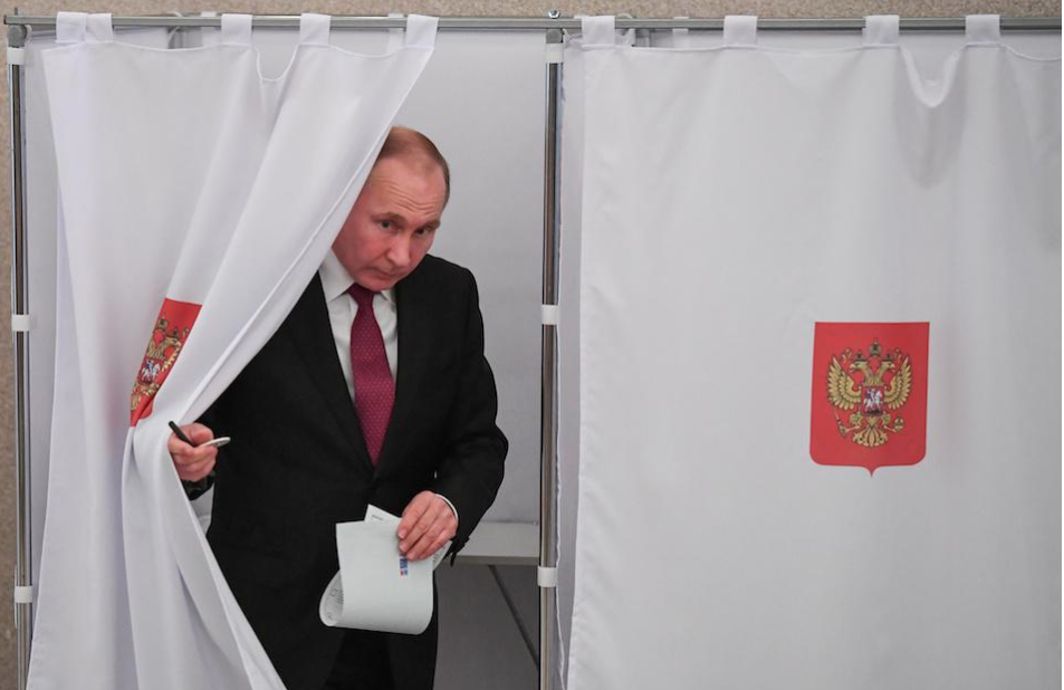 The reports from Moscow believe that President Vladimir Putin is expected to win the elections for the fourth time since he is leading in the polls by a wide margin.
The election results are expected to trickle in by the end of the day and a stage where Putin is expected to deliver his victory address has already been set up in Moscow’s city centre, near the Kremlin.
Nearly 109 million voters have the right to cast their ballot in approximately 100,000 voting stations across the 85 regions and republics of the Russian Federation. Russian citizens are also casting their votes in their embassies and other representative offices in 145 countries.
Polling stations on 38 cross-country trains, hospitals and military bases were also provided. A virtual voting station in space for Russian astronaut, Anton Shkaplerov, current crew commander at the International Space Station, to cast his vote has also been made available.
Residents of Crimea, where Putin held his last public rally on Wednesday, will vote for the first time in Russian presidential elections. Elections are being coincided with the fourth anniversary of the annexation of the peninsula. Crimea figured prominently in Putin’s election campaign.
Meanwhile, the opposition leader Alexey Navalny, who was barred from running in the elections over a fraud conviction in a court case has called for a boycott of the vote. He has claimed that it was politically motivated.
On Friday, Russian news outlet RBC reported that the Kremlin has indicated that a turnout of 65 percent would be considered “good”. During the 2012 presidential elections, 65.3 percent of voters turned up to the voting.





Latest world news
S Jaishankar says India is a natural option for Russia amid Europe tensions
External Affairs Minister S Jaishankar said India remained a natural option for Russia as Moscow increasingly turned towards Asia amid strained relations with Europe. He highlighted the continuity of India-Russia ties and their significance for the balance of power in Asia.


Latest world news
Putin praises PM Modi, says he has very good ideas on Ukraine war
Russian President Vladimir Putin has praised Prime Minister Narendra Modi for repeatedly raising the need to end the Ukraine war, describing his ideas for a settlement as “very good”.
Latest world news
S Jaishankar calls Pakistan a “serial practitioner of terrorism” at UN
S Jaishankar criticised Pakistan at the UN General Assembly, referring to a “serial practitioner of terrorism” and warning against attempts to normalise terrorism.


CJP claims Saurav Das, Ashutosh Ranka detained at Jantar Mantar

Supreme Court stays defamation case against Rahul Gandhi over PM Modi remarks

Rahul Gandhi hosts high tea for INDIA bloc after Gyanesh Kumar protests

Amit Shah attacks Rahul Gandhi over Congress poll losses, questions SIR row

L Murugan quits Union ministry to strengthen BJP in Tamil Nadu

PM Modi speaks to Mark Carney as India and Canada push to strengthen ties

S Jaishankar says India is a natural option for Russia amid Europe tensions

CJP leaders Saurav Das, Ashutosh Ranka, Ajinkya Shinde sent to 5-day judicial custody

BJP focuses on religion as opposition pushes BDM strategy in UP
L Murugan quits Union ministry to strengthen BJP in Tamil Nadu

Afghan Men Try To Hang With The Jet Engine Of The Aircraft in Kabul- Afghanistan News – Kabul News
Trending Top 10 News: 10000 Crore Fine on Flipkart, Apple to Launch Unique Feature, Hdfc Bank Job Ad

Trending Top 10 News: Nokia 6310, Apple sales, Bachpan ka Pyar Video Kid, Dainik Bhaskar IT Raid

Trending Top 10 News: Canada bans Indian flights, Rain in Delhi NCR, AIMIM Twitter hacked, Raj Kundra case

Trending Top 10 News: Shein India, Apple New Service, Pocket Oxygen, Oppo Launched New Phone
-
 India News23 hours ago
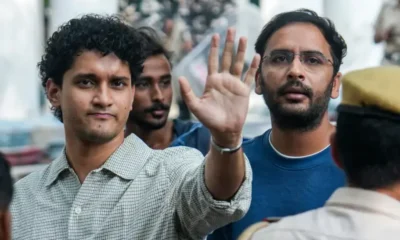
CJP claims Saurav Das, Ashutosh Ranka detained at Jantar Mantar
-
 India News21 hours ago
Supreme Court stays defamation case against Rahul Gandhi over PM Modi remarks
-
 India News13 hours ago
Rahul Gandhi hosts high tea for INDIA bloc after Gyanesh Kumar protests
-
 India News13 hours ago
Amit Shah attacks Rahul Gandhi over Congress poll losses, questions SIR row
-
 India News12 hours ago
L Murugan quits Union ministry to strengthen BJP in Tamil Nadu
-
 India News11 hours ago
BJP focuses on religion as opposition pushes BDM strategy in UP
-
 India News41 mins ago
CJP leaders Saurav Das, Ashutosh Ranka, Ajinkya Shinde sent to 5-day judicial custody
-
 Latest world news28 mins ago
S Jaishankar says India is a natural option for Russia amid Europe tensions

