English हिन्दी
Connect with us

Latest world news

Thailand, Cambodia slug it out over emerald triangle dispute

Published

on

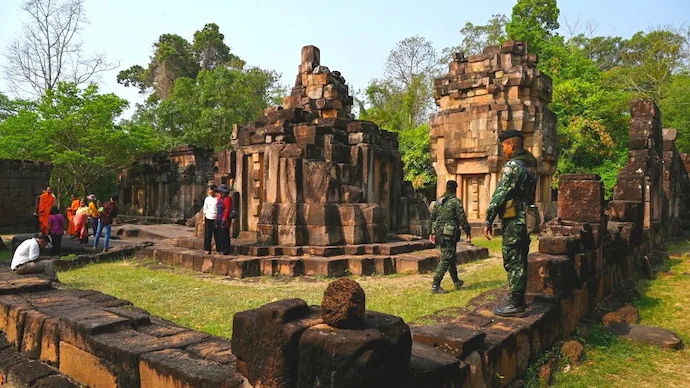
War has broken out in South East Asia Violence between Thailand and Cambodia. The violence began at the Thai-Cambodia border on Thursday, resulting in 15 casualties, near the Ta Muen Thom temple in Thailand’s Surin Province.

Thai authorities accused Cambodia of starting the war by using drones to conduct aerial surveillance near Thai military outposts. Attempts at de-escalation by the Thai military failed, leading to heavy exchange of fire in self-defence around 8:20 AM local time. Cambodia, however, claims Thailand infringed upon its sovereignty.

The clashes featuring small arms fire, rocket attacks, artillery shelling, and airstrikes persisted into Friday along the long-contested border. While the countries have had occasional disputes that quickly de-escalated, this confrontation is the most violent in over a decade.

Thai authorities triggered a Level 4 threat, proceeding with a full closure of border checkpoints. The Thai interior ministry reported that the conflict has disrupted four provinces, with 40,000 civilians being evacuated from 86 villages. It added that 106,672 people were forced to seek shelter because of the conflict. On the Cambodian front, families in the bordering villages moved away with their belongings in homemade tractors from the border, settling into makeshift camps.

The trigger switch of the conflict was a landmine blast on Wednesday, which injured five Thai soldiers. Thai authorities claimed Cambodia laid new Russian-made mines, a claim which Cambodia dismissed as baseless accusations, blaming leftover artillery from previous conflicts.

The Emerald Triangle, home to several ancient temples, is at the heart of the conflict. The border dispute stems from the controversy surrounding the demarcation between Cambodia and Thailand by the French in the colonial era.

According to the French-drawn map, Ta Muen Thom Temple, a Khmer Hindu complex, falls under Cambodian territory—a decision initially accepted and then argued by Thailand. In 1962, the International Court of Justice (ICJ) sided with Cambodia, ordering Thailand to withdraw its troops and return any artefacts removed after 1954. In 2011, the ICJ reaffirmed Cambodia’s position, noting that Thailand had previously accepted the boundary map following a clash. This ruling was further upheld by the ICJ in 2013.

The diplomatic fallout was set in motion when Cambodia’s senior leader Hun Sen leaked a phone conversation between him and Thai Prime Minister Paetongtarn Shinawatra about the disputed border in June. Shinawatra referred to Hun as “uncle” while criticising one of her military commanders. She was subsequently suspended with Phumtham Wechayachai being installed as the acting Prime Minister. The reasons behind Hun Sen’s actions are unclear, especially since the two families shared a decades-long friendship.

Latest world news

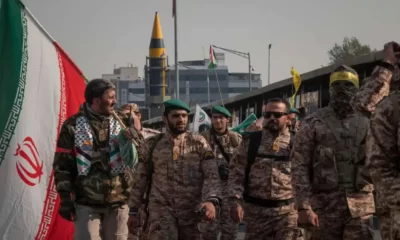
Nearly 2,000 killed as Iran acknowledges high death toll in nationwide protests

Iran has for the first time acknowledged that nearly 2,000 people were killed during nationwide protests sparked by economic distress, as authorities continue a strict security crackdown.

Published

on

unrest in iran

Iran has acknowledged for the first time that close to 2,000 people, including members of the security forces, have been killed during two weeks of widespread protests across the country, according to an Iranian official.

The official said the deaths occurred amid violent clashes during nationwide unrest that erupted over worsening economic conditions. The figure marks the highest acknowledged toll so far from the current wave of demonstrations, which has posed one of the most serious internal challenges to Iran’s leadership in recent years.

Official blames “terrorists” for violence

According to the official, those described as “terrorists” were responsible for the deaths of both protesters and security personnel. However, no detailed breakdown was provided regarding how many civilians or security forces were killed.

Iran’s clerical leadership has accused the United States and Israel of instigating unrest in the country, alleging that external actors exploited public anger and escalated the demonstrations into violent confrontations.

Dual approach to protests

Authorities have attempted to balance their response by distinguishing between what they describe as legitimate protests over economic hardship and acts of violence. While acknowledging public frustration over living conditions, the government has simultaneously enforced a strict security crackdown to contain the unrest.

The protests are reported to be the most significant challenge to the Iranian establishment in at least three years and come at a time of heightened international pressure following military strikes by the US and Israel last year.

Rights groups cite arrests and casualties

Human rights organisations had earlier reported that hundreds of people were killed during the protests and said thousands were detained as security forces moved to suppress demonstrations across several cities.

The flow of information from inside Iran has been severely restricted due to communications curbs, including recent internet blackouts, making independent verification difficult.

Clashes captured on video

Despite restrictions, multiple videos circulating online have shown intense nighttime clashes between demonstrators and security forces. Some of these visuals, verified by media, depict gunfire, burning vehicles, and damage to buildings, highlighting the scale of violence during the unrest.

Continue Reading

Latest world news

Khamenei warns US against deceitful actions as Trump announces 25% tariff threat

Ayatollah Ali Khamenei has warned the United States against “deceitful actions” after Donald Trump announced a 25% tariff threat, as protests continue to challenge Iran’s leadership.

Published

on

khamenei

Iran’s Supreme Leader Ayatollah Ali Khamenei has warned the United States to stop what he described as “deceitful actions” and reliance on “traitorous hirelings,” responding to escalating pressure from US President Donald Trump, including a proposed 25 per cent tariff on countries trading with Iran.

In a post on X, Khamenei said the Iranian nation had demonstrated its resolve in the face of external pressure and issued a warning to American politicians. He asserted that Iran remained strong, aware of its adversaries, and firmly present on the political stage.

Protests pose major challenge to Iran’s leadership

Khamenei’s remarks come amid more than two weeks of nationwide demonstrations that began over economic grievances and have since grown into one of the most serious challenges to Iran’s theocratic system since the 1979 Islamic revolution.

Rights groups have claimed that at least 646 people have been killed during the protests, which have spread across several cities. The unrest has intensified international scrutiny of Tehran’s response and further strained relations with Washington.

Trump signals economic and military options

President Trump has repeatedly warned Iran over its handling of the protests, stating that the United States was prepared to act if demonstrators were killed. He has said possible US responses range from low-risk to high-risk options, depending on the ultimate objective.

While Trump has previously criticised “regime change” as a foreign policy goal, citing past US involvement in Iraq, he has continued to apply economic pressure on Tehran. On Monday, he announced a 25 per cent tariff on countries that trade with Iran, marking a significant escalation in sanctions-linked measures.

Trump has also spoken about efforts to restore internet access in Iran after authorities imposed shutdowns during the protests.

Limited communication revealed

Despite the sharp public rhetoric, both governments have acknowledged that some level of communication has taken place. These contacts were reportedly coordinated through Trump’s envoy Steve Witkoff.

Iran and the United States have remained adversaries since the 1979 revolution that overthrew the pro-Western shah. Any major shift in Iran’s political system would have far-reaching consequences for the Middle East, making the current standoff closely watched across the region.

Continue Reading

Latest world news

Trump may visit India next year as US envoy calls New Delhi Washington’s most essential partner

The US has described India as its most essential global partner, with ambassador-designate Sergio Gor indicating a possible visit by President Donald Trump next year.

Published

on

trump modi

The United States has said that no country is more essential to its global interests than India, with US ambassador-designate Sergio Gor indicating that President Donald Trump may visit India within the next year or two.

Speaking at the US Embassy in New Delhi, Gor highlighted the close personal rapport between Trump and Prime Minister Narendra Modi, describing their relationship as genuine and resilient even in times of disagreement.

India-US ties anchored at the highest level

Gor said the partnership between India and the United States is rooted not only in shared strategic interests but also in strong leadership-level engagement.

He noted that while differences may arise between the two countries, they are resolved through dialogue, reflecting the maturity of the relationship. According to him, India’s scale and global standing make bilateral cooperation both complex and crucial.

Trade talks to resume from January 12

The ambassador-designate confirmed that the next round of India-US trade negotiations will begin on Tuesday, January 12. Acknowledging the challenges involved, Gor said both sides remain committed to reaching an agreement.

Trade, he said, is a vital pillar of bilateral ties, alongside cooperation in areas such as security, counter-terrorism, energy, technology, education and health.

Trump-Modi friendship described as ‘real’

Gor reiterated that he has personally witnessed the bond between Trump and Modi during international engagements, stressing that the friendship goes beyond diplomacy.

Recalling conversations with the US President, he said Trump often speaks positively about his previous India visit and his relationship with the Indian Prime Minister.

Possible Trump visit to India

Indicating a potential presidential visit, Gor said Trump could travel to India in the next one or two years. He described his own appointment as an effort to elevate the bilateral partnership to a new level, calling the India-US relationship a meeting point of the world’s oldest and largest democracies.

India to join Pax Silica alliance

Gor also announced that India will be invited to join the US-led Pax Silica alliance as a full member next month.

The initiative aims to develop a secure, resilient and innovation-driven global silicon supply chain, reinforcing India’s role in strategic technology partnerships.

Continue Reading

Trending

© Copyright 2022 APNLIVE.com