Instead of protecting victims of such incidents, the perpetrators not only enjoy immunity from the law, but also the administration in BJP-ruled states punishes victims. The use of false cases and arrests under draconian laws like UAPA are the preferred weapons.
2021 is about to melt into 2022 in less than 48 hours. Majoritarian politics continued to hold its way over the country this year. But this year, it was not just Muslims but also Christians who felt the heat of Hindutva attacks across India as right-wing Hindu groups waged a culture war against them. Several churches have been attacked and statues of Jesus broken, the latest being in Ambala’s Army Cantonment, the scene of many a Rudyard Kipling work.
December saw targeted hate speeches against minorities. The one at Haridwar saw many participants vow to even take up weapons to redeem their faith by killing non-Hindus. The Hindu right-wing has waged war against Christians accusing them of religious conversion through their missionary work and Muslims for Love Jihad, an Islamophobic trope singling out Muslim men for falling in love with Hindu women and then converting them into Islam. However, such allegations targeting minorities have become a cornerstone of Hindu right-wing nationalism.
The Association for the Protection of Civil Rights, United Against Hate, and United Christian Forum jointly released a fact-finding report highlighting the series of attacks on churches and hate speech against Christians across India. According to the report, India has recorded more than 300 attacks on Christians and worship places within the first nine months of 2021.
Of the 305 incidents, 66 took place in Uttar Pradesh, 47 in Chhattisgarh and at least 32 in Karnataka.
While another report of the United Christian Forum had claimed that India reported more than 400 incidents of violence against Christians across the country. Among those, the incident involved storming churches, burning Christian literature, attacking schools and assaulting worshipers.
However, it is shocking that only 30 FIRs have been registered so far in these cases. On many occasions, restrictions were imposed on people to carry out religious ceremonies.
First on the list of attacks is the one on October 3, where a mob of 250-300 persons barged into a Roorkee church in Uttarakhand and attacked people, destroyed CCTV cameras, and vandalized church premises. Many reports said there were only 12 inside the church for prayers when the attack took place.
Apart from this, the attacks on churches were also reported from BJP-ruled states Haryana, Uttar Pradesh, Madhya Pradesh and Karnataka. And these attacks have taken place over allegations of religious conversion. Christians prayers meetings have also been stopped by the same Hindu mob who had stopped Jumma namaz in the so-called Millennium City, Gurugram. The city also saw an attack on a school’s Christmas celebration.
In the last week of 2021, the bank accounts of Mother Teresa’s Missionaries of Charity were frozen over FCRA claims, West Bengal Chief Minister Mamata Banerjee tweeted about the heartlessness behind the move affecting the charity of the outfit.
Some 22,000 patients and employees have been left without food and medicines, the West Bengal Chief Minister had tweeted.
The Missionaries of Charity was founded in 1950 by the late Mother Teresa, a Catholic nun from Macedonia, who moved to India and took care of the destitute and the poor and won the Nobel Peace Prize in 1979 for her work.
Hate speeches have been curtailed by some norms, keeping them among friends and family. The last week of 2021 saw more public hate speeches in the country. The controversial Dharam Sansad organized in Haridwar, other such events in Delhi and Chattisgarh saw where priests and leaders taking an oath to kill Muslims, and even urged Hindus to arm themselves against the Muslims to make India a Hindu Rashtra.
With next year’s assembly elections in Uttar Pradesh, Uttarakhand, Punjab, Goa and Manipur due shortly, the increase in such hate is an attempt at reviving polarisation.
The violence in Tripura, where VHP hoodlums attacked Muslims and vandalized some of their mosques and Friday prayers disruptions at designated places at Gurugram were also the prime example of rising hate against Muslims.
Anti-Hindu violence in parts of Bangladesh triggered violence in Tripura. The communal riots erupted on October 26 after a rally organized by the Vishwa Hindu Parishad to protest against the attacks on Hindus in Bangladesh turned violent.
The VHP and the Hindu Jagran Manch organized rallies in different parts of the state to protest against the violence in Bangladesh. Later, the VHP and other right-wing groups denied any role in the violence.
The anti-Hindu violence in Bangladesh, which erupted during the Durga Puja festival, was triggered by rumours that the Quran had been insulted in one of the pavilions set up for the celebrations. Seven people were killed, several temples desecrated, and hundreds of houses and business establishments of the Hindu minority were torched.
However, many Muslim groups alleged political conspiracy claiming that the minorities were being targeted in the north eastern state. There were many arrests and some journalists covering the riots in Tripura were also detained. Those who tweeted in favour of Tripura’s Muslims also found themselves being served notices by the state police.
The Uttar Pradesh government had faced severe criticism from the opposition over the killings of Kasganj youth Altaaf in mysterious circumstance. He had been arrested on suspicion of eloping with a Hindu woman. Again, the smoldering love jihad theory. The law and order in Uttar Pradesh, which had earlier won so much praise from PM Modi and other BJP leaders, has been roundly criticized by opposition parties in Uttar Pradesh.
The family of the deceased had alleged that he was tortured by police in the lockup, which led to his death. Police claimed the accused killed himself using the drawstring of his jacket’s hood when he went to the lockup washroom.
Apart from mob lynching, Muslim street vendors in Ahmedabad and some parts of Madhya Pradesh and other parts of the country have been threatened and disallowed from pursuing their livelihood. In Ahmedabad, the Hujarat High Court stepped in to tell off the civic authority to desist from such measures. In Assam, poor peasant families cultivating land for decades were brutally evicted only because they belonged to the Muslim minority. The point-blank shooting of Moinal Haque by police personnel caught on video and the subsequent death dance by a photographer with the remains indeed were a mirror for the crumbling facade of secular India, now overtaken by an aggressive mindless herd mentality spewing hate and violence.
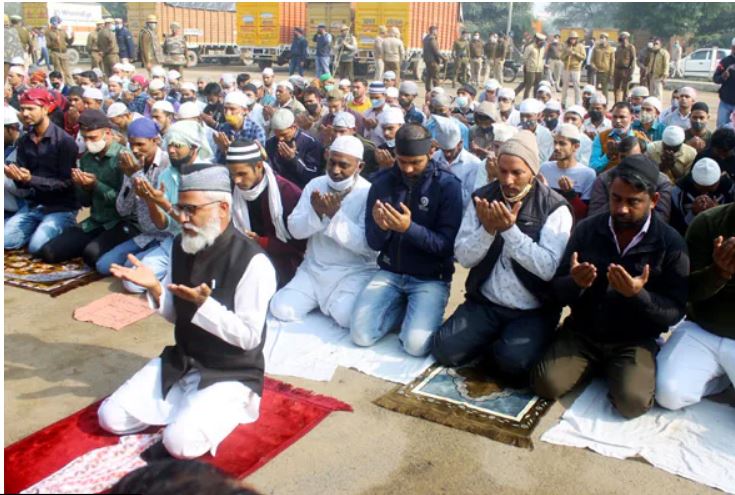
An empty desolate car park outside Sector 37 police station in Gurugram where Muslims had performed Friday prayers for more than a decade turned into a battleground of faith. Hindu right-wing groups staged protests, sloganeered during Friday prayers and held a Govardhan puja at the namaz site just to deny namaz here.
Instead of protecting victims of such incidents, the perpetrators not only enjoy immunity from the law, but also the administration in BJP-ruled states punishes victims. The use of false cases and arrests under draconian laws like UAPA are the preferred weapons.
Chaos mars Lionel Messi’s Kolkata GOAT Tour event as fans protest poor arrangements
Lionel Messi’s brief appearance in Kolkata was overshadowed by chaos as fans alleged mismanagement, prompting an apology and an official enquiry by the state government.
Lionel Messi’s much-anticipated appearance in Kolkata turned chaotic on Saturday after thousands of fans alleged mismanagement at the Yuva Bharati Krirangan, leaving many unable to even see the Argentine football icon despite holding high-priced tickets
Fans express anger over limited access
The Kolkata leg of the G.O.A.T. Tour was billed as a special moment for Indian football fans, with ticket prices ranging between Rs 5,000 and Rs 25,000. However, discontent grew rapidly inside the stadium as several attendees claimed their view of Messi was obstructed by security personnel and invited guests positioned close to him.
As frustration mounted, some fans resorted to throwing chairs and bottles from the stands, forcing organisers to intervene and cut the programme short.
Event cut short amid disorder
Messi reached the venue around 11:15 am and remained there for roughly 20 minutes. He was expected to take a full lap of the stadium, but that plan was abandoned as the situation deteriorated soon after he emerged from the tunnel.
The disorder also meant that prominent personalities, including actor Shah Rukh Khan, former India cricket captain Sourav Ganguly and West Bengal Chief Minister Mamata Banerjee, could not participate in the programme as scheduled.
Organisers whisk Messi away
With fans breaching security and some vandalising canopies set up at the Salt Lake Stadium, the organisers, along with security personnel, escorted Messi out of the venue to prevent further escalation.
Several attendees described the event as poorly organised, with some fans calling it an “absolute disgrace” and blaming mismanagement for spoiling what was meant to be a celebratory occasion.
Mamata Banerjee apologises, orders enquiry
Chief Minister Mamata Banerjee later issued a public apology to Messi and the fans, expressing shock over the mismanagement. She announced the formation of an enquiry committee headed by retired Justice Ashim Kumar Ray, with senior state officials as members.
The committee has been tasked with conducting a detailed probe, fixing responsibility and suggesting steps to ensure such incidents are not repeated in the future.
Delhi enforces new law to regulate fees in private schools
Delhi has notified a new law to regulate private school fees, capping charges, banning capitation fees and mandating transparent, committee-approved fee structures.
The Delhi government has officially brought into force a new law aimed at regulating fees in private schools, notifying the Delhi School Education (Transparency in Fixation and Regulation of Fee) Act, 2025. The notification was issued on Wednesday, nearly four months after the Bill was cleared by the Delhi Assembly and received approval from Lieutenant Governor V K Saxena.
The Act establishes a comprehensive framework to govern how private unaided schools fix and collect fees, with a clear emphasis on transparency, accountability and relief for parents facing repeated fee hikes.
What the new Act provides for
Under the legislation, private unaided recognised schools can charge fees only under clearly defined heads such as registration, admission, tuition, annual charges and development fees. The law caps registration fees at Rs 25, admission charges at Rs 200 and caution money at Rs 500, which must be refunded with interest. Development fees have been restricted to a maximum of 10 per cent of the annual tuition fee.
Schools have also been directed to disclose all fee components in detail and maintain separate accounts for each category. Any fee not specifically permitted under the Act will be treated as an unjustified demand.
The law strictly prohibits the collection of capitation fees, whether direct or indirect. It further mandates that user-based service charges must be collected strictly on a no-profit, no-loss basis and only from students who actually use the service.
Accounting norms and restrictions on surplus funds
To ensure financial transparency, schools are required to follow prescribed accounting standards, maintain fixed asset registers and make proper provisions for employee benefits. The transfer of funds collected from students to any other legal entity, including a school’s managing society or trust, has been barred.
Any surplus generated must either be refunded to parents or adjusted against future fees, according to the notification.
Protection for students and parents
The Act also places restrictions on punitive action by schools in fee-related matters. Schools are prohibited from withholding results, striking off names or denying entry to classrooms due to unpaid or delayed fees.
The law applies uniformly to all private unaided schools in Delhi, including minority institutions and schools not built on government-allotted land.
School-level committees to approve fees
A key feature of the legislation is the mandatory formation of a School-Level Fee Regulation Committee by July 15 each year. The committee will include five parents selected through a draw of lots from the parent-teacher association, with compulsory representation of women and members from Scheduled Castes, Scheduled Tribes and socially and educationally backward classes.
A representative from the Directorate of Education will also be part of the panel, while the chairperson will be from the school management.
Schools must submit their proposed fee structure to the committee by July 31. The committee can approve or reduce the proposed fees but cannot increase them. Once finalised, the fee structure will remain fixed for three academic years.
The approved fees must be displayed prominently on the school notice board in Hindi, English and the medium of instruction, and uploaded on the school website wherever applicable.
The Delhi government had earlier described the legislation as a significant step towards curbing arbitrary fee hikes after widespread complaints from parents at the start of the academic session.
Residents across Delhi and adjoining areas woke up to dense smog on Saturday morning, with air quality levels edging close to the ‘severe’ category in several locations
Data from the Central Pollution Control Board showed the overall Air Quality Index (AQI) at 390 at 8 am, placing it in the ‘very poor’ category. However, multiple monitoring stations in the national capital recorded AQI readings in the ‘severe’ range.
Areas reporting severe air quality included Anand Vihar (435), Ghazipur (435), Jahangirpuri (442), Rohini (436), Chandni Chowk (419), Burari Crossing (415), and RK Puram (404). The high pollution levels were accompanied by a mix of smog and shallow fog, which reduced visibility in several parts of the city during the early hours.
Smog reduces visibility, health risks rise
As per AQI classification, readings between 401 and 500 fall under the ‘severe’ category, indicating serious health risks. Officials note that prolonged exposure at such levels can trigger respiratory problems even among healthy individuals, while those with existing conditions face higher risks.
Dangerous pollution levels have become a recurring concern in Delhi during the winter months. On Friday as well, a thick haze covered the city, with the overall AQI recorded at 386 and visibility remaining poor in several localities.
Delhi airport activates low visibility procedures
Amid the deteriorating air quality, Delhi airport issued an advisory stating that low visibility procedures were in place. In a post on X, the airport confirmed that flight operations were normal at present but advised passengers to stay in touch with their respective airlines for the latest updates.
Despite some marginal improvement over recent weeks, large parts of the capital continue to remain under a blanket of toxic smog. The worsening situation has also intensified political sparring over pollution control measures in the city.
APN News is today the most watched and the most credible and respected news channel in India. APN has been at the forefront of every single news revolution. The channel is being recognized for its in-depth, analytical reportage and hard hitting discussions on burning issues; without any bias or vested interests.