English हिन्दी
Connect with us

Latest world news

Iran Receives G-77 Support against US Tirade on Nuclear Deal

Published

on

G-77

[vc_row][vc_column][vc_column_text]Trump faces isolation: UN and EU also support n-deal

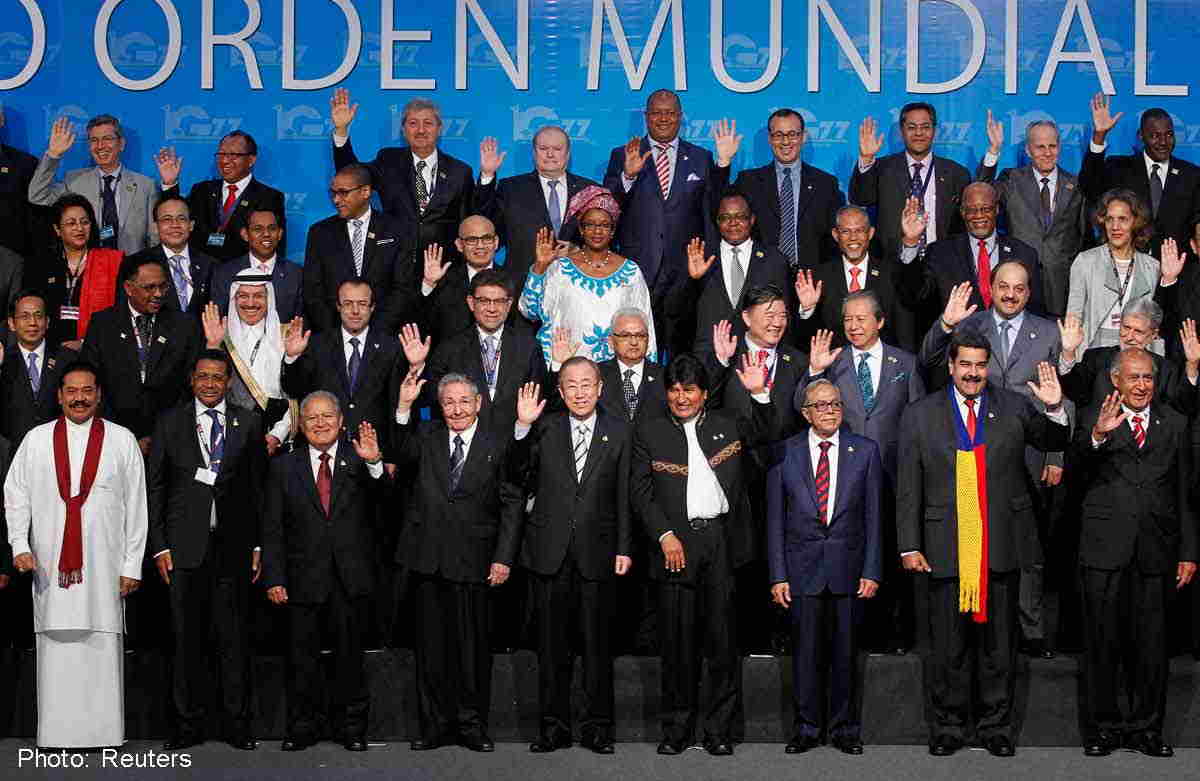
In a major setback to US President Donald Trump who has been criticizing Iran nuclear deal as worst ever, 134 countries came together under the banner of Group of 77 at United Nations voicing support for the 2015 Iran nuclear deal known as JCPOA.

The deal was signed by Iran and six world major powers including five UN Security Council permanent members: US, France, Britain, Russia, China – and Germany (known as P5+1) on July 14, 2015.  

The implementation of the deal started on January 16, 2016 with Iran undertaking limitations on its nuclear program in exchange of removal of nuclear related sanctions imposed against Tehran.

Till date International Atomic Energy Agency (IAEA), responsible for monitoring the implementation of the agreement, has certified about Iran abiding the deal through seven consecutive quarterly reports.

On Tuesday, US President Donald Trump, while addressing UN General Assembly (UNGA)’s 72nd session, branded the agreement as “an embarrassment” for the US. He said that the deal, known as Joint Comprehensive Plan of Action (JCPOA) was “one of the worst and most one-sided transactions the United States has ever entered into.”

According to Press TV, the statement issued at the end of the G-77 foreign ministers’ meeting at New York on Friday, “reaffirmed the importance of supporting and strengthening multilateralism, and in this regard recognized that the Joint Comprehensive Plan of Action (JCPOA) between the Islamic Republic of Iran and P5+1 is a concrete case of a successful multilateral action for resolving outstanding global issues.”

The G-77 did not only supported the Iran deal but also “stressed that such model sets a real example for further accelerating the achievement of sustainable development, including by strengthening international cooperation, through enhanced means of implementation.”

G-77 was formed in 1964 with 77 developing countries as its founding members for promoting member countries’ collective economic interests and enhance joint negotiating capacity in the world body. Though its membership has grown to 134, it has kept its original name.

All the signatories to the nuclear deal, except US Administration under Donald Trump, have hailed the nuclear deal as a victory of diplomacy and urged its continued implementation. UN and European Union have also supported the Iran nuclear deal.

The G-77 ministers also affirmed their rejection of the unilateral economic sanctions imposed by US administration against Iran saying that the bans had a negative impact on the development and prosperity of the Iranian people and called for their immediate removal.

Since Donald Trump occupied White House in January this year, his administration has been seeking to potentially withdraw from the Iran nuclear deal. Washington has imposed certain unilateral sanctions on Iran and has recently been saying that the JCPOA should be re-negotiated.

Iran and other signatories to the deal have supporting the continuation of its implementation.

Meanwhile, Iran’s foreign minister Mohammad Javad Zarif has claimed that the representatives of over 30 countries, he met in the sidelines of the UNGA, have stressed that the JCPOA was non-negotiable. “All these people placed emphasis on the need to honor the JCPOA and the agreement’s being non-negotiable,” he said.

In the meantime, Iranian President Hassan Rouhani, while addressing a press conference in New York has said  that there could be no future dialogue with the US at a time when Washington speaks of leaving the 2015 Iran nuclear  agreement with P5+1 group of countries.

He said “We held negotiations for many years on (the nuclear) agreement… but today the Americans talks of leaving the deal. So why negotiations on other issues should be held (with the US)?”  Given the current situation, holding talks with the US “would be waste of time” he said.

Iranian President said that his country had “various options” such as “the removal of obstacles,” if Washington pulls out of the nuclear agreement. “It means that our hand would be completely open to take any action that we see beneficial to our country,” he added.[/vc_column_text][/vc_column][/vc_row]

Latest world news

Imran Khan accuses Asim Munir of mental torture, says sister after rare jail meeting

Imran Khan has alleged “mental torture” inside Adiala Jail, according to his sister who met him after weeks of blocked access. The family claims authorities are withholding information about his condition.

Published

on

Former Pakistan Prime Minister Imran Khan has alleged that he is being “mentally tortured” in prison and held General Asim Munir responsible for his continued isolation, according to his sister Dr Uzma Khanum, who met him inside Rawalpindi’s Adiala Jail for 20 minutes.

Sister says Khan “angry” over isolation

Dr Khanum told reporters that her brother is allowed out of his cell only briefly and has no means of communication with the outside world. She said Khan expressed anger over the conditions in which he is being held, stating he remains confined all day with no access to his family or party members.

She also said Imran Khan directly blamed General Asim Munir — now seen as Pakistan’s most powerful authority, having consolidated military control and secured lifetime immunity for top officials — for the treatment he is receiving in custody.

Meeting follows weeks of denied access

The rare meeting came after weeks of barred family visits, which fuelled speculation about Khan’s health. His sisters earlier claimed they were assaulted when they sought permission to meet him, while his sons publicly alleged that jail authorities were concealing “something irreversible” about his condition.

One of his sons, Kasim Khan, told media that despite a court order for weekly family meetings, they had no direct or verified contact.

Family members also said prison authorities repeatedly refused entry to Imran Khan’s personal doctor.

Rumours and protests intensify

Before Tuesday’s meeting, neither his relatives nor his Pakistan Tehreek-e-Insaf colleagues had seen him for over 25 days, triggering widespread rumours of his death — speculation that officials did not counter with proof of life even as pressure mounted on Prime Minister Shehbaz Sharif’s government.

PTI’s Senator Khurram Zeeshan claimed Khan was being kept in isolation to force him into leaving Pakistan and accused authorities of withholding photos or videos due to fears over his influence.

The situation has sparked protests across Islamabad and Rawalpindi, including demonstrations outside the Islamabad High Court.

In jail since August 2023

Imran Khan, the 72-year-old former cricketer and World Cup-winning captain, has been incarcerated since August 2023. Rumours about his wellbeing first circulated from social media accounts in Afghanistan, at a time when both countries have been locked in military tensions over a border dispute.

Continue Reading

Latest world news

Trump pledges permanent pause on migration from Third World countries in Thanksgiving message

US President Donald Trump declared that migration from all Third World countries will be permanently paused, criticising current immigration policies and announcing measures to remove non-citizens who he says do not benefit the US.

Published

on

US President Donald Trump has announced that he will “permanently pause migration from all Third World countries”, asserting that the move is necessary for the United States to “recover” and “heal”. His remarks were delivered in a Thanksgiving post, where he sharply criticised the Biden administration’s immigration policies and outlined sweeping measures aimed at restricting migration and removing non-citizens who, he says, do not contribute to the country.

Trump said he intends to reverse what he described as “illegal admissions”, end federal benefits for non-citizens, and strip citizenship from migrants who pose security concerns. He also reiterated plans to deport individuals he considers a “public charge” or “non-compatible with Western Civilization”.

The statement came shortly after two members of the National Guard were shot near the White House, an attack Trump called an “act of terror”.

One National Guard member dies after Washington shooting

Trump confirmed that Specialist Sarah Beckstrom, 20, one of the two West Virginia National Guard soldiers shot near Farragut West Metro station on Wednesday, died of her injuries. The ambush occurred while Trump was in Florida.

The alleged shooter was identified as Rahmanullah Lakanwal, a 29-year-old Afghan national who entered the US in September 2021, according to enforcement officials.

‘Reverse migration’ needed, says Trump

In his post, Trump said his actions aim to significantly reduce “illegal and disruptive populations”, adding that only “reverse migration” can address the current situation. He accused the Biden administration of admitting migrants through an “unauthorized and illegal” approval process.

Concluding his message, he wished Americans a Happy Thanksgiving but added that those who “hate, steal, murder, and destroy” would “not be here for long”.

Attacks on foreign populations and Minnesota officials

Trump also targeted Somali refugees in Minnesota, alleging that gangs from the community are creating fear on the streets. He accused the Minnesota Governor of failing to address the situation due to “fear or incompetence”.

He further criticised Ilhan Omar, accusing her of complaining about the US despite her origins in a “crime ridden” nation.

Comments on America’s foreign-born population

Citing Census estimates, Trump claimed that the US foreign-born population stood at 53 million, alleging that “most are on welfare” or come from “failed nations” or criminal backgrounds. He said American citizens continue to support this population despite personal discomfort.

Continue Reading

Latest world news

Putin to visit India on December 4-5 for annual summit with PM Modi

Vladimir Putin will visit India on December 4-5 for the 23rd India-Russia Annual Summit, where he and PM Modi will review bilateral progress and discuss strategic issues.

Published

on

Vladimir Putin

Russia’s President Vladimir Putin will travel to India on December 4-5 for the 23rd India-Russia Annual Summit, marking a significant diplomatic engagement between New Delhi and Moscow. The Ministry of External Affairs confirmed that the visit comes on the invitation of Prime Minister Narendra Modi.

According to the government, the two leaders will assess ongoing bilateral cooperation, set future goals for the Special and Privileged Strategic Partnership, and discuss key regional and global developments of mutual concern.

President Droupadi Murmu will receive Putin at Rashtrapati Bhavan and host a banquet in his honour.

Talks expected to focus on bilateral progress

PM Modi and Putin are expected to review major areas of cooperation, including trade, investments, defence ties and energy engagements. India has remained one of the key buyers of Russian oil, despite global pressure and criticism.

The visit is also significant as India continues to balance ties with both Russia and the United States. New Delhi’s continued oil imports from Moscow earlier led to punitive tariffs imposed by the US.

Background of the visit

Putin’s India trip was first indicated in August during National Security Advisor Ajit Doval’s visit to Moscow. The dates were finalised later.

The two leaders last met informally in September during the SCO Summit in China, where they held discussions inside the Russian president’s limousine.

Earlier this month, PM Modi conveyed his greetings to Putin when Nikolai Patrushev, a senior Russian official, met him in Delhi.

Putin’s reduced foreign travel

The Russian president has made limited overseas trips since the beginning of the Ukraine conflict due to an International Criminal Court warrant. India is not a party to the ICC, and therefore, has no obligation to act on the warrant.

Bilateral ties remain strong

India and Russia share decades-old defence and economic cooperation. Moscow remains a major defence supplier to India, while New Delhi continues as an important buyer of Russian crude.

The summit is expected to reinforce this long-standing partnership.

Continue Reading

Trending

© Copyright 2022 APNLIVE.com

Left Menu Icon