English हिन्दी
Connect with us

India News

White-collar terrorism an alarming new threat in India, says Rajnath Singh

Rajnath Singh has raised concerns over the rise of white-collar terrorism in India, citing the Delhi car bomb case involving doctors and calling for education rooted in values and ethics.

Published

on

Rajnath Singh

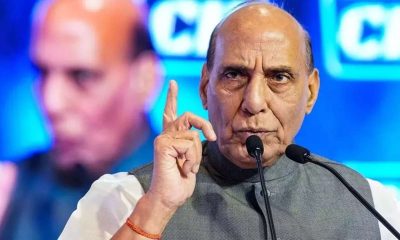
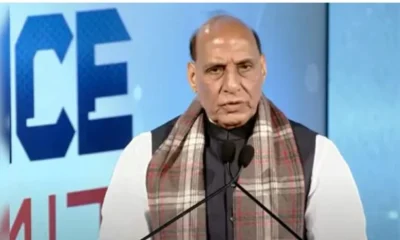
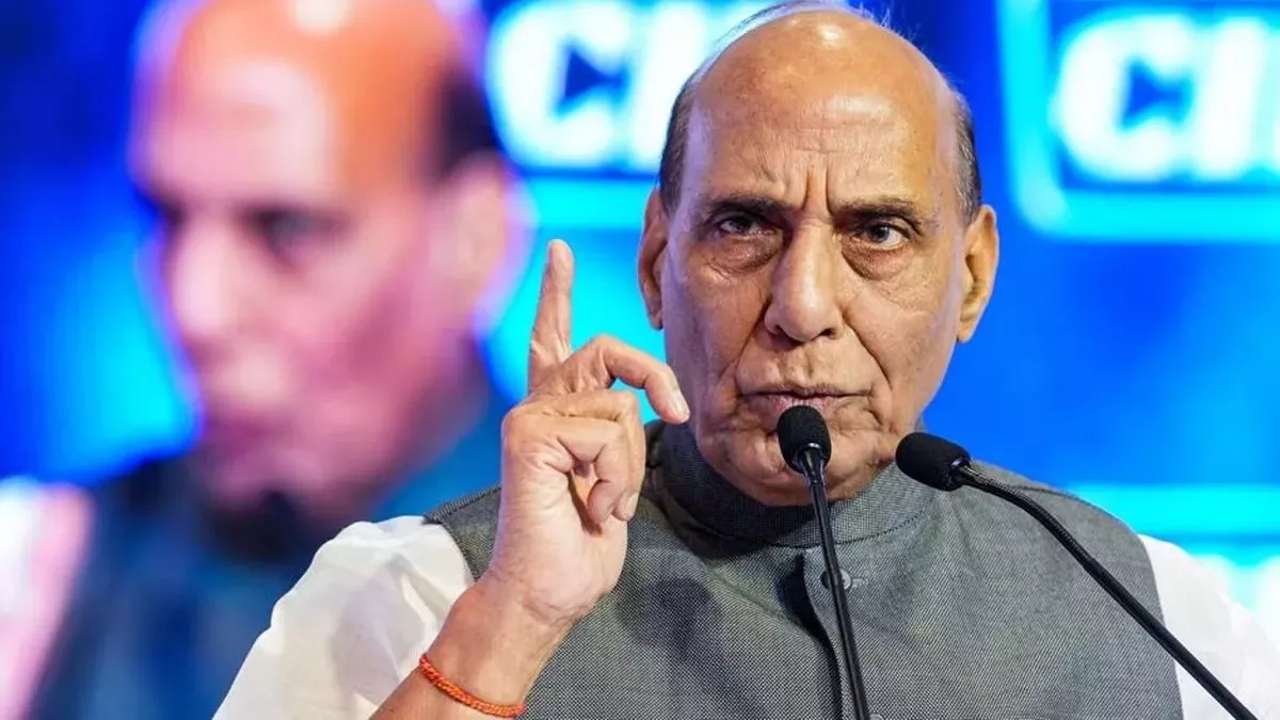
Defence Minister Rajnath Singh has warned that India is witnessing an alarming rise in what he described as “white-collar terrorism”, where highly educated individuals are allegedly engaging in anti-social and anti-national activities.

Speaking at the 104th foundation day event of Bhupal Nobles’ University on Friday, Singh referred to the November 10 car bomb blast near Delhi’s Red Fort to underline his concern. The incident, which claimed 15 lives, revealed the involvement of medical professionals in the terror plot.

According to Singh, the case exposed how education without moral grounding can pose a serious threat to society.

“Today, an alarming trend of white-collar terrorism is emerging in the country. Highly educated people are working against society and the country,” he said.

Education must be rooted in values, not just degrees

Highlighting the contradiction in the Delhi blast case, the defence minister noted that the accused were doctors — individuals traditionally associated with saving lives.

“Those who write ‘Rx’ on prescriptions had RDX in their hands. This shows that knowledge must go hand in hand with values and character,” Singh said.

He emphasised that the true purpose of education goes beyond professional success and must include the development of ethics, morality and human values.

Delhi car bomb probe revealed ‘white-collar’ terror module

The explosion on November 10 involved an explosives-laden i20 car that detonated outside the Red Fort. Investigations revealed that the vehicle was driven by Dr Umar-un-Nabi.

The probe later uncovered a so-called white-collar terror module, leading to the arrest of several individuals, including doctors Muzammil Ganai, Adeel Rather and Shaheena Saeed, among others.

India’s growth and role of universities

During his address, Singh also spoke about India’s economic and technological progress. He said India is currently the world’s fourth-largest economy and is on track to become the third-largest by 2030.

Universities, he said, have a crucial role in shaping this journey by producing not only skilled professionals but also responsible citizens.

He also pointed to advancements in artificial intelligence, machine learning and emerging technologies, stressing that they must be used positively to support national development.

Self-respect should not turn into arrogance

The defence minister further urged people to understand the fine balance between self-respect and ego.

“Self-respect is important, but it should never turn into arrogance,” Singh said.

He also expressed confidence in India’s defence manufacturing ecosystem, stating that the country could become fully self-reliant in weapons over the next 15 to 20 years, citing the progress made by defence startups.

India News

Stealing TMC’s data: Mamata Banerjee visits I-PAC chief’s home during ED searches

Mamata Banerjee visited the residence of I-PAC chief Pratik Jain during ED searches, alleging attempts to seize TMC’s internal documents, while the agency denied political targeting.

Published

on

mamta banerjee

West Bengal Chief Minister Mamata Banerjee on Thursday visited the residence of Indian Political Action Committee (I-PAC) chief Pratik Jain amid ongoing searches by the Enforcement Directorate (ED), triggering a major political confrontation in Kolkata.

Banerjee reached Jain’s house around noon, shortly after Kolkata Police Commissioner Manoj Verma arrived at the location. She remained there for nearly 20 to 25 minutes before stepping out with a green folder, alleging that the central agency was attempting to seize sensitive digital data and internal documents belonging to the Trinamool Congress (TMC).

Addressing reporters outside the residence, the chief minister claimed that the ED raid targeted the party’s IT cell and involved the confiscation of hard disks, mobile phones, laptops and documents related to candidate selection and internal election strategy.

“ED raided my IT sector office and searched the residence of the in-charge of my IT sector. They were confiscating my party’s documents and hard disks which have details about our assembly election candidates. I have brought those back,” Banerjee said.

She described the searches as politically motivated and unconstitutional, alleging that central agencies were being used to intimidate opposition parties ahead of elections.

Banerjee accuses Amit Shah of political vendetta

Escalating her attack, Banerjee targeted Union Home Minister Amit Shah, accusing him of misusing constitutional institutions for political purposes.

“This is not law enforcement, this is political vendetta. The home minister is behaving like the nastiest home minister, not someone who protects the country,” she alleged.

The chief minister also claimed that ED officials attempted to take away a laptop from the premises and were selectively collecting political data. She further alleged that names of more than 15 lakh voters from West Bengal had been deleted from electoral rolls without proper explanation.

Meanwhile, searches were also conducted at the office of I-PAC, the political consultancy firm headed by Jain, as part of the same operation.

What the ED said

In an official statement, the ED rejected the allegations and clarified that the searches were evidence-based and not directed at any political party or office.

“Search is ongoing at 10 places — six in West Bengal and four in Delhi. The case relates to illegal coal smuggling. The search covers various premises linked to generation of cash and hawala transfers,” the agency said.

The ED maintained that the action was part of a routine investigation into money laundering and had no connection with elections. It also alleged that certain individuals, including constitutional functionaries, had illegally intruded into two of the searched premises and forcibly taken away documents.

Continue Reading

India News

Vedanta chairman Anil Agarwal calls son’s death the darkest day of his life

Vedanta chairman Anil Agarwal expressed deep grief after his son Agnivesh Agarwal died of a sudden cardiac arrest in New York while recovering from a skiing accident.

Published

on

Vedanta chairman Anil Agarwal calls son’s death the darkest day of his life

Vedanta Group chairman Anil Agarwal announced the sudden death of his son, Agnivesh Agarwal, describing it as the darkest day of his life. Agnivesh, 49, died following a cardiac arrest in New York, where he was undergoing treatment after a skiing accident.

In an emotional message shared on social media, Agarwal said his son had been recovering well at Mount Sinai Hospital and that the family believed the worst phase was over. “But fate had other plans, and a sudden cardiac arrest snatched our son away from us,” he wrote.

A journey from Patna to corporate leadership

Recalling his son’s life, Agarwal said Agnivesh was born in Patna on June 3, 1976, and grew up in a middle-class family. He studied at Mayo College in Ajmer and later went on to establish Fujeirah Gold.

Over the years, Agnivesh rose to become a prominent business leader, serving as chairman of Hindustan Zinc and leading key responsibilities within the Vedanta group. He was also the chairperson of Vedanta subsidiary Talwandi Sabo Power Ltd.

Despite his professional achievements, Agarwal said his son remained grounded and compassionate. “He was simple, warm, and deeply human,” he noted, adding that to him, Agnivesh was not just a son but also a close friend.

Renewing a promise to society

Agarwal said his son strongly believed in building a self-reliant India and often spoke about the country’s potential. Remembering those conversations, he reaffirmed a shared commitment to give back to society.

“I had promised Agni that more than 75% of what we earn would be given back to society. Today, I renew that promise and resolve to live an even simpler life,” he said.

In his concluding message, Agarwal said he would try to carry forward his son’s values and ideals, adding that Agnivesh would continue to live on through the lives he touched.

Condolences from Prime Minister Modi

Prime Minister Narendra Modi also expressed condolences on the untimely passing of Agnivesh Agarwal. In a message posted on X, he said the loss was deeply shocking and saddening, and offered prayers for strength and courage to the Agarwal family.

Anil Agarwal has two children — his late son Agnivesh and his daughter Priya Agarwal, who serves on the board of Vedanta Ltd. and is the chairperson of Hindustan Zinc Ltd.

Continue Reading

India News

Somnath Temple attacks reinforced India’s cultural unity, says PM Modi ahead of visit

PM Modi says centuries-old attacks on Somnath Temple strengthened India’s cultural unity, highlighting the shrine’s enduring spiritual resilience.

Published

on

PM Modi

Ahead of his scheduled visit to the Somnath Temple on January 11, Prime Minister Narendra Modi on Thursday said that repeated historical attacks on the shrine failed to weaken India’s spiritual foundations and instead strengthened the country’s cultural unity.

In a message shared on social media platform X, the prime minister reflected on the first recorded attack on the Somnath Temple in January 1026 and the several assaults that followed over the centuries. He said these events could not break the faith of the people, leading instead to the temple being rebuilt time and again as a symbol of civilisational continuity.

“The attack of the year 1026 and the numerous assaults that followed thereafter could not shake our eternal faith. On the contrary, these strengthened the sentiment of India’s cultural unity,” the prime minister wrote, while sharing images from his earlier visits to the temple.

PM Modi said the Somnath Swabhiman Parv, which begins on January 8, is being observed as a festival of remembrance, honouring generations of Indians who upheld their values and cultural consciousness even during the most difficult periods.

He noted that their steadfast commitment to civilisation and national unity continues to inspire the country today. According to the prime minister, the thousand-year legacy of faith associated with Somnath serves as a reminder of India’s enduring spiritual resolve.

Recalling Somnath’s reconstruction and national leaders’ role

The prime minister also shared visuals from a programme held at Somnath on October 31, 2001, marking 50 years since the temple’s reconstruction and inauguration in 1951.

He recalled that the historic ceremony in 1951 was attended by then President Dr Rajendra Prasad and highlighted the key role played by leaders such as Sardar Vallabhbhai Patel and K M Munshi in rebuilding the shrine after Independence.

PM Modi further noted that the 2001 event saw the participation of senior national leaders, and added that the year 2026 will mark the 75th anniversary of the 1951 inauguration ceremony.

The prime minister is scheduled to visit the Somnath Temple on January 11 to take part in the concluding events of the Somnath Swabhiman Parv.

The four-day observance, running from January 8 to January 11, will feature programmes focused on India’s spiritual heritage, cultural pride and social values.

Continue Reading

Trending

© Copyright 2022 APNLIVE.com