English हिन्दी
Connect with us

India News

RSS says Ram Mandir donation theft has hurt devotees’ faith, seeks strict action

The RSS has condemned the alleged Ram Temple donation theft, expressing deep sorrow and urging a thorough investigation and strict punishment for those found guilty.


Published

on

Ram Mandir

The Rashtriya Swayamsevak Sangh (RSS) has issued its first official response to the alleged theft of donations from the Ram Temple in Ayodhya, describing the incident as deeply distressing and calling for the strictest action against those found guilty.

In a statement, the RSS said the alleged theft of money deposited in the temple’s donation boxes had deeply hurt the faith and sentiments of millions of devotees. It added that the organisation was saddened by the incident and expected a fair and comprehensive investigation into the matter.

RSS backs trust’s investigation

The RSS said it had full faith that the Shri Ram Janmabhoomi Teerth Kshetra Trust was committed to ensuring transparency and accountability. It also expressed confidence that the ongoing investigation would identify those responsible and bring them to justice.

The organisation stressed that anyone found guilty should receive the strictest punishment under the law, irrespective of their position or role.

Probe into donation theft continues

The alleged theft case has already led to the arrest of eight individuals, including employees associated with the temple’s donation counting process. Investigating agencies have recovered a significant portion of the suspected stolen cash while continuing to examine financial records and cash-handling procedures. The investigation has also expanded to include questioning of several individuals linked to the temple’s administration and banking operations.

The RSS maintained that the incident should be investigated thoroughly to preserve the trust of devotees and uphold the sanctity of one of India’s most revered religious institutions.

India News

India reiterates Indus Waters Treaty will remain in abeyance until Pakistan ends terror support

India has reaffirmed that the Indus Waters Treaty will remain in abeyance until Pakistan credibly ends support for cross-border terrorism, while also condemning Pakistani military strikes in Afghanistan.

Published

on

Indus Water Treaty

India on Friday reaffirmed that its decision to keep the Indus Waters Treaty (IWT) in abeyance remains unchanged, stating that the treaty will remain suspended until Pakistan credibly and irrevocably ends its support for cross-border terrorism.

Responding to recent statements from Pakistan, the Ministry of External Affairs (MEA) said India’s position on the water-sharing agreement continues to be consistent.

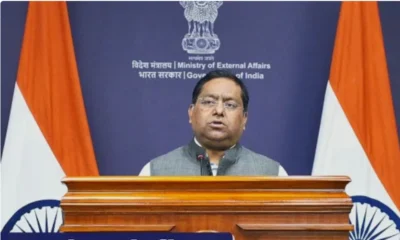
MEA spokesperson Randhir Jaiswal said the treaty was placed in abeyance in response to Pakistan’s continued sponsorship of cross-border terrorism.

“India’s position on the Indus Waters Treaty is consistent. IWT stands in abeyance in response to Pakistan’s continued sponsorship of cross-border terrorism. Pakistan must credibly and irrevocably abjure its support for cross-border terrorism,” Jaiswal said during a media briefing.

Treaty kept in abeyance after Pahalgam terror attack

India decided to keep the Indus Waters Treaty in abeyance following the April 2025 terror attack in Jammu and Kashmir’s Pahalgam, in which 26 tourists were killed.

According to the government, Pakistan has since attempted to convince the international community that India’s move could set a concerning precedent for countries sharing transboundary rivers. India, however, maintained that its position remains unchanged.

Pakistan reiterates treaty remains valid

Earlier this week, Pakistan’s Deputy Prime Minister Ishaq Dar said Islamabad rejected India’s decision to keep the treaty in abeyance, asserting that the agreement remained “valid, binding and operative.”

During the same event, former Pakistani foreign minister Bilawal Bhutto Zardari referred to a possible “nuclear option” if efforts to restore the treaty failed. His remarks have drawn criticism from some strategic experts, who described the statement as irresponsible.

India reiterates legal position

India has previously maintained that while the treaty remains in abeyance, it is not obligated to fulfil its commitments under the agreement.

In June 2025, the MEA also stated that no court of arbitration, including what it described as an illegally constituted arbitral body, had jurisdiction to examine India’s actions taken in exercise of its sovereign rights.

The Indus Waters Treaty, brokered by the World Bank, was signed by India and Pakistan in 1960 after nine years of negotiations. It governs the sharing and use of the Indus river system between the two countries.

India also condemns Pakistan’s strikes in Afghanistan

During the same media briefing, Randhir Jaiswal also reiterated India’s condemnation of Pakistani military airstrikes in Afghanistan that reportedly caused civilian casualties, including women and children.

He said India had expressed condolences for the loss of lives and reaffirmed its support for Afghanistan’s sovereignty and territorial integrity.

Separately, India and Japan, following bilateral talks between Prime Minister Narendra Modi and Japanese Prime Minister Sanae Takaichi, issued a joint statement condemning cross-border terrorism and calling for stronger international action against terror safe havens and financing networks.

Continue Reading

India News

ICAI announces CA Foundation May 2026 exam results, pass percentage at 20.09%

Published

on

The Institute of Chartered Accountants of India (ICAI) has declared the result of the CA Foundation exam conducted in May 2026, wherein the pass percentage is recorded as 20.09%. This is a landmark moment for the students who wish to make their careers as chartered accountants, which is the most competitive professional course in the country.

ICAI announced that 1,09,694 students had sat for the exam, of which over 22,000 passed. Officials said a large percentage of the passouts were male.

Students may check their result on the ICAI result portal website using the roll number along with the registration number/PIN allotted. The online result contains the marks scored in each subject and the total marks scored by the candidate. In order to clear the CA Foundation Exam, students need to get a minimum 40% marks in each paper and 50% marks overall in all papers.

Those who have cleared the Foundation exam are eligible to appear in the CA Intermediate exam, which is the next level of the CA course. The CA Foundation exam is the gateway to the CA course and has a tough evaluation system. In every examination cycle, a lot of candidates take this exam making it one of the toughest non-science exams in the country.

With the announcement of the results of May 2026, successful candidates are now in a position to prepare themselves for intermediate level, whereas those who could not pass the examination this time, have been asked to prepare themselves for their next attempt. ICAI has requested all candidates to download and save a copy of their marksheet for future use.


Continue Reading

India News

Centre plans stricter compliance rules for VPN providers, may mandate compliance officers

The Centre is exploring stricter compliance requirements for VPN providers, including designated compliance officers, to improve cybercrime investigations and regulatory accountability.

Published

on

The Centre is considering stricter compliance measures for virtual private network (VPN) service providers operating in India as part of its broader efforts to strengthen cybersecurity enforcement and improve cybercrime investigations. Officials are exploring a framework that could require VPN companies to appoint designated compliance officers or authorised representatives to coordinate with enforcement agencies and the Indian Computer Emergency Response Team (CERT-In).

The move comes amid growing concerns within the government over the alleged misuse of VPN services to conceal user identities, bypass law enforcement, and access websites or online platforms that have been blocked in the country.

Government seeks stronger compliance framework

According to government officials, the proposal is intended to ensure that VPN providers establish a clear compliance mechanism in India. Designated officials would be responsible for responding promptly to lawful requests from investigating agencies and CERT-In during cyber incident investigations.

Authorities have stressed that the objective is to improve accountability and facilitate quicker coordination during investigations involving cyber offences rather than monitor ordinary internet users.

Officials also noted that cybercriminals frequently use anonymisation tools, including VPN services, while carrying out ransomware attacks, financial fraud, phishing campaigns, and other online crimes. The proposed framework is aimed at helping investigators trace those involved in such offences through lawful procedures.

Proposal draws from existing IT Rules

The proposed compliance model is similar to the framework introduced under the Information Technology (Intermediary Guidelines and Digital Media Ethics Code) Rules, 2021.

Under those rules, significant social media intermediaries are required to appoint a Chief Compliance Officer, a Nodal Contact Person for round-the-clock coordination with law enforcement agencies, and a Resident Grievance Officer. Officials believe adopting a comparable structure for VPN providers would improve accountability, particularly for companies serving Indian users from outside the country.

Existing CERT-In directions remain in focus

The renewed discussions also highlight the cybersecurity directions issued by CERT-In in April 2022.

Under these directions, VPN providers, cloud service providers, virtual private server (VPS) providers, and data centres are required to collect and retain subscriber information for at least five years, even after a customer stops using the service.

The framework requires providers to maintain verified subscriber details, including names, physical addresses, contact numbers, email addresses, IP addresses, the duration of service usage, and the purpose for which the service was obtained. These records must be made available to authorities when sought as part of a lawful cybercrime investigation.

Government officials have maintained that access to subscriber information is limited to lawful investigations and is not intended for indiscriminate surveillance.

VPN industry had opposed data retention rules

When the CERT-In directions were introduced in 2022, several VPN companies and digital rights groups opposed the requirements. They argued that mandatory retention of customer information conflicted with their “no-logs” policies, which are designed to protect user privacy.

Some providers responded by changing their operational models. ExpressVPN, for instance, removed its physical servers from India and began serving Indian users through virtual server locations outside the country. Other VPN companies adopted similar arrangements while continuing to offer services in the Indian market.

Following representations from industry associations and technology companies, the government had extended the compliance deadline from June 27 to September 25, 2022, allowing providers additional time to implement the required changes.

Focus remains on cybercrime investigations

Officials said the latest initiative is intended to place VPN providers under compliance standards comparable to those applicable to other digital intermediaries operating in India. The government believes the proposed measures will strengthen its ability to investigate cybercrimes while further expanding the country’s digital regulatory framework.

Continue Reading

Trending

© Copyright 2022 APNLIVE.com