English हिन्दी
Connect with us

India News

8.5 per cent GDP growth needed over several years for India’s transformation: Speakers at Swadesh Conclave 2025

Published

on

Retired JNU Economics Professor Arun Kumar on Wednesday said India needs high rates of growth over the next few years at 8.5 per cent to become a developed nation by 2047.

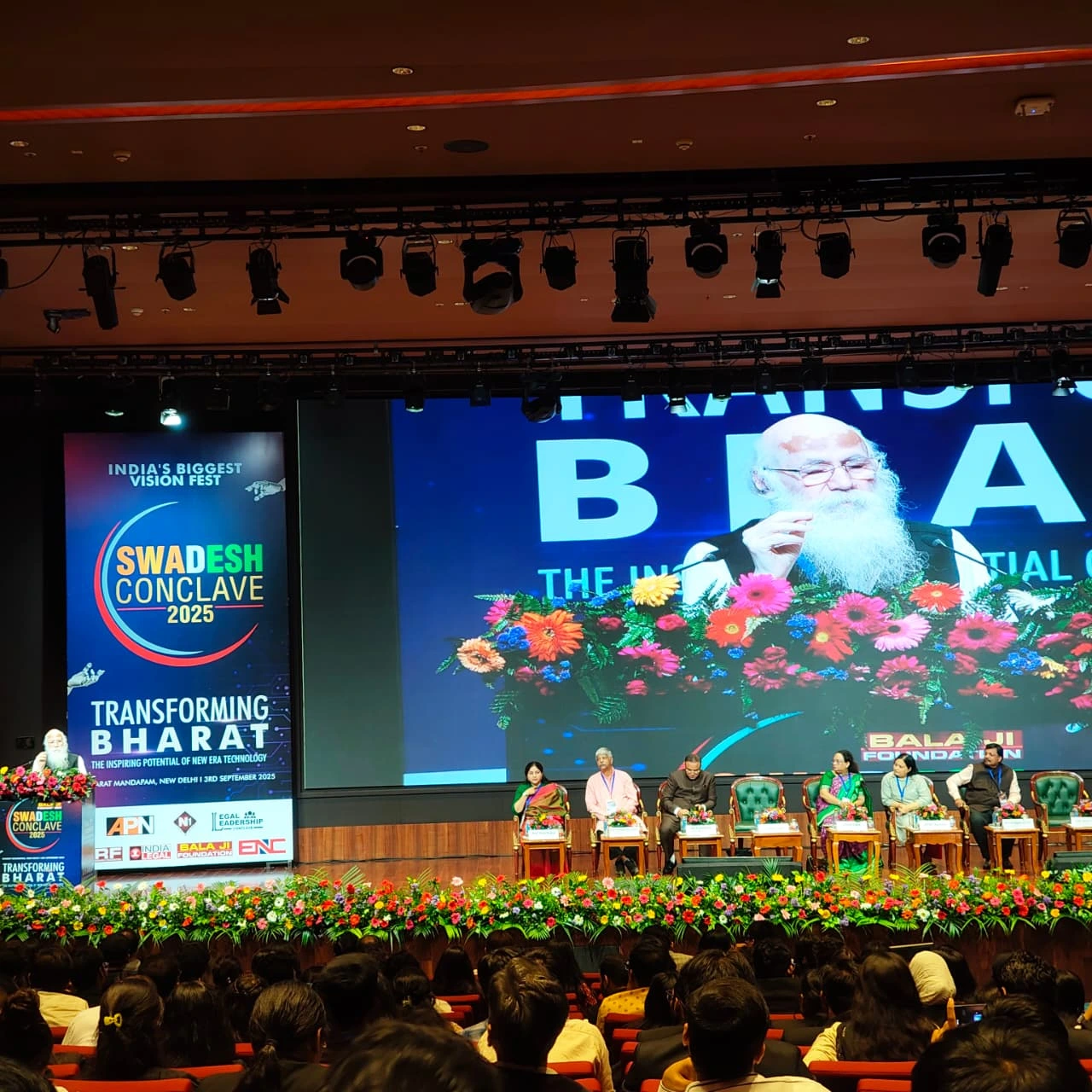
Speaking at Swadesh Conclave 2025’s Transforming Bharat through Commerce, Industry & Technology in New Delhi, Kumar said the income per capita should be $14000, it is around $2700 in India now. “We need high rates of growth at 8.5 per cent to grow demand and jobs and all of this has to be equitable.”

Speaking on the economic structure, he said employment is a big issue. Women also face unemployment. Only 6 per cent people work in organised sector, the rest in unorganised sector, and it is not contributing to demand. This is why the disparity.

If demand from unorganised sector goes up, even organised sector will grow fast. Currently, growth is dependent on 10 per cent of organised sector.

Decades ago, China focused on the rural areas and unorganised sector so that demand can be constant and drive growth. It has invested heavily in R&D and has reaped great growth. We need to do that also. For this, we need a good education, Kumar said.

US President Donald Trump is showing the raw, tough face of capitalism. The West won intellectual property rights through the WTO but the soft face of capitalism is gone. Now, the tough face will face a market crash like they did in the late 1920s.

Transformation through technology is being hastened by AI. It has changed blue-collar jobs in technology such as car factories and will threaten white-collar jobs now, such as journalists, doctors and more.

Physicist & JNU Professor of Econophysics Anirban Chakrabarti said an interdisciplinary approach is needed to combat challenges, including climate change which is causing cloudbursts and droughts at the same time. This will need experts from various sciences to come together.

He said there has been a boom in AI with students taking admission in courses to study it. It is important to understand all aspects of the entire system.

Explaining how AI can help, he said one can record data and use machine learning to see trends. “If we can predict price volatility via ML tools, it will help small farmers to decide what crops to sow. I can tell how market is moving and the volatility the farmers can face, help them make well-informed choices.”

He said many regulatory bodies including RBI, SEBI using AI-ML to predict trends etc so that India can be transformed into a developed nation by 2047.  

OTBL Chairperson (retd) Sushma Rawat thanked the organisers for holding the Conclave in an effort to bridge the gap between people over the transformation technology and AI can bring about.

She said she joined ONGC in 1989 as a geologist, was in ONGC to explore oil reserves and other group companies. Recalling the story of oil in India, she said oil was first in Assam’s Digboi in 1889 when they found sticky substance on elephants’ legs. It was a held belief in the West and among people that oil was only in Assam, India. After Independence, we struck oil off Gujarat in 1959 under the ONGC, she said.

Rawat called upon the dignitaries and attendees at the gathering to have belief in oneself and one’s nation. Recalling the transformation in technology across the ages, she said, “I had a 386 computer in 1990, then Sun Microsystems, now all talk is of AI, IoT, data analytics. The changes have been gradual and not sudden. For instance, the mobile phone is a guru and can answer almost all our queries. It will grow further exponentially.”

She told the youngsters at the event to remain curious and keep on learning.

Differing with Prof Arun Kumar’s AI predictions, Supreme Court Senior Advocate Shri Pradeep Rai said AI will not take away all the core functions of doctors, lawyers and journalists. AI will be of help but cannot investigate, for instance, like journalists can, he said.

Blinkit, Google Pay etc were things which could not be imagined in earlier times, all innovations brought through by technology, said Rai.

The virtual hearings in courts during the pandemic were done because of the availability of technology. It has become commonplace now, making distances a remote thing of the past, Rai noted.

The Senior Advocate said the monopoly of US companies will be a problem. He cited an instance where Google refused to share data with Apple until the court forced them to. Without data, there is no AI, he added.

Kerala State Financial Enterprises Ltd (KSFE) Managing Director SK Sanil said micro-finance institutions are needed for the welfare of the poor. Bangladesh’s Mohammad Yunus and his Grameen Bank have been a success in that country. The innovation which made a great impact won him the Nobel Prize. Micro financing can help the poor and the needy in the drive to transform the country.

In her address, Balaji Foundation Chairperson Smt. Rajshri Rai introduced the Swadesh Conclave, saying it is a platform for collective dialogue. She said this year is the sixth edition of Swadesh Conclave. Swadesh is the platform to talk about national interests. This year’s theme is Transforming India. She quoted Faiz Ahmed Faiz’s Bol, saying everybody is entitled to airing their opinion and welcomed them to the Conclave.

India News

PM Modi assures no discrimination in women’s quota, delimitation debate intensifies in Parliament

PM Narendra Modi has assured that women’s reservation will be implemented without discrimination, amid a heated debate over delimitation in Parliament.

Published

on

PM modi

Prime Minister Narendra Modi has assured that there will be no discrimination in the implementation of women’s reservation, as Parliament witnessed a sharp debate over the proposed linkage between the quota and delimitation exercise.

During the ongoing special session, the government reiterated its commitment to ensuring fair representation while addressing concerns raised by opposition parties regarding the timing and structure of the legislation.

The proposed framework aims to reserve 33 percent of seats for women in the Lok Sabha and state assemblies. However, its implementation is tied to a fresh delimitation exercise, which is expected after the next census.

Opposition questions timing and intent

Opposition leaders have raised concerns that linking the women’s quota to delimitation could delay its implementation. They argue that the process of redrawing constituencies may push the actual rollout further into the future.

The issue has triggered a broader political confrontation, with multiple parties questioning whether the move could alter representation across states.

Some critics have also alleged that the delimitation exercise could disproportionately benefit certain regions based on population, a charge the government has rejected.

Government reiterates commitment to fair implementation

Responding to these concerns, the Centre has maintained that the reforms are necessary to ensure accurate and updated representation based on population data.

Leaders from the ruling side have repeatedly emphasized that the process will be carried out transparently and without bias. The assurance that there will be “no discrimination” is aimed at addressing fears among states and opposition parties.

The debate marks a key moment in Parliament, with both sides engaging in intense exchanges over one of the most significant electoral reforms in recent years.

Continue Reading

India News

Give all tickets to Muslim women, Amit Shah says, attacking Akhilesh Yadav on sub-quota demand

A sharp exchange between Amit Shah and Akhilesh Yadav in Parliament over sub-quota for Muslim women highlights key divisions on women’s reservation implementation.

Published

on

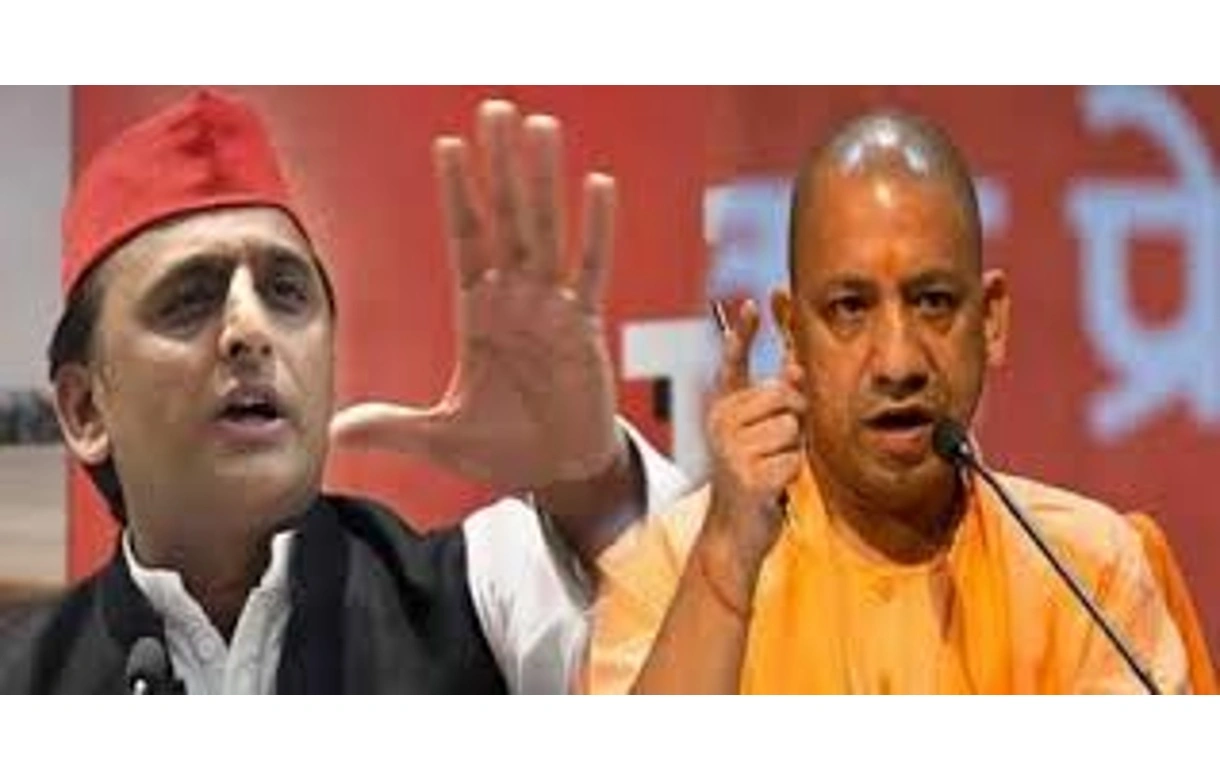
A heated exchange broke out in Parliament during discussions on the women’s reservation framework, with Union Home Minister Amit Shah and Samajwadi Party chief Akhilesh Yadav locking horns over the demand for a sub-quota for Muslim women.

The debate unfolded as the government pushed forward key legislative measures to implement 33% reservation for women in the Lok Sabha and state assemblies.

Akhilesh Yadav argued that the proposed reservation must ensure representation for women from marginalised communities, including Other Backward Classes (OBCs) and Muslim women. He said that without such provisions, large sections could remain excluded from political participation.

He also questioned the timing of the bill, alleging that the Centre was avoiding a caste census. According to him, a census would lead to renewed demands for caste-based reservations, which the government is reluctant to address.

Government rejects religion-based quota

Responding to the demand, Amit Shah made it clear that reservation based on religion is not permitted under the Constitution.

He stated that any proposal to provide quota to Muslims on religious grounds would be unconstitutional, firmly rejecting the idea of a separate sub-quota for Muslim women within the broader reservation framework.

The government has maintained that the existing framework already includes provisions for Scheduled Castes (SC) and Scheduled Tribes (ST) women within the overall reservation structure.

Wider political divide over implementation

The issue of sub-categorisation within the women’s quota has emerged as a major flashpoint, even as most opposition parties broadly support the idea of women’s reservation.

Samajwadi Party leaders reiterated that their support for the bill depends on inclusion of OBC and minority women, while the government continues to defend its constitutional position.

The debate is part of a broader discussion during the special Parliament session, where multiple bills linked to delimitation and implementation of the women’s quota are being taken up.

Continue Reading

India News

No state will lose a seat, Centre assures as delimitation debate takes centre stage in Parliament

Parliament’s special session begins with key focus on implementing women’s reservation and delimitation, setting the stage for major electoral changes.

Published

on

Parliament

A special session of Parliament commenced on Thursday, with the Centre set to take up crucial legislation related to women’s reservation and delimitation of constituencies. The session, scheduled over three days, is expected to witness intense debate as the government pushes forward its legislative agenda.

At the centre of discussions is the proposal to operationalise the women’s reservation law, which seeks to allocate 33 percent of seats in the Lok Sabha and state assemblies to women. The law, passed earlier, requires enabling provisions before it can be implemented.

The rollout of the reservation is closely tied to the delimitation exercise — a process that redraws parliamentary constituencies based on updated population data. The implementation is expected only after the next census and delimitation process are completed.

The government is aiming to put in place the framework so that the reservation can be enforced in future elections, likely around 2029.

Delimitation and numbers at play

Delimitation is a key aspect of the proposed changes, as it will determine how seats are redistributed and which constituencies are reserved. The exercise is expected to reflect population shifts and may also involve an increase in the total number of Lok Sabha seats.

This linkage has made the issue politically sensitive, with several opposition parties backing women’s reservation in principle but raising concerns over how and when delimitation will be carried out.

Political reactions and expected debate

The session is likely to see sharp exchanges between the government and opposition. While there is broad agreement on increasing women’s representation, disagreements remain over the timing, process, and potential political implications of the delimitation exercise.

Some leaders have argued that delimitation could significantly alter the balance of representation among states, making it a contentious issue beyond the women’s quota itself.

The government, however, has framed the move as a step toward strengthening women’s participation in governance and ensuring more inclusive policymaking.

Continue Reading

Trending

© Copyright 2022 APNLIVE.com