English हिन्दी
Connect with us

India News

Pakistan targeted J&K tourism to fuel unrest, says PM Modi after Pahalgam attack

PM Modi accused Pakistan of conspiring to derail Jammu and Kashmir’s tourism by attacking tourists in Pahalgam, while inaugurating key railway projects including the Chenab bridge.

Published

on

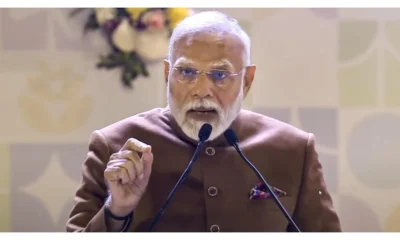
PM Narendra Modi

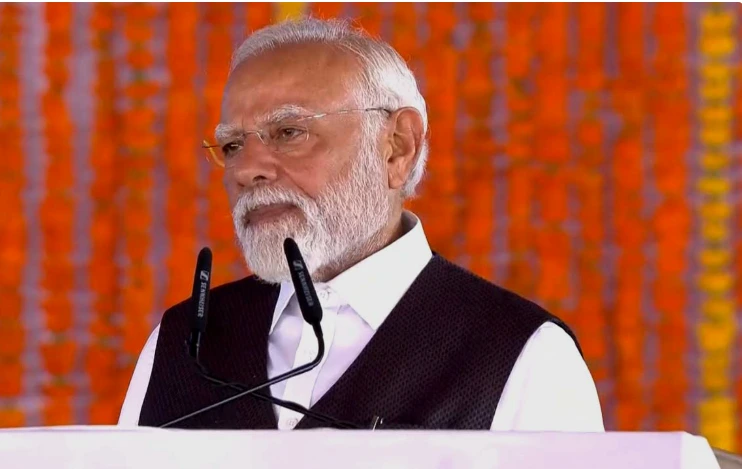
In a strong rebuke to Pakistan, Prime Minister Narendra Modi accused the neighbouring country of plotting to cripple Jammu and Kashmir’s tourism sector and sow communal discord in India. Speaking from Katra after inaugurating two landmark railway projects, PM Modi referenced the tragic killing of 26 tourists in Pahalgam, alleging it was a deliberate attack aimed at undermining the state’s economy.

“Pakistan is against humanity, tourism, and the livelihood of Kashmiris,” PM Modi declared, linking the violence directly to a broader strategy by Pakistan to promote unrest in the region.

India responds with infrastructure strides and military resolve

While addressing the gathering, PM Modi asserted that Pakistan had been warned and would not succeed in its attempts to destabilise the country. The Prime Minister highlighted India’s response through Operation Sindoor, which involved precision strikes on terror hubs in Pakistan and Pakistan-Occupied Kashmir (PoK). These strikes targeted radar systems and air bases, sending a strong message against the harbouring of terrorists.

“Operation Sindoor will remain a reminder of Pakistan’s shameful defeat,” he said, reaffirming India’s stance of targeting terrorism, not the Pakistani people.

Record-breaking infrastructure boost to Jammu and Kashmir

The Prime Minister used the occasion to underscore the Union government’s development push in the region. He flagged off the Vande Bharat Express between Katra and Srinagar, marking the first direct train link between the Jammu region and the Kashmir Valley.

Also inaugurated were two engineering marvels:

  • Chenab Rail Bridge: The world’s highest railway bridge, standing 359 metres above the river—35 metres taller than the Eiffel Tower. The 1.3 km long bridge required more than 600 km of steel welding, exceeding the distance from Jammu to Delhi.
  • Anji Bridge: India’s first cable-stayed railway bridge, spanning 725.5 metres. Its distinctive single pylon structure supports 96 stay cables installed in a record 11 months, stretching a combined length of 653 km.

The train route features India’s second-longest transportation tunnel, the Pir Panjal Railway Tunnel (T-80), which spans 11.22 km between Banihal and Qazigund. The entire rail link involves 36 tunnels and 66.4 km of escape routes, making it a historic milestone in Indian rail engineering.

Railway connectivity promises economic uplift

According to Northern Railway, the new Vande Bharat service offers Chair Car and Executive Class options, priced at ₹715 and ₹1,320 respectively. The enhanced connectivity is expected to boost regional tourism and local employment.

PM Modi’s statements and the launch of these infrastructure projects mark a significant assertion of India’s development agenda in the region, even as it faces continued threats from across the border.

India News

DMK leader’s son arrested after car rams family in Krishnagiri, one dead

A 20-year-old son of a DMK leader has been arrested for allegedly driving a car into four members of a family in Krishnagiri, killing assistant labour inspector Sivamoorthy.

Published

on

DMK leader

A 20-year-old son of a leader from the Dravida Munnetra Kazhagam (DMK) has been arrested for allegedly mowing down four members of a family following a heated argument in Tamil Nadu’s Krishnagiri district. One person died in the incident, police said.

The deceased has been identified as Sivamoorthy, an assistant labour inspector and a resident of Krishnagiri. According to the police, the incident occurred outside his residence after the accused, identified as Adithya, objected to a two-wheeler parked on the road.

Police said Adithya was driving the car and began honking as the two-wheeler was blocking the road. Sivamoorthy and his family members reportedly stepped out to move the vehicle. During the exchange that followed, an altercation broke out.

Investigators allege that Adithya then rammed his car into Sivamoorthy, his son Kirubakaran, daughter-in-law Amsavalli and granddaughter Nilani. Sivamoorthy sustained severe injuries and later succumbed. The others were injured in the incident.

Besides Adithya, two of his friends — Rithik Kumar and Harish — who were present in the car at the time, have also been arrested. A case of murder has been registered against the trio and further investigation is underway.

Kirubakaran, recounting the incident, said the family had attempted to move the parked two-wheeler when the accused damaged it. He alleged that the men appeared intoxicated and tried to assault them with a stick before the vehicle was driven into the family.

Amsavalli said they had tried to defuse the situation peacefully but the confrontation turned violent, resulting in her father-in-law’s death and injuries to her child.

A police officer stated that Adithya’s father is a local functionary of the DMK in Krishnagiri district. The victim’s family has demanded strict action in the case.

Reacting to the incident, state BJP chief Nainar Nagendran criticised the ruling Dravida Munnetra Kazhagam, questioning the state government over the episode and alleging that party functionaries were misusing their influence.

Police said the probe is ongoing.

Continue Reading

India News

Security tightened across Delhi metro stations after bomb threat emails

Delhi is on high alert after bomb threat emails targeted metro stations, the Red Fort and the Assembly. Authorities confirmed the threats were hoaxes but tightened security as a precaution.

Published

on

Delhi Metro

Security has been intensified across all metro stations and major installations in the national capital after a series of bomb threat emails were received on Monday. Authorities later confirmed that the threats were hoaxes following detailed inspections by security agencies.

According to officials, several key institutions — including the Delhi Secretariat, Delhi Assembly, the Red Fort and two schools — received threatening emails earlier in the day. Extensive searches were carried out at all the locations mentioned in the messages, but nothing suspicious was found.

A senior police officer said cyber teams are working to trace the origin of the emails. Preliminary findings suggest that the senders may have used Virtual Private Networks (VPNs) in an attempt to conceal their identities and mislead investigators. Officials expressed confidence that those responsible would be identified.

Metro stations under heightened surveillance

Following specific references to metro services in the emails, security arrangements were strengthened across the entire network of the Delhi Metro Rail Corporation. Additional personnel have been deployed at stations, and anti-sabotage checks are being conducted.

Police said random frisking of passengers and intensified CCTV surveillance are being carried out as part of precautionary measures. Bomb disposal squads and dog squads were stationed at sensitive sites, including the Red Fort, Delhi Secretariat and the Assembly complex.

The threatening emails reportedly included the slogan “Delhi banega Khalistan” and warned of explosions at an Army school, the Assembly and the Red Fort at specific times during the day. Officials stated that all mentioned locations were thoroughly checked and declared safe.

Authorities also coordinated with counterparts in neighbouring states to enhance security at metro stations falling under their jurisdictions.

While no explosives were found, officials said the tightened security arrangements will remain in place as a precaution. Cyber teams continue efforts to trace the IP addresses and identify those behind the threat emails.

Continue Reading

India News

JNU protest turns violent as Left and Right student groups trade charges

A late-night protest at JNU turned violent as Left and ABVP student groups accused each other of stone-throwing and attacks near the East Gate.

Published

on

JNU Protest

Tension gripped the campus of Jawaharlal Nehru University in the early hours of Monday after a protest march allegedly spiralled into violence, with rival student groups accusing each other of triggering the unrest.

Students claimed that the incident occurred around 1.30 am when a confrontation broke out during a march called by the Jawaharlal Nehru University Students’ Union. The protest, named “Samta Juloos”, was headed towards the East Gate and was organised to demand the resignation of Vice-Chancellor Santishree Dhulipudi Pandit and the withdrawal of a rustication order.

According to protesters, several students were injured after alleged stone-throwing during the clash. They alleged that the university administration did not intervene during the march and instead permitted members of the Akhil Bharatiya Vidyarthi Parishad to confront demonstrators.

However, the ABVP denied the allegations and countered that Left-affiliated organisations instigated the confrontation and were spreading misinformation about the events.

Left-backed groups, including the All India Students’ Association, claimed that ABVP activists targeted the JNUSU encampment and hurled stones at “unarmed students”, leading to multiple injuries.

Videos shared by students on social media reportedly showed chaotic scenes near the protest site, with members of rival groups engaged in heated exchanges and physical scuffles.

University authorities did not immediately respond to queries regarding the incident. Students said the situation on campus remained tense following the overnight clashes.

Continue Reading

Trending

© Copyright 2022 APNLIVE.com