English हिन्दी
Connect with us

India News

PM Modi celebrates Diwali with armed forces on LoC in Kashmir’s Rajouri

Prime Minister Narendra Modi, on Sunday, celebrated Diwali with the troops deployed in Jammu and Kashmir’s border district of Rajouri and praised them for their valour, saying it enables the government to take decisions hitherto considered impossible.

Published

on

Modi with soldier

[vc_row][vc_column][vc_column_text]Prime Minister Narendra Modi, on Sunday, celebrated Diwali with the troops deployed in Jammu and Kashmir’s border district of Rajouri and praised them for their valour, saying it enables the government to take decisions hitherto considered impossible.
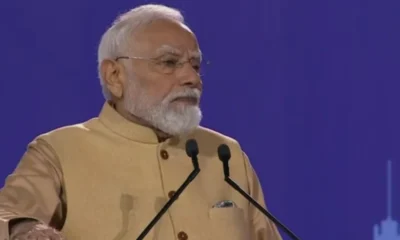
Accompanied by Army Chief General Bipin Rawat, Modi flew to the Army Brigade Headquarters in Rajouri town just a few hours after the Pakistani army targeted forward posts in the district. The shelling from across the border was retaliated by the Indian army.

Wearing a combat jacket, PM Modi exchanged wishes and sweets during his nearly two-hour-long stay and interaction with the troops deployed along the LoC, officials said.

Addressing the 1,000-strong soldiers, PM Modi said, “The valour of the Indian defence forces made it possible for the central government to take decisions which were hitherto considered impossible.”

He was apparently referring to India’s preemptive air strike on a Jaish-e-Mohammad terror camp in Pakistan’s Balakot on February 26 in response to the February 14 Pulwama terror attack in which 40 CRPF personnel were killed besides abrogation of Article 370 provisions.

He said everyone wants to celebrate Diwali with their family and so he too travelled to be with his family, which is the “brave jawans of the armed forces”.

He visited the ‘Hall of Fame’ in Rajouri and paid homage to the soldiers and brave citizens who laid down their lives to protect Rajouri and Poonch sectors.

He termed the Hall of Fame as ‘Parakram Bhoomi, Prerna Bhoomi, Paavan Bhoomi’.

Highlighting the courage and fortitude of the forces in safeguarding national security, PM Modi thanked them on behalf of the people of the country for their monumental service.

To pay homage to and mark their contributions, the government endeavoured to etch the landmark National War Memorial in Delhi, he said, adding the increasing number of visitors to the memorial shows the respect accorded by the citizens towards the contributions of armed forces.

Later in a series of tweets, PM Modi said, “Celebrated #Diwali with the brave soldiers of the Indian Army in Rajouri, Jammu and Kashmir. It is always a matter of great joy to be able to interact with these courageous personnel.”

He also spoke about the steps the NDA government is taking for the welfare of soldiers. “While interacting with our soldiers, I thanked them on behalf of the people of India for their monumental service. Their vigilance and valour keeps our nation safe!”

In another tweet about his visit to the ‘Hall of Fame’, he said, “Anecdotes about the courage of our soldiers are widely shared but do you also know about the stupendous efforts of our armed forces during natural disasters? Their swift action saves many lives and prevents public property from being destroyed.”

On his way back from Rajouri, PM Modi interacted with air warriors and personnel of the army at the Pathankot Air Force Station.

He also posted a short video, with a heading “#Diwali is sweeter when celebrated with our brave soldiers”, in which he is seen offering sweets to the soldiers under a camouflaged tent. The soldiers then raised ‘Bharat Mata ki jai’ slogans.

The prime minister’s visit to Rajouri coincided with Infantry Day celebrations, which is observed to mark the landing of the first Indian troops in Jammu and Kashmir in 1947 to push back Pakistan supported intruders.

This is the third time that PM Modi celebrated Diwali with troops in Jammu and Kashmir since 2014, and the first after the abrogation of Article 370 provisions.

The army personnel were ecstatic and said they feel proud about the prime minister’s “surprise” visit.

“We never thought of the prime minister visiting us and making our Diwali a memorable one… It was a big surprise and we are feeling proud after meeting him,” one of the soldiers said while leaving the venue after the departure of PM Modi.

Since becoming prime minister in 2014, PM Modi has interacted with troops serving in tough areas on Diwali. That year, he visited Siachen in Ladakh region and in 2015, he went to the Punjab border.

The next year, PM Modi was in Himachal Pradesh, where he spent time with Indo-Tibetan Border Police (ITBP) personnel at an outpost.

He visited Gurez sector of north Kashmir in 2017 and last year, he was with Army and ITBP personnel in the icy terrain near the India-China border in Uttarakhand.

(With ANI Inputs)[/vc_column_text][/vc_column][/vc_row]

India News

Amit Shah counters delimitation concerns, says southern states to gain Lok Sabha seats

Amit Shah assures Parliament that southern states will gain Lok Sabha seats after delimitation, countering opposition criticism during the women’s reservation debate.

Published

on

Amit Shah

Union Home Minister Amit Shah on Thursday addressed concerns over the proposed delimitation exercise, asserting in the Lok Sabha that southern states will not lose representation but instead see an increase in their number of seats.

His remarks came during a heated debate linked to the implementation of women’s reservation, where opposition parties have raised fears that population-based delimitation could reduce the political weight of southern states.

Shah rejected these claims, calling them misleading, and said the proposed framework ensures fairness while expanding the overall strength of the Lok Sabha.

Seat count to rise with expansion of Lok Sabha

The government has indicated that the total number of Lok Sabha seats could increase significantly as part of the delimitation process. In this expanded House, the combined representation of southern states is expected to rise from 129 seats at present to around 195 seats.

Shah emphasised that no state will lose seats in absolute terms, and the exercise is designed to reflect population changes while maintaining balance across regions.

State-wise projections shared in Parliament

During his address, Shah also provided indicative figures for individual southern states, suggesting notable increases in representation. According to the projections:

  • Tamil Nadu could see its seats rise substantially
  • Kerala, Telangana, and Andhra Pradesh are also expected to gain additional seats
  • Karnataka’s representation may increase as well

These figures were presented to counter the argument that delimitation would disproportionately favour northern states.

Political debate intensifies over linkage with women’s quota

The delimitation exercise has been closely linked to the rollout of women’s reservation, which proposes one-third seats for women in Parliament and state assemblies.

Opposition leaders have questioned this linkage, arguing that tying reservation to delimitation could delay its implementation and raise federal concerns. Some leaders have also warned that the move could impact national unity if apprehensions among states are not addressed.

The government, however, maintains that the reforms are necessary to ensure equitable representation and to align the electoral system with demographic realities.

Centre dismisses ‘false narrative’ on southern states

Shah reiterated that concerns about southern states losing influence are unfounded. He said the delimitation process will increase representation across regions and described the criticism as a “false narrative” aimed at creating confusion.

The issue is expected to remain a key flashpoint as Parliament continues discussions on the women’s reservation framework and related legislative changes.

Continue Reading

India News

PM Modi assures no discrimination in women’s quota, delimitation debate intensifies in Parliament

PM Narendra Modi has assured that women’s reservation will be implemented without discrimination, amid a heated debate over delimitation in Parliament.

Published

on

PM modi

Prime Minister Narendra Modi has assured that there will be no discrimination in the implementation of women’s reservation, as Parliament witnessed a sharp debate over the proposed linkage between the quota and delimitation exercise.

During the ongoing special session, the government reiterated its commitment to ensuring fair representation while addressing concerns raised by opposition parties regarding the timing and structure of the legislation.

The proposed framework aims to reserve 33 percent of seats for women in the Lok Sabha and state assemblies. However, its implementation is tied to a fresh delimitation exercise, which is expected after the next census.

Opposition questions timing and intent

Opposition leaders have raised concerns that linking the women’s quota to delimitation could delay its implementation. They argue that the process of redrawing constituencies may push the actual rollout further into the future.

The issue has triggered a broader political confrontation, with multiple parties questioning whether the move could alter representation across states.

Some critics have also alleged that the delimitation exercise could disproportionately benefit certain regions based on population, a charge the government has rejected.

Government reiterates commitment to fair implementation

Responding to these concerns, the Centre has maintained that the reforms are necessary to ensure accurate and updated representation based on population data.

Leaders from the ruling side have repeatedly emphasized that the process will be carried out transparently and without bias. The assurance that there will be “no discrimination” is aimed at addressing fears among states and opposition parties.

The debate marks a key moment in Parliament, with both sides engaging in intense exchanges over one of the most significant electoral reforms in recent years.

Continue Reading

India News

Give all tickets to Muslim women, Amit Shah says, attacking Akhilesh Yadav on sub-quota demand

A sharp exchange between Amit Shah and Akhilesh Yadav in Parliament over sub-quota for Muslim women highlights key divisions on women’s reservation implementation.

Published

on

A heated exchange broke out in Parliament during discussions on the women’s reservation framework, with Union Home Minister Amit Shah and Samajwadi Party chief Akhilesh Yadav locking horns over the demand for a sub-quota for Muslim women.

The debate unfolded as the government pushed forward key legislative measures to implement 33% reservation for women in the Lok Sabha and state assemblies.

Akhilesh Yadav argued that the proposed reservation must ensure representation for women from marginalised communities, including Other Backward Classes (OBCs) and Muslim women. He said that without such provisions, large sections could remain excluded from political participation.

He also questioned the timing of the bill, alleging that the Centre was avoiding a caste census. According to him, a census would lead to renewed demands for caste-based reservations, which the government is reluctant to address.

Government rejects religion-based quota

Responding to the demand, Amit Shah made it clear that reservation based on religion is not permitted under the Constitution.

He stated that any proposal to provide quota to Muslims on religious grounds would be unconstitutional, firmly rejecting the idea of a separate sub-quota for Muslim women within the broader reservation framework.

The government has maintained that the existing framework already includes provisions for Scheduled Castes (SC) and Scheduled Tribes (ST) women within the overall reservation structure.

Wider political divide over implementation

The issue of sub-categorisation within the women’s quota has emerged as a major flashpoint, even as most opposition parties broadly support the idea of women’s reservation.

Samajwadi Party leaders reiterated that their support for the bill depends on inclusion of OBC and minority women, while the government continues to defend its constitutional position.

The debate is part of a broader discussion during the special Parliament session, where multiple bills linked to delimitation and implementation of the women’s quota are being taken up.

Continue Reading

Trending

© Copyright 2022 APNLIVE.com