English हिन्दी
Connect with us

India News

Pinned Against The Wall: Losing The Argument In Srinagar

Published

on

Pinned Against The Wall: Losing The Argument In Srinagar

[vc_row][vc_column][vc_column_text]~By Saeed Naqvi

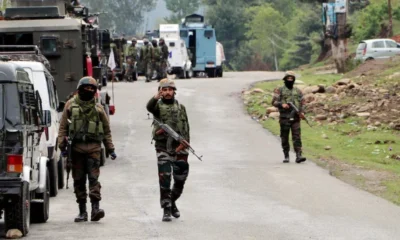
The arrival of Dineshwar Sharma, formerly of the Intelligence Bureau, as the Centre’s interlocutor in the troubled state, has clearly not set the Jhelum on fire. But Hari Niwas, the former Maharaja’s palace, Sharma’s headquarter, has acquired a temporary prominence with Armoured Personnel carriers, TV vans, and a gradually diminishing number of journalists outside. The approaching winter is a deterrence for assembly after sunset.

Reactions range from total nonchalance at the Amar Singh club, to bewilderment among the intelligencia and anger among prominent members of the civil society. “Yet again, this is an insult to Kashmiris; what can an interlocutor find out that the State does not already know after 28 years of total military occupation.”

Subjects that were hush hush in the past are now part of casual conversation over cups of kahva. “Democratization of corruption” for instance. This the intelligence agencies have achieved – transferring cash in ever expanding concentric circles. This kind of money, induces dependency, not gratitude, a sort of helplessness, demoralization, which conceals simmering anger.

Householders are more liable to be implicated in such transactions. This would distance them further from the youth fired by idealism and the social media. It is this youth which is controlling the agitational mood. I must however, add in parenthesis that too much should not be extrapolated from the experience of urban centres like Srinagar.

Hardly a day passes without an encounter, a shootout, disappearances. Director General of Police S.P. Vaid’s boast that 170 militants have been killed this year disguises the hundreds of civilians and security personnel, including the Army, who have also been killed. Figures, in any case, do not reflect the scale of the tragedy.

South Asian Terrorism Portal records 11 civilians, 15 security forces and 40 militants killed in the past two months. These, again, are mere figures. They reveal little. The tragedy is in the empty streets past 9 pm. During a 30 kms ride from a friend’s house near the airport to my hotel past Dal Lake, I saw headlights of one or two cars, but no people, not even security personnel. Has this stretch been totally tranquilized? No one will ever know what fills the spaces within the heart behind those unlit windows?

One of the finer intellectuals in Srinagar tossed in a comparison with Catalonia. He was suggesting that Catalonia is more prosperous than the rest of Spain and is yet in rebellion, seeking independence. The comparison is slightly farfetched even though people in Kashmir are apparently better off than in many places in the rest of India. A study of this relative economic well being would have to be a mean minded accumulation of data. How can you point to the decorous carpet in a man’s house when you have blinded two of his sons with pellet guns?

Lifestyles are sometimes a self-deception, make belief, a cover up for a deeper want. The most spectacular arrangement of colours and motifs in women’s wear in Rajasthan, Kutch and Sind, compensate for the aridity as far as the eye can see.

People living under extreme pressure pick up nuances swiftly. When Mehbooba Mufti, Ram Madhav and Dineshwar Sharma repeat the same image, ears are cocked: “We do not want Kashmir to become another Syria”. This raises a spectre of Jabhat al Nusra, Al Qaeda, the Islamic State. Well, the US had to flatten out Raqqa on the scale of Dresden during World War II and yet allowed 375 IS to sneak out to few know where.

The very mention of Syria invites a kneejerk response. After the massive protests last year following Burhan Wani’s killing, new names are being brought into focus as militant leaders, some of them demanding Shariah law, unusual for youth rebels in their 20s.

Zakir Musa, once associated with Burhan Wani, is being projected as the new jihadist. That Musa is alive in a culture saturated with “encounters”, is interpreted here, by some groups, as the Deep State promoting ogres to justify some drastic action in the future.

In an atmosphere so charged with suspicion, no one is expecting the interlocutor to pull a rabbit out of his hat. He has diligently started visiting senior politicians who ask “what is the bottom line?” To this Sharma cannot possibly be expected to have an answer. Has he been sent to salvage accidental Chief Minister Mehbooba Mufti’s sinking political fortunes? It has certainly given people something to watch – wearily though.

The Sharma initiative makes sense if there is a similar expedition to Pakistan. This cannot happen before the 2019 General elections because such a step would immediately bring down Hindu-Muslim temperatures, a state of affairs most deleterious to the BJP’s electoral health.

In the 70s and 80s I wrote repeatedly with such conviction:

“Indian secularism protects, among a billion others, the world’s second largest Muslim population. Any issue, including Kashmir should be addressed keeping this in mind.’

How foolish I feel when some of the best minds in Kashmir hurl the following at me: Love Jihad, Cow lynchings, Ghar Wapsi, Tipu the traitor, transformation of shrines into temples….

“You in India are a cowering minority” they mock. “We in Kashmir are in battle against occupation.”

“They disempowered you through secularism; they are disempowering us through democracy.” It is a staggering barrage. I find myself wriggling against the wall.[/vc_column_text][/vc_column][/vc_row]

India News

AI errors in voter list digitisation causing hardship during SIR, Mamata writes to EC chief

Mamata Banerjee has written to the chief election commissioner alleging that AI-driven digitisation errors in electoral rolls are causing hardship, harassment and distress to genuine voters during the SIR process in West Bengal.

Published

on

mamta banerjee

West Bengal Chief Minister Mamata Banerjee has once again written to Chief Election Commissioner Gyanesh Kumar, alleging that errors arising from AI-driven digitisation of the 2002 electoral rolls are causing widespread hardship to genuine voters during the ongoing Special Intensive Revision (SIR) exercise in the state.

In her fifth letter since the SIR process began, Banerjee claimed that the use of artificial intelligence tools to digitise older voter lists led to serious inaccuracies in electors’ personal details. According to her, these errors have resulted in large-scale data mismatches, with many genuine voters being wrongly flagged as having “logical discrepancies”.

The chief minister accused the Election Commission of disregarding statutory processes that had been followed over the past two decades. She said voters were now being forced to re-establish their identity despite corrections having been made earlier through quasi-judicial hearings.

Calling the approach arbitrary and illogical, Banerjee alleged that it went against the constitutional spirit by effectively disowning the commission’s own past actions and mechanisms. She further claimed that voters submitting documents during the SIR exercise were not being given proper acknowledgements, terming the procedure “fundamentally flawed”.

Raising concerns over the nature of hearings, Banerjee said the SIR process had become largely mechanical and overly dependent on technical data, lacking sensitivity, human judgment and compassion. She argued that such an approach undermines democratic values and the constitutional framework.

Highlighting the human impact of the exercise, the chief minister claimed that the revision process had already seen 77 deaths, four suicide attempts and 17 cases of hospitalisation. She attributed these incidents to fear, intimidation and excessive workload caused by what she described as an unplanned exercise by the Election Commission.

Banerjee also criticised the treatment of several eminent citizens, alleging that they were subjected to harassment during the process. She further expressed concern over the handling of cases involving women voters, particularly those who had changed their surnames after marriage or shifted to their matrimonial homes.

According to her, women electors were being questioned and summoned to prove their identity, reflecting a lack of social sensitivity and amounting to an insult to women and genuine voters. She questioned whether a constitutional authority should treat half of the electorate in such a manner.

Urging immediate corrective steps, Banerjee called on the Election Commission to address the issues arising from the SIR exercise to end what she described as harassment and agony for both citizens and officials, and to safeguard democratic rights.

Continue Reading

India News

Communist Party of China delegation visits BJP headquarters in Delhi

A delegation from the Communist Party of China, led by Vice Minister Sun Haiyan, visited the BJP headquarters in Delhi and held discussions on inter-party communication.

Published

on

China delegation visits BJP office

A delegation from the Communist Party of China (CPC), led by Sun Haiyan, Vice Minister of the International Department of the CPC Central Committee (IDCPC), visited the Bharatiya Janata Party (BJP) headquarters in Delhi on Monday.

During the visit, the Chinese delegation held discussions with a BJP team headed by party general secretary Arun Singh. The talks focused on ways to advance inter-party communication and engagement between the BJP and the CPC.

Sharing details of the meeting, BJP foreign affairs department in-charge Vijay Chauthaiwale said the interaction involved an in-depth exchange on strengthening party-to-party dialogue. He confirmed the visit in a post on social media, stating that the CPC delegation was received at the BJP head office as part of ongoing inter-party interactions.

The Chinese Ambassador to India, Xu Feihong, was also present during the meeting, accompanying the CPC delegation.

According to Chauthaiwale, the visit was led by Sun Haiyan in her capacity as Vice Minister of the IDCPC, underscoring the importance attached to party-level exchanges between the two sides.

Continue Reading

India News

Only Marathi leadership will run BMC, says Fadnavis ahead of civic polls

Devendra Fadnavis says BMC will remain under Marathi leadership, dismissing opposition claims of threats to the Marathi community ahead of civic polls.

Published

on

Devendra Fadnavis

With elections to major civic bodies approaching, Maharashtra Chief Minister Devendra Fadnavis on Monday asserted that the Brihanmumbai Municipal Corporation (BMC) would continue to be led by a Marathi leader, rejecting opposition claims that the interests of the “Marathi manush” were under threat.

Addressing the political narrative around Marathi identity, Fadnavis said that it was not the Marathi community whose existence was at risk, but certain political forces attempting to create fear ahead of the polls. He stressed that Maharashtra belongs to all Marathi people and not to any single political group.

“I want to reiterate that only a Marathi person will be at the helm of affairs in the BMC. Only Marathi will lead,” the chief minister said, pushing back against allegations of marginalisation of the Marathi community.

Language policy row and cabinet decision

Responding to criticism over the language policy debate, Fadnavis said the recommendation to teach Hindi and English in schools was approved during the tenure of former chief minister Uddhav Thackeray. He clarified that the present government had merely constituted a committee to examine the implementation of that earlier cabinet decision.

According to Fadnavis, the report recommending the inclusion of Hindi and English was submitted in September 2021 and received cabinet approval in January 2022, with the decision being reaffirmed later. “We have only formed a committee to study the implementation of that decision, yet unnecessary controversy was created,” he said.

Opposition sharpens attack

Earlier, Shiv Sena (UBT) chief Uddhav Thackeray accused the state government of damaging Mumbai over the last three years and claimed that the work carried out by the undivided Shiv Sena over 25 years was being undone.

The political rhetoric intensified further after Maharashtra Navnirman Sena (MNS) chief Raj Thackeray called for Marathi unity, warning that Maharashtra’s language, land and identity were under threat. Addressing party workers, he said any attempt to impose Hindi in the state would be opposed and described the upcoming BMC polls as a decisive election for the Marathi community.

The exchanges come ahead of elections to 29 municipal corporations across Maharashtra, including the BMC, Pune Municipal Corporation and Pimpri-Chinchwad Municipal Corporation. Polling is scheduled for January 15, with counting to take place on January 16.

Continue Reading

Trending

© Copyright 2022 APNLIVE.com