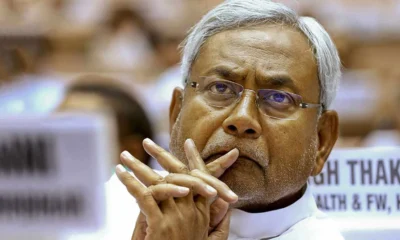
Ahead of the meeting of leaders of NDA constituents on June 7 in the wake of recent polls reverses and discordant noises from within the coalition, Nitish Kumar’s Janata Dal (United) seems to have decided to push its luck and try to extract something more than what was likely.
All said and done, the Bihar chief minister is in a fix. His image as an able administrator – ‘Sushasan Babu’ – has been eroded because of poor law and order, hate crimes and communal clashes in which leaders of his alliance partner BJP have been involved. It has also cost him the support he had among Muslims and his political base has been eroded. Nitish Kumar anyway lacks a sufficiently large, core, solid support base like Lalu Prasad’s Rashtriya Janata Dal (RJD) or BJP.
The BJP treats him like a junior partner, its central leadership has snubbed him on several occasions and the Modi government has paid no heed to some of his key demands.
His waning influence and support base was driven home by the losses in bypolls. Kumar’s party has lost 2 recent assembly bypolls, while BJP has won 1 and lost the Araria Lok Sabha bypoll.
It is a critical phase in Nitish Kumar’s political career. Kumar is weighing his options, and there aren’t many.
He cannot part ways with BJP if he has to stay in power in Bihar and the BJP knows he has nowhere left to go after he ditched the grand alliance with RJD and Congress to ally with BJP once again to hang on as CM.
Nitish Kumar has reportedly tried reaching out to Congress but the response was lukewarm at best. In any case, it is Congress’ ally Lalu Prasad-led RJD that calls the shots in Bihar, not Congress. If they consider taking JD(U) on board at all, it would be after the 2019 Lok Sabha polls.
JD(U)’s problems with BJP
There is growing angst within the JD(U). Signals of JD(U) trying to assert itself follow some earlier statements (in March, after losing Jahanabad bypoll) from the Bihar chief minister.
Nitish Kumar has earlier expressed unhappiness at ‘communal’ politics as BJP pushed its Hindutva agenda. He has revived the demand for special status for Bihar and has also been heard speaking against Assam’s Citizenship Bill and Modi government’s demonetisation move. He had lauded demonetisation earlier.
Resentment against BJP has been brewing in JD(U) for some time, according to several media reports. At the core lies the assertiveness of BJP which is treating it as a junior partner of little value, despite having fewer seats in the state assembly: the BJP had won 53 seats in assembly polls and the JD(U) 71, the tally having gone down after reverses in bypolls.
Unlike previous terms, this time when, increasingly uncomfortable with Lau Prasad-led RJD’s antics, Nitish Kumar deserted the grand alliance to ally with BJP, the latter – with Prime Minister Narendra Modi as its sole icon and BJP president Amit Shah intent on expanding the party and pushing its agenda – started working towards expanding BJP’s base and reduce if not eliminate dependence on support of allies: without the support of Nitish Kumar’s JD(U).
After joining Nitish-led government, this was undertaken aggressively. Pushing the saffron agenda through moves like establishing a ‘Rama circuit’ that includes sites associated with Sita, increasing number of RSS ‘shakhas’, trying communal polarisation, taking out aggressive Ram Navami processions with sword-wielding zealots who provoked riots across eight districts, all are part of this plan.
There are also attempts to ‘militarise’ campuses besides appointing people owing allegiance to RSS as vice chancellors in universities, said a report in the Asia Times.
Snub to Nitish Kumar
On top of this, CM Nitish Kumar was also snubbed on a few occasions, effectively conveying to him his diminished status and importance. One was the demand for special status to Bihar. As in the case of Telugu Desam’s demand for such status to Andhra Pradesh, the Centre paid no heed to this. The TDP walked out of NDA over this: it could, the JD(U) couldn’t if it wanted to stay in power. That hurt.
When Bihar was ravaged by floods, PM Modi came, toured and promised a quick relief of Rs 500 crore with more to follow. The state government later demanded Rs 7,636 crore for flood relief package. The Centre, however, sanctioned only Rs 1,700 crore, which included the Rs 500 crore promised by the prime minister.
The PM also ignored pleas from Bihar CM to accord central university status to Patna University. Nitish Kumar made the request in public. The PM’s silence was thus a snub delivered publicly.
JD(U)’s attempt at asserting itself
When the BJP — and its allies including JD(U) — lost big in bypolls across 10 states, including Uttar Pradesh and Bihar, some NDA allies started having second thoughts about staying on in the alliance (and one – Shiv Sena – has broken off already, although it remains with NDA at the Centre). Some NDA constituents raised voices against BJP and asked it not be have a cavalier attitude towards allies. JD(U) leaders now felt it was time for their party to assert itself.
They also started speaking out. JD(U) spokesperson KC Tyagi told India Today that NDA allies are feeling isolated and a united strategy is needed to win the 2019 general elections.
“UP results are alarming, coming together of two big regional parties of the state, Samajwadi Party and Bahujan Samaj Party, and western UP’s influential party RLD, is a big challenge, there is a need to bring changes in demeanour and work to expand our mass base especially with the farmers,” said KC Tyagi.
Talking about the lessons from the opposition parties’ gains in the bypolls, Tyagi said, “Naidu has left, Shiv Sena is fighting against BJP in Palghar, Akali Dal is unhappy, Indian National Lok Dal our old ally also left us, Mehbooba Mufti’s concerns are not taken seriously, it’s our suggestion that there should be effective campaign with those left in the NDA to make 2019 victory possible.”
After talking about need to be more accommodative towards allies, the JD(U) leader asserted the importance of his party for BJP. “Some people are propagating that JD(U) brings no value to the alliance. They should just recall that in 2005, it was because of the JD(U) that the BJP’s seats went up from 37 to 55. In 2010, it went up to 91,” said Tyagi. “When Nitish broke away, their seat tally plunged to 53.”
Two JD(U) general sectetaries, KC Tyagi and Pawan Verma, declared that Nitish Kumar should be the face of the BJP-led National Democratic Alliance (NDA) in Bihar in 2019 elections because of his popularity.
“Nitish Kumar is the face of the NDA in Bihar, that is why he is the chief minister. JDU is the largest constituent of the coalition,” JDU national general secretary Pavan Varma said after a meeting of top leaders at the chief minister’s home in Patna.
“Our concern is to get the maximum mileage and full dividends out of his [Kumar’s] image for the NDA,” said Tyagi.
Pavan K Varma, said the BJP, Lok Janshakti Party (LJP) and Rashtriya Lok Samta Party (RLSP) will have to approach the Lok Sabha polls under Kumar’s leadership.
The JD(U) also wants to press for a seat arrangement to be worked out now, in advance, for 2019 Lok Sabha elections. It wants the old, 2009 arrangement of seat sharing when it got 25 seats and the BJP 15.
BJP response
The BJP downplayed the comments, insisting there is no dispute. “Jab dil mil gaye (When hearts have connected), seats are no big deal. Who will contest how many seats in elections, all this will be decide after we sit together for our meeting,” senior Bihar BJP leader and Deputy Chief Minister Sushil Modi said.
Reports said BJP leaders, conceding talks were on for seat adjustments, said Nitish Kumar’s statements signifying differences with BJP on issues (backtracking from his support to demonetisation, demand for special category status for Bihar) were basically aimed at positioning before hard bargaining.
JD(U) leaders’ statements voicing these sentiments denote an ambition without ability to achieve it. The BJP fights elections projecting Prime Minister Narendra Modi even in state assembly elections. There is little chance of it going to Lok Sabha polls projecting another alongside.
Even if they agree to posters displaying Nitish’s face, the BJP is highly unlikely to meet JD(U)’s demand for 25 seats. After JD(U) split with BJP before 2014 Lok Sabha polls, the BJP won 22 seats . The JD(U) got only two. Hardly any political party, much less a BJP with a give-no-quarter president like Amit Shah, would agree to fewer seats than what it had won.
Options before Nitish
The JD(U) was also trying to join hands with LJP and RLSP to drive a better bargain with BJP. RLSP, led by Upendra Kushwaha, has openly demanded that seat distribution be done now rather than later.
Some JD(U) leaders say Nitish might perform another flip-flop and pull out of the NDA again, and then form or join a third front.
Some reports say that Kumar, like Shiv Sena’s Uddhav Thackeray, has decided to go solo and the announcement of both the breakups will be made on Vijay Dashmi.
About Nitish Kumar, Manoj Jha, RJD spokesperson and Rajya Sabha MP, was reported to have said some days ago: “Usually in a democracy, the voters write a leader’s political obituary. But Nitish Kumar has written his political obituary all by himself. Today it is BJP vs RJD in Bihar; his party is nowhere in the picture.”