
Latest world news
2017 Was The Hottest Year On Record – Without The El Nino Boost


[vc_row][vc_column][vc_column_text]Backing the common observation that winters have been mild this time, comes the official, scientific data: The year 2017 was the hottest year on record – from the time global records are available – without receiving an additional boost from El Nino.
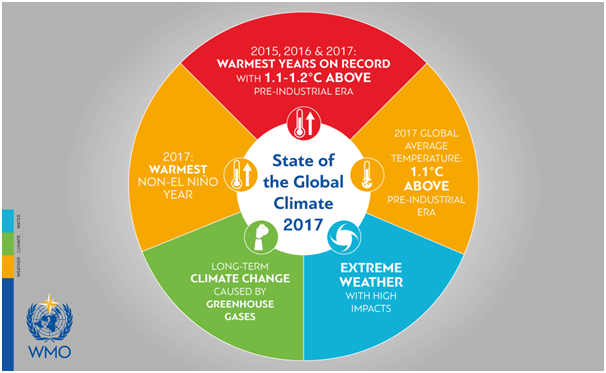
With El Nino, it was the preceding year, 2016, that holds the top position. While there are minor variations in estimates due to different methodologies used, on average, reports said that global temperature in 2017 was 1C above the levels in pre-industrial times, just short of 1.2C recorded in 2016 when the El Niño event in 2015-16 raised the annual average temperature for 2016 by 0.2C.
The high temperature in 2017 was despite the Pacific Ocean moving into its cooler La Niña phase.
NASA pegged the temperature at 0.9C higher, while UN’s World Meteorological Organisation (WMO) said a consolidated analysis of five leading international datasets showed that the global average surface temperature in 2017 was approximately 1.1C above the pre-industrial era.
The three years are the hottest years ever recorded. Furthermore, 17 of the 18 hottest years recorded since 1850 have occurred since 2000.
 [/vc_column_text][/vc_column][/vc_row][vc_row][vc_column][vc_column_text]2017 also saw extreme weather events strike across the world, from hurricanes in the US and Caribbean to heatwaves in Australia and devastating floods in Asia. Many of these events have been shown to have been made much more likely by the heat resulting from global warming, said a report in The Guardian.
“The long-term temperature trend is far more important than the ranking of individual years, and that trend is an upward one,” said WMO Secretary-General Petteri Taalas, in a press release. “Seventeen of the 18 warmest years on record have all been during this century, and the degree of warming during the past three years has been exceptional. Arctic warmth has been especially pronounced and this will have profound and long-lasting repercussions on sea levels, and on weather patterns in other parts of the world.”
“Temperatures tell only a small part of the story. The warmth in 2017 was accompanied by extreme weather in many countries around the world. The United States of America had its most expensive year ever in terms of weather and climate disasters, whilst other countries saw their development slowed or reversed by tropical cyclones, floods and drought,” said Mr Taalas.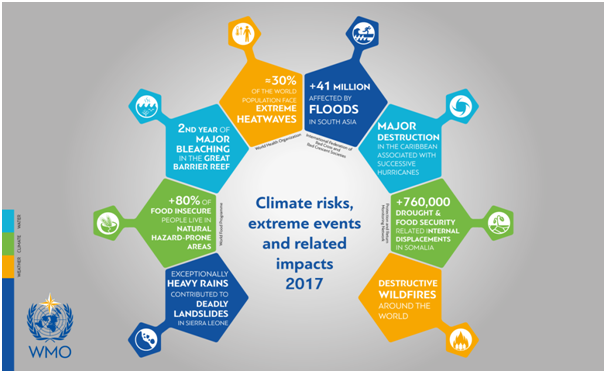 [/vc_column_text][/vc_column][/vc_row][vc_row][vc_column][vc_column_text]In a separate, independent analysis, scientists at the National Oceanic and Atmospheric Administration (NOAA) concluded that 2017 was the third-warmest year in their record.
NASA said the minor difference in rankings is due to the different methods used by the agencies to analyse global temperatures, but over the long-term the agencies’ records remain in strong agreement. Both NASA and NOAA analyses show that the five warmest years on record all have taken place since 2010.
The planet’s average surface temperature has risen about 2 degrees Fahrenheit (a little more than 1 degree Celsius) during the last century or so, a change driven largely by increased carbon dioxide and other human-made emissions into the atmosphere. Last year was the third consecutive year in which global temperatures were more than 1.8 degrees Fahrenheit (1 degree Celsius) above late nineteenth-century levels.
Phenomena such as El Niño or La Niña, which warm or cool the upper tropical Pacific Ocean and cause corresponding variations in global wind and weather patterns, contribute to short-term variations in global average temperature. A warming El Niño event was in effect for most of 2015 and the first third of 2016. Even without an El Niño event – and with a La Niña starting in the later months of 2017 – last year’s temperatures ranked between 2015 and 2016 in NASA’s records.
In an analysis where the effects of the recent El Niño and La Niña patterns were statistically removed from the record, 2017 would have been the warmest year on record.
Warming trends are strongest in the Arctic regions, where 2017 saw the continued loss of sea ice.
Scientists from across the globe warned that the goal of containing the warming within 2C rise – a limit of 1.5C of warming, set as a goal by the international Paris climate change treaty – was approaching very rapidly and that it was more urgent than ever to slash emissions to avoid the worst impacts.
“While climate change deniers continue to bury their heads in the sand, global warming continues unabated,” said Prof Michael Mann, at Pennsylvania State University in the US, according to The Guardian, “And the impacts of that warming – unprecedented wildfires, superstorms and floods – are now plain for all to see. There has never been greater urgency.”
In December, the US president, Donald Trump, suggested cold weather in the eastern US undermined the evidence of climate change, a statement called “phenomenally dumb“ by climate scientist Dr Sarah Myhre.
“Despite colder than average temperatures in any one part of the world, temperatures over the planet as a whole continue the rapid warming trend we’ve seen over the last 40 years,” said GISS Director Gavin Schmidt.[/vc_column_text][/vc_column][/vc_row]







Latest world news
S Jaishankar says India is a natural option for Russia amid Europe tensions
External Affairs Minister S Jaishankar said India remained a natural option for Russia as Moscow increasingly turned towards Asia amid strained relations with Europe. He highlighted the continuity of India-Russia ties and their significance for the balance of power in Asia.


Latest world news
Putin praises PM Modi, says he has very good ideas on Ukraine war
Russian President Vladimir Putin has praised Prime Minister Narendra Modi for repeatedly raising the need to end the Ukraine war, describing his ideas for a settlement as “very good”.

Latest world news
S Jaishankar calls Pakistan a “serial practitioner of terrorism” at UN
S Jaishankar criticised Pakistan at the UN General Assembly, referring to a “serial practitioner of terrorism” and warning against attempts to normalise terrorism.

Dhruv Rathee gets fresh summons in 2018 BJP IT cell video case

Nobody can browbeat judiciary, Chief Justice warns over Rahul Gandhi’s march

India-US trade deal first phase finalised, drafting underway

Election Commission orders voter roll revision in 17 states, UTs

Actor Imran Khan asked to leave India after CJP protest

Delhi Police offers 11-person limit for CJP’s Connaught Place protest
Actor Imran Khan asked to leave India after CJP protest
Election Commission orders voter roll revision in 17 states, UTs
India-US trade deal first phase finalised, drafting underway
Nobody can browbeat judiciary, Chief Justice warns over Rahul Gandhi’s march

Afghan Men Try To Hang With The Jet Engine Of The Aircraft in Kabul- Afghanistan News – Kabul News
Trending Top 10 News: 10000 Crore Fine on Flipkart, Apple to Launch Unique Feature, Hdfc Bank Job Ad

Trending Top 10 News: Nokia 6310, Apple sales, Bachpan ka Pyar Video Kid, Dainik Bhaskar IT Raid

Trending Top 10 News: Canada bans Indian flights, Rain in Delhi NCR, AIMIM Twitter hacked, Raj Kundra case

Trending Top 10 News: Shein India, Apple New Service, Pocket Oxygen, Oppo Launched New Phone
-
 India News20 hours ago
Dhruv Rathee gets fresh summons in 2018 BJP IT cell video case
-
 India News17 hours ago
Nobody can browbeat judiciary, Chief Justice warns over Rahul Gandhi’s march
-
 India News12 hours ago
India-US trade deal first phase finalised, drafting underway
-
 India News10 hours ago
Election Commission orders voter roll revision in 17 states, UTs
-
 India News10 hours ago
Actor Imran Khan asked to leave India after CJP protest
-
 India News8 hours ago
Delhi Police offers 11-person limit for CJP’s Connaught Place protest
