
Latest world news
Israel-Hamas ceasefire holds after escalation in attacks


Both sides claim to hit back if violation occurs
There are contradictory reports of a ceasefire between Gaza based Palestinian resistance groups and Israeli forces. An Arab news network has claimed of a ceasefire agreement between Hamas and Israel, Iranian media has quoted Hamas official saying Palestinian resistance groups have agreed to ceasefire in the blockaded coastal silver as long as Israel abides by a truce.
However, a Hezbollah owned Lebanese network has quoted Israeli Transport and Intelligence Minister Yisrael Katz saying that there was no proposal regarding a military operation in Gaza and denied reaching a ceasefire with Palestinian resistance in the besieged enclave.
Katz, while speaking in an interview in a Ynet studio on Wednesday, said “Cabinet is currently reviewing no proposal by a certified authority to act in an initiated manner to subdue Hamas in Gaza”.
Katz reacted on Hamas’s announcement of a ceasefire saying, “Israel does not hold ceasefires. Our rules of engagement have changed. I won’t be surprised if Hamas realized that and we may indeed be facing a calm, just as soon as they stop firing. Israel doesn’t have anything to do in Gaza.”
 However, Jerusalem Post, a prominent Israeli newspaper reports that “The rocket and mortar fire from Gaza has ceased because of significant strikes that the IDF (Israeli Defense Forces) carried out overnight in Gaza,” a senior source in the Israeli defense establishment said Wednesday.
Read More: PLO Central Council: Palestine to revoke Israel’s recognition
The Israeli Defense official further said, “The IDF launched a significant strike overnight in Gaza and we have acted responsibly, and since the morning the fire has stopped. Israel has delivered a message that if the fire resumes, the attacks on Hamas and the other groups will intensify,” he said.
Earlier Doha based Aljazeera reported that Hamas said on Wednesday that armed groups in the Gaza strip had agreed to deal with Israel following a night of air attacks targeting several Hamas and Islamic Jihad positions in the coastal enclave.
Aljazeera and Tehran based Press TV quoted Khalil al-Hayya, Hamas Deputy chief in Gaza saying in a statement, “A number of mediators intervened in the past hours, and an agreement was reached to return to a ceasefire in Gaza”.
Read More: OIC Summit: Erdogan call Muslim leaders to confront Israel
He further said, “After the resistance succeeded in confronting the [Israeli] aggression … there was a lot of mediation in the past hours. An agreement was reached to return to the (2014) ceasefire understandings in the Gaza Strip. The resistance factions will abide by it as long as the Occupation does the same.”
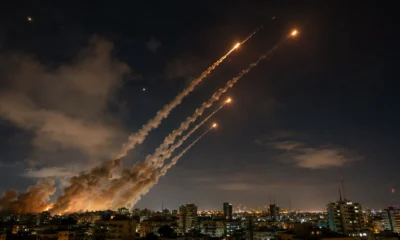
Israel’s Reshet Bet reported that over 180 rockets and mortars were launched towards Israeli civilian areas, and earlier on Wednesday the IDF released an info graphic of 65 airstrikes carried against Hamas targets in the Gaza Strip in response to the over 24 hours of fire launched from the enclave.
Press TV reports that Israeli tank fire and airstrikes hit Gaza on Tuesday. The Tel Aviv regime said its assault came in response to a barrage of rocket and mortar rounds fired at the occupied territories.
Read More: Saudi Crown Prince recognise Israelis right to their own land
Palestinian Authority President Mahmoud Abbas said Israel’s “fierce aggression” on Gaza “indicates that the occupation does not want peace. However, we want peace and we demand peace.”
The military wings of Hamas and the Palestinian Islamic Jihad claimed the “responsibility for the striking of military positions and Zionist settlements,” saying their strikes were in response to Israeli attacks targeting their positions in recent days.
They said in a rare joint statement that Israeli “crimes cannot be tolerated,” warning that “all options will be open” to them.
Read More: Israel’s Mossad killed Hamas engineer in Kuala Lumpur: NYT
Late on Tuesday, Islamic Jihad spokesman Dawoud Shihab told AFP that after Egyptian mediation a “ceasefire agreement was reached with Israel to return to calm. All factions, including Hamas and Jihad, are committed to understandings for calm.”
Observers believe that Hamas strikes on Israeli targets were serious. Egyptian government is considered to be ally of US and Israel. Mediation from Egyptians indicates Israel’s frustration in recent days.
There were reports that after escalation in the attacks from Syria forces and Hamas in Gaza on occupied territories there have been rise in insurance business. Recently American and Israeli citizens went into bunkers to save themselves in occupied Golan Heights from Syrian missile attacks.











Latest world news
Magnitude 7 earthquake strikes Tibet after floods
A magnitude 7 earthquake struck northern Tibet on Thursday, October 22. The tremor came weeks after deadly flash floods and landslides hit the mountainous region near the Nepal-China border. Initial reports did not confirm casualties or damage from the earthquake.


Latest world news
Macron rejects Trump’s immigration claims over France riots
French President Emmanuel Macron criticised Donald Trump and other foreign leaders over their comments on France’s recent unrest. Macron rejected claims that the country was being overrun by migrants and Islamists, calling such assertions false.

Latest world news
Marco Rubio says India and US share extraordinary alignment on key issues
US Secretary of State Marco Rubio said India and the United States share an extraordinary alignment on core issues, even though disagreements between the two countries may arise.


Om Prakash Mathur sworn in as Keralam Governor

PM Modi to inaugurate Rs 169-crore RBI data centre in Odisha on October 25

MEA responds after ITBP chief flags ongoing face-offs with China in Arunachal

Delhi High Court rejects Neha Bora’s plea against peace bond notice

Thousands bang utensils, beat drums in Manipur protest over continued killings

Congress seeks 175-200 seats in UP, Samajwadi Party stresses on winnability
Thousands bang utensils, beat drums in Manipur protest over continued killings
MEA responds after ITBP chief flags ongoing face-offs with China in Arunachal
Delhi High Court rejects Neha Bora’s plea against peace bond notice
PM Modi to inaugurate Rs 169-crore RBI data centre in Odisha on October 25

Afghan Men Try To Hang With The Jet Engine Of The Aircraft in Kabul- Afghanistan News – Kabul News
Trending Top 10 News: 10000 Crore Fine on Flipkart, Apple to Launch Unique Feature, Hdfc Bank Job Ad

Trending Top 10 News: Nokia 6310, Apple sales, Bachpan ka Pyar Video Kid, Dainik Bhaskar IT Raid

Trending Top 10 News: Canada bans Indian flights, Rain in Delhi NCR, AIMIM Twitter hacked, Raj Kundra case

Trending Top 10 News: Shein India, Apple New Service, Pocket Oxygen, Oppo Launched New Phone
-
 India News20 hours ago
Om Prakash Mathur sworn in as Keralam Governor
-
 India News20 hours ago
PM Modi to inaugurate Rs 169-crore RBI data centre in Odisha on October 25
-
 India News18 hours ago
MEA responds after ITBP chief flags ongoing face-offs with China in Arunachal
-
 India News19 hours ago
Delhi High Court rejects Neha Bora’s plea against peace bond notice
-
 India News6 hours ago
Thousands bang utensils, beat drums in Manipur protest over continued killings
-
 India News5 hours ago
Congress seeks 175-200 seats in UP, Samajwadi Party stresses on winnability
