
Latest world news
Israeli jets flying over Yemen, alleges Houthi leader


Amidst large number of killings of Palestinian protesters by Israeli forces in recent weeks, Tel Aviv’s connivance with Riyadh in its air campaign against Yemen has been revealed. Leader of Yemen’s Houthi Ansarullah movement Abdul-Malik Badreddin al-Houthi has, on Saturday, revealed that Israeli warplanes have been detected flying over the key port city of Hudaydah, along the red Sea coast.
According to Sana’a based Arabic language al-Masirah TV network, Houthi said Israeli jets have been seen in Hudaydah’s skies over the past few days amid a push by Saudi mercenaries to seize the city.
“Yemen is actually fighting against a Saudi-Zionist coalition,” he said, referring to a military campaign which Riyadh has been carrying out against Yemen since 2015. Israeli government is referred as Zionist by the media in the region, especially in the countries which are not part of the US-Israel-Saudi Arabia alliance.
Earlier several Western countries including US and UK in particular were widely known to be helping Saudi Arabia led coalition engaged in anti-Yemen aggression. This is the first time when claims of Israeli complicity have been made public.
Read More: Saudi warship attacked by Yemen’s Houthis near Hudaydah
The leader of the Houthi Ansarullah, who have been fighting against the Saudi led aggression, referred to the alleged close ties between Israel and various terrorist groups in Syria and noted that the terrorists in his country are also the “mercenaries and servants” of Tel Aviv and Washington.
 Israel and Saudi Arabia have no diplomatic relations, but there have been reports of two regimes working behind the scenes to establish formal contact. Recently Saudi Arabia has allowed Air India to use its airspace for its commercial flights from New Delhi to Tel Aviv.
Read More: Yemen: Cracks in anti-Houthi Coalition, fears rise of Iran influence
Moreover, a senior Israeli nuclear expert has recently revealed that Israel was selling Saudi Arabia information that would help develop nuclear weapons.
Hudaydah, home to about 400,000 people, is a lifeline for aid to war-torn Yemen. Riyadh claims the Houthis are using the key port for weapons delivery, an allegation rejected by the fighters, who are generally referred to be the pro-Iran group in the western media.
Hudaydah, situated on Yemen’s western Red Sea coast, has witnessed renewed tensions over the past few days. Saudi-backed forces have closed in on Hudaydah, sparking fears of an all-out assault.
 Read More: Saudi Arabia denounces Iran for supplying missiles to Yemen’s Houthis
The UN and humanitarian organizations have warned that a potential Saudi attack on Hudaydah could result in a disaster.
The International Committee of the Red Cross (ICRC) has also warned that fighting in Hudaydah would make “an already catastrophic situation even worse.”
The Geneva based humanitarian institution said in a statement, “The ICRC is line with international humanitarian law urges all the parties to the conflict to respect civilian lives by taking every possible measure to protect civilians.”
Separately on Saturday, al-Masirah reported that Yemeni army soldiers and fighters from allied Popular Committees had destroyed seven Saudi armored vehicles in the kingdom’s southern regions of Asir and Najran.
Read More: Yemen’s Houthi condemn Saudi Arabia for hitting Presidential Office






Latest world news
S Jaishankar says India is a natural option for Russia amid Europe tensions
External Affairs Minister S Jaishankar said India remained a natural option for Russia as Moscow increasingly turned towards Asia amid strained relations with Europe. He highlighted the continuity of India-Russia ties and their significance for the balance of power in Asia.


Latest world news
Putin praises PM Modi, says he has very good ideas on Ukraine war
Russian President Vladimir Putin has praised Prime Minister Narendra Modi for repeatedly raising the need to end the Ukraine war, describing his ideas for a settlement as “very good”.

Latest world news
S Jaishankar calls Pakistan a “serial practitioner of terrorism” at UN
S Jaishankar criticised Pakistan at the UN General Assembly, referring to a “serial practitioner of terrorism” and warning against attempts to normalise terrorism.

Rahul Gandhi hosts high tea for INDIA bloc after Gyanesh Kumar protests

L Murugan quits Union ministry to strengthen BJP in Tamil Nadu

Amit Shah attacks Rahul Gandhi over Congress poll losses, questions SIR row

BJP focuses on religion as opposition pushes BDM strategy in UP

CJP leaders Saurav Das, Ashutosh Ranka, Ajinkya Shinde sent to 5-day judicial custody

PM Modi speaks to Mark Carney as India and Canada push to strengthen ties

S Jaishankar says India is a natural option for Russia amid Europe tensions
CJP leaders Saurav Das, Ashutosh Ranka, Ajinkya Shinde sent to 5-day judicial custody
BJP focuses on religion as opposition pushes BDM strategy in UP
L Murugan quits Union ministry to strengthen BJP in Tamil Nadu

Afghan Men Try To Hang With The Jet Engine Of The Aircraft in Kabul- Afghanistan News – Kabul News
Trending Top 10 News: 10000 Crore Fine on Flipkart, Apple to Launch Unique Feature, Hdfc Bank Job Ad

Trending Top 10 News: Nokia 6310, Apple sales, Bachpan ka Pyar Video Kid, Dainik Bhaskar IT Raid

Trending Top 10 News: Canada bans Indian flights, Rain in Delhi NCR, AIMIM Twitter hacked, Raj Kundra case

Trending Top 10 News: Shein India, Apple New Service, Pocket Oxygen, Oppo Launched New Phone
-
 India News16 hours ago
Rahul Gandhi hosts high tea for INDIA bloc after Gyanesh Kumar protests
-
 India News15 hours ago
L Murugan quits Union ministry to strengthen BJP in Tamil Nadu
-
 India News16 hours ago
Amit Shah attacks Rahul Gandhi over Congress poll losses, questions SIR row
-
 India News14 hours ago
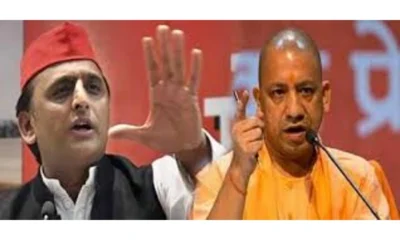
BJP focuses on religion as opposition pushes BDM strategy in UP
-
 India News4 hours ago
CJP leaders Saurav Das, Ashutosh Ranka, Ajinkya Shinde sent to 5-day judicial custody
-
 Latest world news3 hours ago
S Jaishankar says India is a natural option for Russia amid Europe tensions
-
 India News3 hours ago
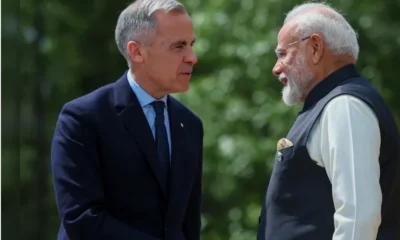
PM Modi speaks to Mark Carney as India and Canada push to strengthen ties
