English हिन्दी
Connect with us

Latest world news

Pakistan closes entire airspace after Indian strikes under Operation Sindoor

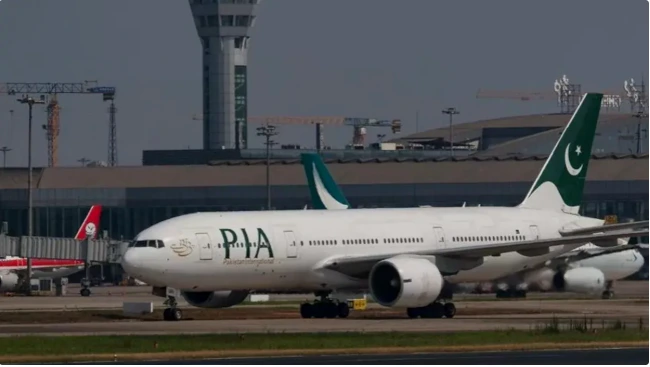
In a major escalation, Pakistan has shut down its entire airspace after Indian armed forces launched missile strikes on terror camps under Operation Sindoor.

Published

on

In a sharp escalation of tensions between India and Pakistan, Islamabad has announced a complete closure of its airspace following a series of targeted missile strikes carried out by the Indian armed forces under Operation Sindoor. The strikes, launched early Wednesday, reportedly hit nine terror-linked sites located both in Pakistan-occupied Kashmir and deep inside Pakistani territory.

Full airspace closure amid military strain

Until now, Pakistan had limited its airspace restrictions only to Indian-owned or operated flights. However, the fresh military offensive has prompted the Pakistani authorities, including the aviation regulator and military command in Rawalpindi, to declare a blanket 48-hour airspace shutdown. The restrictions apply to all domestic and international flights, sparing only select essential aircraft.

According to sources, air traffic to key airports like Islamabad and Lahore was immediately rerouted to Karachi during and after the strikes, straining operations at the southern hub. Soon after, all civil aviation operations across the country were suspended, plunging Pakistan into a temporary no-fly zone.

India responds to cross-border terror link

The Indian government has clarified that the strikes were a retaliatory step against Pakistan’s alleged involvement in facilitating terror activities, specifically pointing to the Pahalgam terror attack that claimed the lives of 26 civilians. That attack, deemed to be religiously motivated, followed provocative remarks made by Pakistan’s army chief Asim Munir, further intensifying the situation.

India’s action was designed to neutralize terror launchpads and infrastructure, which intelligence indicated had direct links to cross-border operations.

Pakistan deliberates, military response expected

In response, Prime Minister Shehbaz Sharif convened an urgent meeting of Pakistan’s National Security Council to chart a potential course of action. While the closure of airspace has been described by Pakistan as a “precautionary” move, officials have hinted at military retaliation.

However, according to defense experts, any further military step by Pakistan at this stage may be viewed internationally as an act of escalation rather than justified retaliation.

India remains on alert, Western front partially restricted

India has also placed restrictions on civil aviation operations at several airports along the western front, maintaining heightened readiness for any possible reaction from Pakistan. Officials in New Delhi have reiterated that India remains fully prepared and “will retaliate resolutely” should the situation deteriorate further.

Operation Sindoor, the latest kinetic military action by India, marks a significant strategic message amidst growing concerns about regional stability and terror-linked activities across the Line of Control.

India News

Bangladeshi singer James’ concert cancelled after mob attack in Faridpur

A live concert by Bangladeshi singer James was cancelled in Faridpur after a mob allegedly attacked the venue with bricks and stones, raising concerns over safety of artists.

Published

on

Bangladesh singer concert

A concert by popular Bangladeshi singer James was cancelled in Faridpur, around 120 kilometres from Dhaka, after a mob allegedly threw bricks and stones at the venue, forcing local authorities to call off the event.

According to local reports, the concert was scheduled for 9 pm on Friday to mark the anniversary of a local school. A group of attackers attempted to forcibly enter the venue and began pelting stones, creating panic among the audience. Locals said students present at the site initially tried to resist the attackers, but the situation escalated, prompting authorities to cancel the programme.

Taslima Nasreen raises concern over attacks on culture

Author Taslima Nasreen highlighted the incident on social media, expressing concern over what she described as a growing pattern of attacks on artists and cultural spaces in Bangladesh. In her post, she referred to earlier incidents involving cultural institutions and said that the singer was not allowed to perform due to the actions of radical elements.

Nasreen also cited recent instances involving classical musicians. She mentioned that Siraj Ali Khan, grandson of renowned musician Ali Akbar Khan and a noted artist of the Maihar gharana, returned to India without performing in Dhaka, stating he would not return until artists and cultural institutions were safe. She further said that Arman Khan, son of Ustad Rashid Khan, had also declined an invitation to perform in Dhaka.

James’ popularity and wider concerns

James, a well-known Bangladeshi singer-songwriter, guitarist and composer, is the lead vocalist of the rock band Nagar Baul. He has also sung popular Hindi film songs such as Bheegi Bheegi from Gangster and Alvida from Life In A Metro, making him a familiar name across the region.

The cancellation of his concert has drawn attention to recent attacks on cultural organisations, artists and journalists in Bangladesh. Critics have alleged that the interim administration has failed to rein in violent mobs, amid claims that such incidents are contributing to a deteriorating law-and-order situation ahead of elections scheduled in February.

Continue Reading

Latest world news

India flags attacks on Hindus in Bangladesh as worrisome after recent lynchings

India has reacted sharply to recent lynchings of Hindu men in Bangladesh, calling the attacks on minorities worrisome and urging that those responsible be brought to justice.

Published

on

Randhir Jaiswal

India has expressed strong concern over a series of violent incidents targeting members of minority communities in Bangladesh, following the lynching of two Hindu men in separate incidents. The Ministry of External Affairs said such attacks are “worrisome” and cannot be ignored, stressing that those responsible must be held accountable.

Speaking on Friday, External Affairs Ministry spokesperson Randhir Jaiswal said New Delhi has taken serious note of the developments across the border and is closely monitoring the law and order situation. He underlined that continued violence against minorities, including Hindus, Christians and Buddhists, remains a matter of grave concern for India.

“The unremitting hostility against minorities in Bangladesh at the hands of extremists is deeply troubling,” Jaiswal said, while condemning the recent killing of a Hindu youth in Mymensingh. He added that incidents of violence cannot be dismissed as exaggeration and expressed hope that perpetrators would be identified and punished.

According to the ministry, over 2,900 incidents of violence against minorities — including killings, arson and land-related crimes — have been documented by independent sources during the tenure of Bangladesh’s interim government. These developments, India said, cannot be brushed aside.

Rajbari killing under investigation

The latest incident took place on Wednesday in Pangsha upazila of Rajbari district, around 145 km west of Dhaka. As per police accounts quoted by media, the victim, identified as Amrit Mondal, was beaten to death by local residents following allegations of extortion.

Police said Mondal was suspected of leading a criminal gang and had allegedly attempted to extort money from a local resident along with his associates. Locals confronted the group and assaulted Mondal, leaving him critically injured. He was later taken to a hospital, where doctors declared him dead in the early hours of the morning.

Mondal’s body was sent to Rajbari Sadar Hospital for post-mortem examination. While most of his alleged associates fled, police said one person was arrested and firearms were recovered. Investigators also noted that Mondal had multiple criminal cases registered against him, including a murder case.

Lynching in Mymensingh sparks outrage

The Rajbari incident came days after another Hindu man was lynched in Mymensingh, triggering widespread outrage. The victim, identified as Dipu Das, also referred to as Dipu Chandra Das, was a factory worker in the city, located about 112 km north of Dhaka.

According to police and local reports, Das was attacked by a mob over allegations of blasphemy. He was first beaten outside a factory and later hanged from a tree. After the killing, his body was left along the Dhaka-Mymensingh highway and set on fire, leading to traffic disruption. Videos of the incident circulated widely on social media, fuelling anger and concern.

Interim government responds

Bangladesh’s interim government, led by Chief Adviser Muhammad Yunus, condemned the killing and said it does not support illegal activities, mob violence or mass beatings. At the same time, it maintained that the Rajbari incident was not communal in nature, describing it as a violent episode linked to alleged extortion and criminal activities. The administration said legal action would be taken against all those directly or indirectly involved.

India, however, reiterated that violence against minorities is a serious issue and called for effective action to ensure justice and safety for vulnerable communities.

Continue Reading

Latest world news

Khaleda son Tarique Rahman arrives to rapturous welcome in Bangladesh

Tarique Rahman returned to Bangladesh after 17 years and, in his first speech, invoked Martin Luther King while outlining what he called a plan for the country’s future.

Published

on

Khalida Zia son

Bangladesh Nationalist Party (BNP) acting chairman Tarique Rahman, who returned to Bangladesh on Thursday after 17 years in exile, outlined his political vision in his first public address, drawing a comparison with American civil rights leader Martin Luther King Jr.’s famous “I have a dream” speech.

Addressing a massive gathering in Dhaka, Rahman said that just as Martin Luther King spoke of a dream, he wished to speak of a concrete plan for Bangladesh. He referred to the country as “Beloved Bangladesh” and thanked party leaders, workers and citizens who stood by the BNP during his absence.

Rahman, the son of former President Ziaur Rahman and former Prime Minister Khaleda Zia, said that his plan would succeed only with public support and urged citizens to participate actively in nation-building.

Parallels drawn with 1971 and 2024 movements

In his speech, Rahman linked the 1971 Liberation War with the 2024 uprising against the government of former Prime Minister Sheikh Hasina. He said those who lost their lives in these movements should be honoured by building the country they had envisioned.

“We liberated Bangladesh in 1971, and we liberated it again in 2024,” he said, adding that the events of 2024 were about defending the country’s independence and sovereignty. He stressed the need to “repay the blood debt of the martyrs” through responsible governance.

Emphasis on tolerance, safety and economic rights

Touching upon Bangladesh’s social fabric, Rahman said the country belongs to everyone, irrespective of religion or geography, and underlined the importance of tolerance. He spoke about creating a safe environment where women, men and children can move freely without fear.

He also said the BNP would focus on peace, political reform and strengthening the economy. Referring to student leader Sharif Osman Hadi, Rahman said he had dreamt of a democratic Bangladesh and promised justice in connection with his killing, along with restoring people’s economic rights.

Call to youth and visit to Khaleda Zia

Rahman called upon the younger generation to take responsibility for development and stability, stressing that collective effort would be crucial to implementing his plan for Bangladesh.

After the address, he left to visit his ailing mother, Khaleda Zia, who is undergoing treatment at Evercare Hospital.

Rahman has been living in exile since 2008 following convictions in multiple corruption cases, which he has described as politically motivated. He has also alleged that the previous government attempted to assassinate him through torture.

With the Awami League barred from contesting elections, the political landscape has narrowed significantly. The BNP now holds a dominant position, and Rahman’s return has added fresh momentum and uncertainty to Bangladesh’s political future.

Continue Reading

Trending

© Copyright 2022 APNLIVE.com