
Latest world news
Trump-Rouhani Rhetoric Continue At UN General Assembly


Trump embarrassed as world leaders laughed on his “achievement” claims
The UN headquarters in New York witnessed US President Donald Trump and his Iranian counterpart Hassan Rouhani clashing sharply on Tuesday, when Trump urged international community to isolate Tehran from global trade while Rouhani called US sanctions “economic terrorism”.
According to reports coming in all speculations of a possible bilateral meeting between the two leaders at the world body devolved into a war of words over Trump’s decision to withdraw from the 2015 nuclear deal and to re-impose economic sanctions on Iran.
While addressing the UN General Assembly, US President Donald Trump fired the first volley, repeating his administration’s contention that Iran is the world’s “leading sponsor of terrorism”.
He went on accusing Tehran saying, “Iran’s neighbours have paid a heavy toll for the regime’s agenda of aggression and expansion,” and having “embezzled billions of dollars” from the country’s treasury to wage proxy wars.
“The dictatorship used the funds to build nuclear-capable missiles, increase internal repression, finance terrorism, and fund havoc and slaughter in Syria and Yemen,” he said.
He said, “We ask all nations to isolate Iran’s regime as long as its aggression continues.” He promised Iran would face more difficulties when the second round of sanctions targeting its energy sector will be re-imposed on November 5.
Iranian President Hassan Rouhani responded back at Trump saying his decision to impose more sanctions is a form of “economic terrorism”. He also accused US administration of trying to topple his government.
 Rouhani further said,”It is ironic that the US government does not even conceal its plan for overthrowing the same government it invites to talks.”
Avoiding naming Trump, he said some world leaders are undermining world security by their “recklessness and disregard of international values and institutions.”
Read More: Iran Alleges US, Its Gulf Allies for Ahvaz Terror Attack
He further said, “Confronting multilateralism is not a sign of strength, rather a symptom of the weakness of intellect. The government of the US – at least the current administration – seems determined to render all international institutions ineffectual.”
Rouhani said he was pleased that the international community did not follow the Trump administration’s “unilateral and illegal withdrawal from the JCPOA”.
In May, the US President Donald Trump had pulled out of the multilateral Iran nuclear deal signed in 2015 by five permanent UNSC members and Germany, generally known as P5+1. It was implemented in January 2016 paving the way for relaxing sanctions against Iran.
After US withdrawal from the deal, Washington re-imposed the first round of sanctions in August this year. Second round of sanctions are scheduled to be imposed on November 5, including rougher sanctions on Iran oil export.
Earlier there was speculation whether the two leaders would meet during UNGA in New York. Trump said he would be willing to meet without preconditions. But Iranians refused to meet until US rejoins the nuclear deal.
Read More: US Still Studying On Possible Iran Sanctions Waivers
Meanwhile, the five remaining parties to JCPOA – France, Britain, Germany, China and Russia – agreed during a meeting with Iranian foreign minister Javad Zarif in New York late on Monday to set up a payment system to preserve business ties with Iran despite US sanctions.
Meanwhile, in an unprecedented incident, Donald Trump faced embarrassment when world leaders laughed at him while he claimed several achievements of his government during last two years.
See video:
Trump opened his speech by declaring, “In less than two years, my administration has accomplished more than almost any administration in the history of our country.”
The audience almost immediately burst into derisive laughter, in a moment that is set to go down in history as one of the most embarrassing moment for any American leader on the global stage.
Stumped but laughing along with the crowd, Trump tried to move past it by saying, “I didn’t expect that reaction, but that’s OK.”




Latest world news
S Jaishankar says India is a natural option for Russia amid Europe tensions
External Affairs Minister S Jaishankar said India remained a natural option for Russia as Moscow increasingly turned towards Asia amid strained relations with Europe. He highlighted the continuity of India-Russia ties and their significance for the balance of power in Asia.


Latest world news
Putin praises PM Modi, says he has very good ideas on Ukraine war
Russian President Vladimir Putin has praised Prime Minister Narendra Modi for repeatedly raising the need to end the Ukraine war, describing his ideas for a settlement as “very good”.

Latest world news
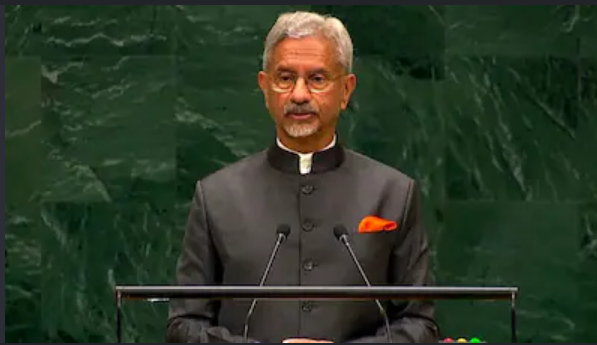
S Jaishankar calls Pakistan a “serial practitioner of terrorism” at UN
S Jaishankar criticised Pakistan at the UN General Assembly, referring to a “serial practitioner of terrorism” and warning against attempts to normalise terrorism.

Dhruv Rathee gets fresh summons in 2018 BJP IT cell video case

Nobody can browbeat judiciary, Chief Justice warns over Rahul Gandhi’s march

India-US trade deal first phase finalised, drafting underway

Election Commission orders voter roll revision in 17 states, UTs

Actor Imran Khan asked to leave India after CJP protest

Delhi Police offers 11-person limit for CJP’s Connaught Place protest
Actor Imran Khan asked to leave India after CJP protest
Election Commission orders voter roll revision in 17 states, UTs
India-US trade deal first phase finalised, drafting underway
Nobody can browbeat judiciary, Chief Justice warns over Rahul Gandhi’s march

Afghan Men Try To Hang With The Jet Engine Of The Aircraft in Kabul- Afghanistan News – Kabul News
Trending Top 10 News: 10000 Crore Fine on Flipkart, Apple to Launch Unique Feature, Hdfc Bank Job Ad

Trending Top 10 News: Nokia 6310, Apple sales, Bachpan ka Pyar Video Kid, Dainik Bhaskar IT Raid

Trending Top 10 News: Canada bans Indian flights, Rain in Delhi NCR, AIMIM Twitter hacked, Raj Kundra case

Trending Top 10 News: Shein India, Apple New Service, Pocket Oxygen, Oppo Launched New Phone
-
 India News22 hours ago
Dhruv Rathee gets fresh summons in 2018 BJP IT cell video case
-
 India News19 hours ago
Nobody can browbeat judiciary, Chief Justice warns over Rahul Gandhi’s march
-
 India News14 hours ago
India-US trade deal first phase finalised, drafting underway
-
 India News12 hours ago
Election Commission orders voter roll revision in 17 states, UTs
-
 India News12 hours ago
Actor Imran Khan asked to leave India after CJP protest
-
 India News10 hours ago
Delhi Police offers 11-person limit for CJP’s Connaught Place protest
