English हिन्दी
Connect with us

Latest world news

China Briefing Diplomats On Doklam: Doval Must Follow Up For India

Published

on

China Briefing Diplomats On Doklam: Doval Must Follow Up For India

[vc_row][vc_column][vc_column_text]

By Saeed Naqvi

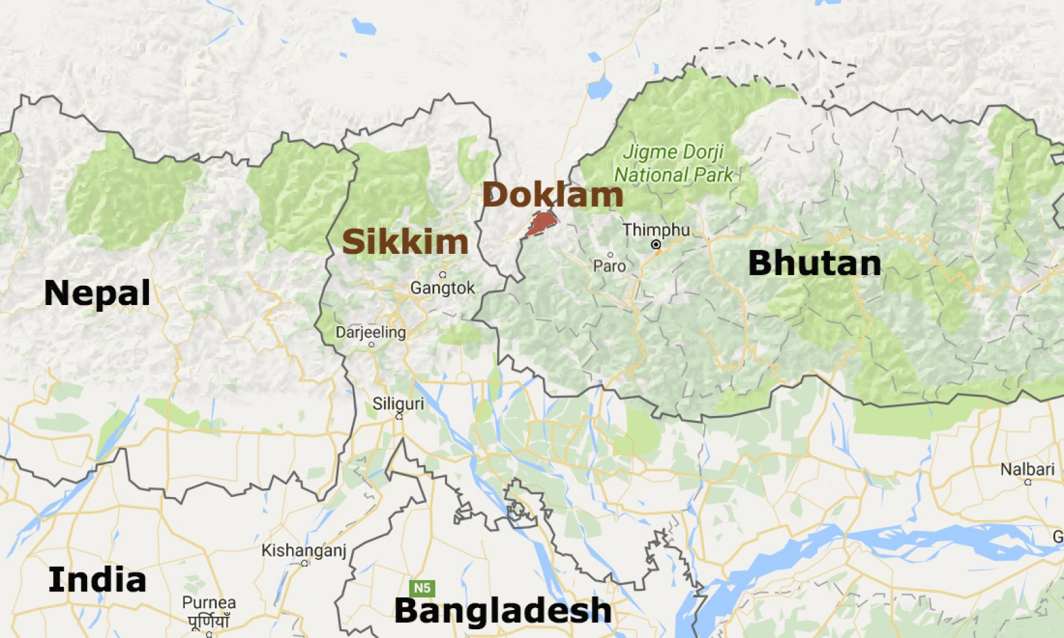
It reflects on the delicate diplomacy involved that the principal issue in the China-India standoff at Doklam is being mentioned only in muted tones. The problem is the undemarcated boundary between China and Bhutan. This demarcation would require Bhutan-China to settle the matter.

The two doing a pirouette is not a good sight for India, which has a special bond with Bhutan sanctified in a treaty signed in 1949. Clause 2 of the treaty amended in 2007, (on which later) stated that Thimpu would be “guided by the advice of the government of India in its external relations”. How can Thimpu settle its border, independent of the Sino-Indian boundary?

Thimpu needed chaperoning when it took its first baby steps as a sovereign state. But once it came of age and made a formal debut at the UN’s great ball (at India’s initiative) in 1971, it began to feel the urge to dance with other partners, of course, without rupturing the special bond dictated by the 1949 treaty. India would remain more equal than others but others there shall surely be. India says “fine” but has palpitations when it fears that Bhutan may be groping for China’s hand.

At the coronation of the present king’s father Jigme Singye Wangchuk in 1974, Foreign Minister, Dawa Tsering said something that was not honeyed music to New Delhi.

India’s advice in the conduct of foreign affairs was welcome but “not binding” on Bhutan, he said. Indeed, among those invited to the coronation was China which turned up with a delegation, not a pleasing sight for the Indian contingent. A gentle, feather touch has marked Indo-Bhutanese diplomacy in both the capitals. Years 1978-79, when Atal Behari Vajpayee was the External Affairs Minister, were marked by considerable warmth in relations.

In August 1978, diplomatic missions in New Delhi received a circular from the Bhutan mission that henceforth it should be addressed as the Royal Bhutan Embassy. The upgradation of the mission was not without considerable debate in South Block.

Prime Minister Morarji Desai downwards there was an entire hierarchy, principally Foreign Secretary Jagat Mehta, endorsing a more relaxed policy towards Bhutan freeing the Himalayan kingdom from the more restrictive interpretations of the 1949 treaty. But there were hawks too

Desai’s government fell in July 1979 making way for Charan Singh’s five month rule. More damage was done to New Delhi’s relations with Thimpu during this brief period by the new, inexperienced External Affairs Minister, Shyam Nandan Mishra, than at any other period.

He led the Indian delegation to the Havana summit of Non-Aligned Nation where the King of Bhutan took a position on a key issue which was independent to the brief Mishra was carrying.

The cold war was at its peak. Indo-China was still at the centre of conflict. The two blocs were in fierce competition on who should occupy Kampuchea’s seat at the summit? Pol Pot, backed by US and China, or Heng Samrin installed in Phnom Penh after Vietnam ousted Pol Pot. He set up sanctuaries on the border with Thailand.

It seems almost comical to reflect that the world was, in the late 70s, riveted on Phnom Penh, Pol Pot and Heng Samrin. But contemplate the global picture, and the chips fall into place.

In 1972, Nixon’s visit to Beijing, creating a triangular strategic balance disadvantageous to Moscow. In 1978 Communists had come to power in Kabul, paving the way for Soviet invasion. Next year, the Shah fell in Tehran. A pro West Morarji Desai lost power in 1979. But in Pakistan, a pro West Zia ul Haq held onto power.

After what I saw at the battle of Lang Son, it was clear as daylight who won but American media dragged its feet conceding victory to Vietnam in the Sino-Vietnam war of 1979. Vietnam’s ouster of Pol Pot, his genocidal record notwithstanding, was, on the global chessboard, a reversal for both China and the US. Their romance was in its 9th year.

It was in this tense global situation that Mishra, on his first mission as foreign minister, attempted to goad the King towards Heng Samrin (Soviet Union) while his own position was unclear. He must have made for a clumsy diplomat, because the King voted for Pol Pot much to the glee of US, China and Pakistan.

So cross was the King by the indecorous way he had been handled in Havana, that, on his way back to Thimpu, he sought me out for what turned out to be a controversial interview. This was the only interview the King of Bhutan had ever granted to the media. I was then the Special Correspondent of the Indian Express.

He clarified his vote in Havana. If Bhutan had not asked for Pol Pot’s representative to be seated at Havana, it would have been tantamount to endorsing Vietnamese armed intervention in Kampuchea. He then made the allegation, “India took no position at all: can you blame us if we took one and can our stand be described as being in opposition to India?” India’s stand was neither here nor there: let Pol Pot be seated but not participate – a non stand endorsed at an earlier NAM meet.

On the relevance of the 1949 treaty he said: “If you want my candid reply and not a diplomatic one – the treaty can certainly be brought upto date.” The two countries have not had serious differences in the interpretation of Article 2 of the treaty. “But why should we retain a treaty which can lend itself to loose interpretations?”

The King was uncomfortable with the expression “close consultations” defining relations. He preferred “close understanding” – consultations implied advice.

The spirit of what the King said in September, 1979, influenced the language of the treaty when it was revised in 2007. The new words were, “India and Bhutan will cooperate closely with each other on issues relating to their national interests. Neither government should allow its territory for activities harmful to its national security.”

What will be the upshot of the Doklam standoff? Well, the king’s explosive interview (on which more later), did have a ripple effect which, in slow measure, resulted in an amended treaty, freeing Bhutan somewhat.

In the given situation, similar advantages will accrue to Bhutan post Doklam. These advantages will not displease China.

After his return from Beijing, the National Security Adviser, Ajit Doval, must brief the diplomatic corps in New Delhi which so far has heard only from the Chinese here and in important capitals. To my knowledge only the American have been briefed by South Block.

[/vc_column_text][/vc_column][/vc_row]

Latest world news

Asim Munir appointed Pakistan’s first Chief of Defence Forces, to serve 5-year term

Field Marshal Asim Munir has been appointed Pakistan’s first Chief of Defence Forces, consolidating top military authority under a new constitutional amendment.

Published

on

Pakistan has named Field Marshal Syed Asim Munir as its first Chief of Defence Forces (CDF), marking a major restructuring in the country’s military command. The appointment was approved by President Asif Ali Zardari following a formal recommendation from Prime Minister Shehbaz Sharif.

Munir to hold dual charge as COAS and CDF

According to the President’s office, Munir will serve concurrently as Chief of the Army Staff (COAS) and Chief of Defence Forces for a five-year tenure. The creation of the CDF role — introduced under the 27th Constitutional Amendment — aims to centralise top-level military authority.

This decision comes after days of speculation due to delays in issuing the official notification, which was originally expected on November 29, the day Munir’s previous three-year term as army chief ended.

Former Indian security official Tilak Devasher had earlier commented to media that the Prime Minister appeared to be avoiding issuing the notification, leading to confusion within Pakistan’s military command structure.

Zardari also approves extension for Air Chief

Alongside Munir’s elevation, President Zardari approved a two-year service extension for Air Chief Marshal Zaheer Ahmad Babar Sidhu, effective from March 2026. The President extended his best wishes to both officers.

Munir, promoted to Field Marshal earlier this year, becomes only the second military officer in Pakistan’s history to hold this rank — the first being Gen. Ayub Khan.

Continue Reading

Latest world news

Imran Khan accuses Asim Munir of mental torture, says sister after rare jail meeting

Imran Khan has alleged “mental torture” inside Adiala Jail, according to his sister who met him after weeks of blocked access. The family claims authorities are withholding information about his condition.

Published

on

Former Pakistan Prime Minister Imran Khan has alleged that he is being “mentally tortured” in prison and held General Asim Munir responsible for his continued isolation, according to his sister Dr Uzma Khanum, who met him inside Rawalpindi’s Adiala Jail for 20 minutes.

Sister says Khan “angry” over isolation

Dr Khanum told reporters that her brother is allowed out of his cell only briefly and has no means of communication with the outside world. She said Khan expressed anger over the conditions in which he is being held, stating he remains confined all day with no access to his family or party members.

She also said Imran Khan directly blamed General Asim Munir — now seen as Pakistan’s most powerful authority, having consolidated military control and secured lifetime immunity for top officials — for the treatment he is receiving in custody.

Meeting follows weeks of denied access

The rare meeting came after weeks of barred family visits, which fuelled speculation about Khan’s health. His sisters earlier claimed they were assaulted when they sought permission to meet him, while his sons publicly alleged that jail authorities were concealing “something irreversible” about his condition.

One of his sons, Kasim Khan, told media that despite a court order for weekly family meetings, they had no direct or verified contact.

Family members also said prison authorities repeatedly refused entry to Imran Khan’s personal doctor.

Rumours and protests intensify

Before Tuesday’s meeting, neither his relatives nor his Pakistan Tehreek-e-Insaf colleagues had seen him for over 25 days, triggering widespread rumours of his death — speculation that officials did not counter with proof of life even as pressure mounted on Prime Minister Shehbaz Sharif’s government.

PTI’s Senator Khurram Zeeshan claimed Khan was being kept in isolation to force him into leaving Pakistan and accused authorities of withholding photos or videos due to fears over his influence.

The situation has sparked protests across Islamabad and Rawalpindi, including demonstrations outside the Islamabad High Court.

In jail since August 2023

Imran Khan, the 72-year-old former cricketer and World Cup-winning captain, has been incarcerated since August 2023. Rumours about his wellbeing first circulated from social media accounts in Afghanistan, at a time when both countries have been locked in military tensions over a border dispute.

Continue Reading

Latest world news

Trump pledges permanent pause on migration from Third World countries in Thanksgiving message

US President Donald Trump declared that migration from all Third World countries will be permanently paused, criticising current immigration policies and announcing measures to remove non-citizens who he says do not benefit the US.

Published

on

US President Donald Trump has announced that he will “permanently pause migration from all Third World countries”, asserting that the move is necessary for the United States to “recover” and “heal”. His remarks were delivered in a Thanksgiving post, where he sharply criticised the Biden administration’s immigration policies and outlined sweeping measures aimed at restricting migration and removing non-citizens who, he says, do not contribute to the country.

Trump said he intends to reverse what he described as “illegal admissions”, end federal benefits for non-citizens, and strip citizenship from migrants who pose security concerns. He also reiterated plans to deport individuals he considers a “public charge” or “non-compatible with Western Civilization”.

The statement came shortly after two members of the National Guard were shot near the White House, an attack Trump called an “act of terror”.

One National Guard member dies after Washington shooting

Trump confirmed that Specialist Sarah Beckstrom, 20, one of the two West Virginia National Guard soldiers shot near Farragut West Metro station on Wednesday, died of her injuries. The ambush occurred while Trump was in Florida.

The alleged shooter was identified as Rahmanullah Lakanwal, a 29-year-old Afghan national who entered the US in September 2021, according to enforcement officials.

‘Reverse migration’ needed, says Trump

In his post, Trump said his actions aim to significantly reduce “illegal and disruptive populations”, adding that only “reverse migration” can address the current situation. He accused the Biden administration of admitting migrants through an “unauthorized and illegal” approval process.

Concluding his message, he wished Americans a Happy Thanksgiving but added that those who “hate, steal, murder, and destroy” would “not be here for long”.

Attacks on foreign populations and Minnesota officials

Trump also targeted Somali refugees in Minnesota, alleging that gangs from the community are creating fear on the streets. He accused the Minnesota Governor of failing to address the situation due to “fear or incompetence”.

He further criticised Ilhan Omar, accusing her of complaining about the US despite her origins in a “crime ridden” nation.

Comments on America’s foreign-born population

Citing Census estimates, Trump claimed that the US foreign-born population stood at 53 million, alleging that “most are on welfare” or come from “failed nations” or criminal backgrounds. He said American citizens continue to support this population despite personal discomfort.

Continue Reading

Trending

© Copyright 2022 APNLIVE.com