English हिन्दी
Connect with us

Latest world news

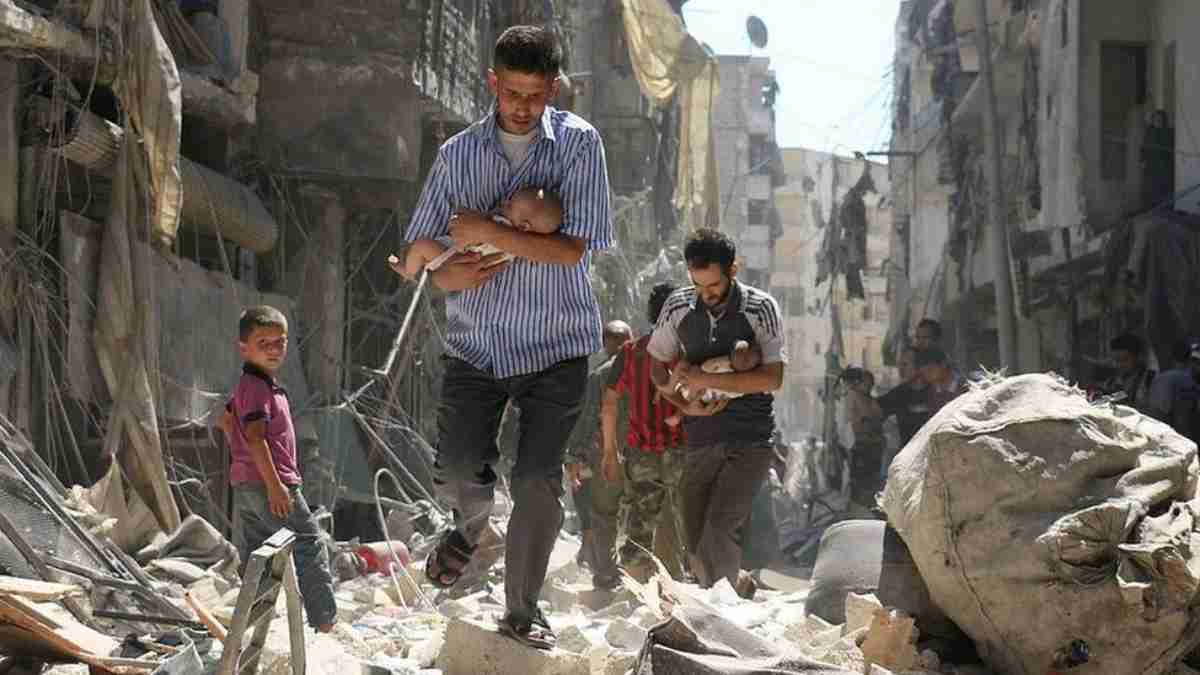
Syria: Terrorists retreat, citizens flee from Eastern Ghouta

Published

on

Syria: Terrorists retreat, citizens flee from Eastern Ghouta

Damascus wins civilians confidence

Finally situation in Eastern Ghauta near Damascus has moved forward with successful government’s dual strategy of continuing military operations against the armed groups and facilitating the civilians exit by implementing five-hour-a-day pause in hostilities as suggested by Russian government. So far some 2,000 civilians have left the besieged enclave.

According to Aljazeera, thousands of Syrians are fleeing a government-led offensive on the rebel-held  Eastern Ghouta as President Bashar al-Assad vowed that the fight would continue until the eradication of terrorism.

According to Syrian state media, President Basher al-Assad, in a televised address to the nation on Sunday evening, has vowed to continue operations in Eastern Ghouta.  “We will continue fighting terrorism … and the Ghouta operation is a continuation of fighting terrorism,” he said.

“There is no contradiction between a truce and combat operations. The progress achieved yesterday and the day before in Ghouta by the Syrian Arab Army was made during this truce. Therefore we must continue with the operation in parallel with opening the way for civilians to leave,” he said.

Read More:  Syria: Rescue leaflets for civilians, militants thrown in Eastern Ghouta

Syrian President also dismissed western claims concerning the humanitarian situation as ridiculous and false accusations. “The humanitarian situation which the West speaks of from time to time, is a very ridiculous lie, as ridiculous as the western officials who repeat it,” he said.

State media has claimed that Syrian forces have advanced on several fronts, retaking control of farms and villages. They seized a number of districts including Al-Nashabiyeh and Otaya and had “eradicated terrorist groups”. The Central Military Media said Syrian forces reached the outskirts of Mesraba, in central Ghouta.

Syrian official news agency SANA, in its latest report has claimed that it has undertaken camera tour over al-Nashabiyeh town in Eastern Ghouta after liberating it from Jabhat al-Nusra terrorists.

Meanwhile, London based pro-rebel Syrian Observatory of Human Rights (SOHR) said that some 2,000 civilians had fled regime shelling and clashes in eastern areas to the western parts of the enclave.

“Everyone is on the road. There’s destruction everywhere,” said 35-year-old Abu Khalil, carrying a little girl in his arms with a wound to her face. “Many families are trapped under rubble, the rescue workers just can’t cope,” he said.

Syrian government forces have seized roughly one-quarter of the territory in recent days. They have reached the centre Eastern Ghouta to the edge of Beit Sawa.

Aljazeera reports that Hamza Biqdar, the spokesman of Jaish al-Islam rebel group, has in an audio message, vowed that government forces would be driven from the territory they had captured. He claimed that the rebels had fortified positions to confront the attacking forces.

Read More: 41 Turkish soldiers killed by US backed militia in Syria

The spokesman further said that anti Assad rebels were forced to retreat and regroup in Eastern Ghouta because of the Syrian government’s “scorched earth” policy involving heavy artillery fire, air strikes, and helicopter attacks.

AFP correspondent in Eastern Ghouta saw hundreds of civilians fleeing from the town of Beit in the southeast of the enclave on Sunday.

Earlier on Sunday, SANA had reported that for the seventh consecutive day, Jabhat al-Nusra terrorist organization and the terrorists affiliated to it have prevented the civilians to exit from Ghouta through the safe corridor in al-Wafideen Camp.

Eastern Ghouta, home to some 400,000 people, has been under a crippling siege and daily bombardment for months. Western media has claimed that more than 600 civilians have been killed in the last two weeks alone.

Read More: Syria: US, Russia continue nursing interests amidst bloodshed

Recently, UN Secretary General Antonio Guterres has expressed his serious concern saying that population of Ghouta is living in “hell on earth”. In one district, 93% of buildings had been damaged or destroyed by December 2017.

United Nations Human rights Council held an emergency meeting on March 2 when its chief Zaid Ra’ad al-Hussain said, “I must emphasise that what we are seeing, in Eastern Ghouta and elsewhere in Syria, are likely war crimes, and potentially, crimes against humanity. The perpetrators of these crimes must know they are being identified; that dossiers are being built up with a view to their prosecution; and that they will be held accountable for what they have done”.

Most of the areas, which were earlier captured by Daesh (IS), Jabhat al-Nusra and other anti Assad groups, have been liberated in recent months. Raqqa, Aleppo, Hama, Deir al-Zaur and several other cities and towns have already been liberated by Syrian forces supported by Hezbollah and Iranian military advisors on the ground and Russian warplanes in the air.

After completion of military operations in Eastern Ghouta Syrian forces will focus in liberating Idlib, where armed groups were transported from other areas during last one year.

Latest world news

Khaleda son Tarique Rahman arrives to rapturous welcome in Bangladesh

Tarique Rahman returned to Bangladesh after 17 years and, in his first speech, invoked Martin Luther King while outlining what he called a plan for the country’s future.

Published

on

Khalida Zia son

Bangladesh Nationalist Party (BNP) acting chairman Tarique Rahman, who returned to Bangladesh on Thursday after 17 years in exile, outlined his political vision in his first public address, drawing a comparison with American civil rights leader Martin Luther King Jr.’s famous “I have a dream” speech.

Addressing a massive gathering in Dhaka, Rahman said that just as Martin Luther King spoke of a dream, he wished to speak of a concrete plan for Bangladesh. He referred to the country as “Beloved Bangladesh” and thanked party leaders, workers and citizens who stood by the BNP during his absence.

Rahman, the son of former President Ziaur Rahman and former Prime Minister Khaleda Zia, said that his plan would succeed only with public support and urged citizens to participate actively in nation-building.

Parallels drawn with 1971 and 2024 movements

In his speech, Rahman linked the 1971 Liberation War with the 2024 uprising against the government of former Prime Minister Sheikh Hasina. He said those who lost their lives in these movements should be honoured by building the country they had envisioned.

“We liberated Bangladesh in 1971, and we liberated it again in 2024,” he said, adding that the events of 2024 were about defending the country’s independence and sovereignty. He stressed the need to “repay the blood debt of the martyrs” through responsible governance.

Emphasis on tolerance, safety and economic rights

Touching upon Bangladesh’s social fabric, Rahman said the country belongs to everyone, irrespective of religion or geography, and underlined the importance of tolerance. He spoke about creating a safe environment where women, men and children can move freely without fear.

He also said the BNP would focus on peace, political reform and strengthening the economy. Referring to student leader Sharif Osman Hadi, Rahman said he had dreamt of a democratic Bangladesh and promised justice in connection with his killing, along with restoring people’s economic rights.

Call to youth and visit to Khaleda Zia

Rahman called upon the younger generation to take responsibility for development and stability, stressing that collective effort would be crucial to implementing his plan for Bangladesh.

After the address, he left to visit his ailing mother, Khaleda Zia, who is undergoing treatment at Evercare Hospital.

Rahman has been living in exile since 2008 following convictions in multiple corruption cases, which he has described as politically motivated. He has also alleged that the previous government attempted to assassinate him through torture.

With the Awami League barred from contesting elections, the political landscape has narrowed significantly. The BNP now holds a dominant position, and Rahman’s return has added fresh momentum and uncertainty to Bangladesh’s political future.

Continue Reading

Latest world news

Tarique Rahman returns to Dhaka after 17 years, massive crowd greets BNP leader

Tarique Rahman returned to Bangladesh after more than 17 years in exile, with thousands of BNP supporters gathering in Dhaka to welcome the party’s acting chairman.

Published

on

Tariq Rahman

Thousands of people poured onto the streets of Dhaka on Thursday as Bangladesh Nationalist Party (BNP) acting chairman Tarique Rahman returned to the country after more than 17 years in self-imposed exile in the United Kingdom. Rahman, who is the son of former prime minister Khaleda Zia, landed in the capital along with his wife Zubaida Rahman and daughter Zaima Rahman.

Supporters and party leaders marched from the Banani Airport Road towards Dhaka airport to welcome him, turning the stretch into a sea of BNP flags and slogans. Rahman was later escorted in a bulletproof vehicle as part of heightened security arrangements for his high-profile return.

Bulletproof convoy and reception in Purbachal

After arriving at the airport, Rahman was received by senior BNP leaders before heading to a large reception organised in the Purbachal area. Party workers and leaders lined both sides of the road to greet him during the journey. According to party expectations, a very large gathering assembled at the venue, where Rahman was scheduled to address supporters.

BNP leaders said only Rahman would speak at the event, while other senior figures remained present on the stage. His return is being closely watched as he has emerged as a key political figure ahead of Bangladesh’s upcoming general elections.

Visit to ailing mother and family residence

Following the public address, Rahman was expected to visit Evercare Hospital to meet his mother, former prime minister Khaleda Zia, who has been undergoing treatment there for over a month. After the hospital visit, the family was scheduled to go to Firoza, the Zia family residence in Gulshan.

Security across Dhaka was tightened during Rahman’s movement, with police deploying additional forces to prevent any untoward incident amid recent political tensions in the country.

Political backdrop of the return

Rahman’s return comes at a time when the BNP is seen to be gaining political ground following the ouster of former prime minister Sheikh Hasina in a student-led uprising last year. Surveys conducted in December indicate the BNP could secure the largest number of seats in the upcoming parliamentary elections, while other parties, including Islamist groups, are also in the fray.

Alongside political developments, personal reasons have also played a role in Rahman’s decision to return, particularly his mother’s prolonged illness, which party sources describe as a key factor behind the move.

Continue Reading

Latest world news

Bangladesh student leader killing sparks allegation against Yunus-led interim government over February polls

The killing of Bangladesh student leader Sharif Osman Hadi has led to protests and serious allegations against the Yunus-led interim government over the February national election.

Published

on

The killing of Bangladesh student leader Sharif Osman Hadi has triggered sharp political allegations, with his family accusing elements within the Muhammad Yunus-led interim government of attempting to derail the country’s upcoming national election scheduled for February.

Sharif Osman Hadi, spokesperson of Inquilab Moncho — a cultural platform that emerged from the July 2024 uprising — was shot at close range in Dhaka on December 12. He was later airlifted to Singapore for advanced treatment, where he succumbed to his injuries on December 18. His death led to violent protests in parts of the capital, including attacks on offices of newspapers and cultural organisations.

Brother alleges political motive behind killing

At a protest gathering in Shahbagh, Sharif Osman Hadi’s brother, Sharif Omar Hadi, accused a section of the interim government of orchestrating the killing to disrupt the election process.

“You had Osman Hadi killed, and now you are trying to foil the election by using this as an issue,” Omar said while addressing protesters. He claimed that his brother was firm on holding the national election by February and did not align himself with any agency or “foreign masters”.

Omar demanded a swift and transparent trial, warning that delays would damage the election environment. He alleged that the authorities have failed to show any visible progress in the investigation so far.

“If justice for Osman Hadi is not delivered, you too will be compelled to flee Bangladesh one day,” Omar said, drawing an apparent reference to former Prime Minister Sheikh Hasina, who left the country following last year’s nationwide protests that resulted in a change of regime.

Claims of wider conspiracy surface

Leaders of Inquilab Moncho also alleged that the killing was part of a broader conspiracy to undermine the gains of the July uprising and weaken Bangladesh’s sovereignty. They claimed that international intelligence agencies and their local collaborators were involved in the murder.

The group demanded that the government identify and present the accused through an investigation meeting international standards within a fixed timeframe. They warned that protests would intensify if their demands were not met.

Protesters said demonstrations would continue until justice is delivered for Sharif Osman Hadi.

Protest plans and political developments

Leaders of Inquilab Moncho announced that they would not hold any programmes on December 25, the day when Bangladesh Nationalist Party’s acting chairman Tarique Rahman is scheduled to return to the country. They expressed hope that Rahman would extend solidarity to their movement demanding justice.

The allegations and ongoing protests have added to political tensions in Bangladesh as the interim government faces growing scrutiny ahead of the proposed February election.

Continue Reading

Trending

© Copyright 2022 APNLIVE.com