English हिन्दी
Connect with us

Latest world news

PM Modi, Trump announce strategic initiatives, aim for $500 billion trade by 2030

PM Modi and President Trump’s meeting at the White House covered defence, trade, technology, and energy. Both leaders aim for a $500 billion trade target by 2030, alongside key defence initiatives.

Published

on

PM Modi

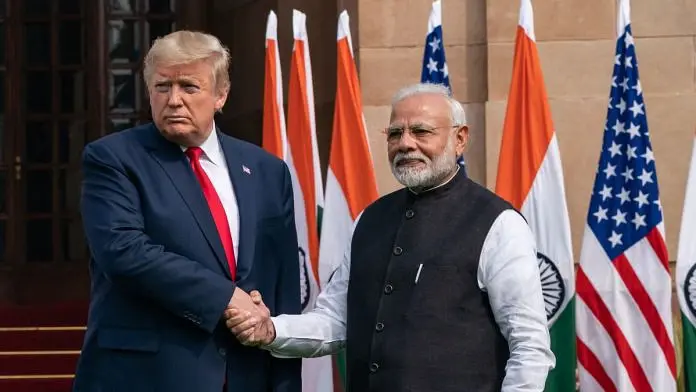
In a pivotal meeting at the White House, Prime Minister Narendra Modi and US President Donald Trump discussed a range of issues that will shape the future of Indo-US relations, covering defence, trade, technology, and energy sectors. The high-level talks, which followed PM Modi’s visit to France, came just hours after President Trump’s announcement of new reciprocal tariffs affecting all US trading partners, including India.

Key highlights from the Modi-Trump talks:

Defence: strengthening military ties

A significant announcement from the meeting was the creation of a new 10-year framework for US-India defence cooperation. This framework will expand US platforms within the Indian defence services, including new deals for Javelin anti-tank missiles and Stryker armoured vehicles. Additionally, the US will deliver six more P8I maritime surveillance aircraft to India.

Another major development includes a review of the International Traffic in Arms Regulations (ITAR), aimed at easing technology transfers and spare part supplies between the two nations. Both countries also initiated talks for a Reciprocal Defence Procurement (RDP) agreement, which will streamline mutual defence purchases. A major breakthrough came with the US’s announcement of policy reviews for releasing fifth-generation fighter jets and underwater warfare systems to India.

The two nations also launched the Autonomous Systems Industry Alliance (ASIA), focusing on collaboration in underwater domain awareness technologies. India will be the first country to co-develop these sensitive technologies with the US.

Trade: ‘Mission 500’ and bilateral trade expansion

On the economic front, both leaders set an ambitious goal of reaching $500 billion in bilateral trade by 2030 under the initiative “Mission 500”. Key trade agreements are set to be concluded by 2025, addressing issues like the controversial reciprocal tariffs. The discussion also highlighted Indian investments in the US worth over $7.3 billion, which have supported thousands of American jobs.

However, trade talks took place against the backdrop of President Trump’s 25% tariff on global steel and aluminium imports, which could have significant implications for Indian exports.

Technology: Advancing strategic partnerships

PM Modi and President Trump also unveiled the TRUST (Transforming the Relationship Utilizing Strategic Technology) initiative, a collaboration designed to accelerate partnerships in critical and emerging technologies. A roadmap for US-India AI collaboration is expected by the end of the year, along with plans for next-generation data centres and AI processing collaborations.

Moreover, both countries are working on expanding Indian pharmaceutical manufacturing in the US, especially for essential medicines, and launching initiatives to recover rare earth minerals to support high-tech industries.

Energy: Strengthening strategic ties

The India-US Energy Security Partnership was reaffirmed, with commitments to support India’s full membership in the International Energy Agency (IEA) and to advance nuclear energy production through the India-US 123 Civil Nuclear Agreement. Plans for collaboration on small modular reactors are also in the pipeline, aiming to boost nuclear energy generation in India.

Counterterrorism and multilateral cooperation

The two leaders also discussed counterterrorism efforts, with both condemning Pakistan’s inaction against terrorist groups. A significant announcement came with the approval of the extradition of Tahawwur Rana, a key convict in the 26/11 Mumbai attacks, to India. Furthermore, both leaders reaffirmed their commitment to the Quad alliance (India, US, Japan, Australia) and laid the groundwork for the India-Middle East-Europe Corridor (IMEC).

The meeting also included discussions on new initiatives for 2025 through the I2U2 Group and the Indian Ocean Strategic Venture, which will focus on economic and security cooperation.

A new chapter in India-US relations

With an array of initiatives spanning defence, trade, technology, and energy, the meeting between PM Modi and President Trump is set to deepen bilateral ties and pave the way for greater cooperation in the years to come.

Latest world news

India rejects Hague court proceedings on Indus Waters Treaty

India has reiterated it will not participate in Hague arbitration proceedings under the Indus Waters Treaty, stating the agreement remains in abeyance following the Pahalgam attack.

Published

on

Indus Water Treaty

India has reiterated its refusal to recognise or participate in proceedings initiated by a Court of Arbitration in The Hague under the Indus Waters Treaty framework, asserting that the treaty itself remains in abeyance following the Pahalgam terror attack last year.

Despite the arbitration court moving ahead with fresh hearings and procedural orders, New Delhi has made it clear that it does not consider the panel legally constituted and will not respond to its communications.

India dismisses court orders as illegitimate

The latest development centres on an order issued by the Court of Arbitration directing India to submit operational pondage logbooks of the Baglihar and Kishanganga hydroelectric projects. The documents were sought as part of what the court described as the “second phase on the merits” of the dispute.

Hearings have been scheduled for February 2 and 3 at the Peace Palace in The Hague. The court has noted that India has neither filed counter submissions nor indicated its participation in the process.

However, government sources said the arbitration panel was “so-called and illegally constituted” and accused it of conducting parallel proceedings alongside the neutral expert mechanism prescribed under the treaty. According to the sources, India does not acknowledge the court’s authority and therefore does not engage with its directions.

They further stated that since the Indus Waters Treaty has been placed in abeyance, India is under no obligation to respond to such requests, describing the move as an attempt by Pakistan to draw New Delhi back into the process.

Treaty placed in abeyance after Pahalgam attack

India’s decision to suspend the treaty dates back to April 23, 2025, a day after a terror attack in Pahalgam claimed the lives of 26 civilians. The government formally placed the six-decade-old water-sharing agreement in abeyance, linking cooperation under the treaty to Pakistan’s continued support for cross-border terrorism.

The move marked a significant shift in policy, signalling that bilateral arrangements could not operate independently of security considerations.

Pakistan escalates international outreach

Since the decision, Pakistan has stepped up diplomatic and legal efforts, approaching international forums, sending delegations abroad and initiating multiple legal actions to challenge India’s stance.

The Indus river system remains critical for Pakistan’s economy, with a large share of its agriculture dependent on its waters. Limited storage capacity and stressed reservoirs have further heightened Islamabad’s concerns, turning what was once a technical dispute into a strategic issue.

Neutral expert versus arbitration court

Under the treaty’s dispute resolution mechanism, technical disagreements are to be examined by a neutral expert, while legal disputes may be referred to a Court of Arbitration. India has consistently maintained that the current issues fall within the technical domain and has accused Pakistan of forum shopping by activating arbitration proceedings.

The arbitration court has, however, proceeded with the case, stating that India’s position on suspending the treaty does not affect its competence. It has also warned that adverse inferences could be drawn if India fails to comply with its directions.

New Delhi rejects this interpretation and continues to recognise only the neutral expert process, viewing attempts to link the two mechanisms as illegitimate.

Strategic standoff continues

Officials believe the ongoing proceedings in The Hague, conducted without India’s participation, are unlikely to result in binding outcomes. Instead, they see the situation as part of a broader strategic contest, with India choosing disengagement and Pakistan seeking internationalisation of the dispute.

India has consistently maintained that treaties cannot function in isolation from ground realities and that cooperation will remain suspended until what it describes as persistent hostility is addressed.

Continue Reading

Latest world news

Lashkar commander admits Hamas links, raises alarm over expanding terror nexus

A senior Lashkar-e-Taiba commander’s admission of meetings with Hamas leaders has intensified concerns over growing coordination between terror groups operating across regions.

Published

on

Lashkar Commander

A senior commander of Pakistan-based Lashkar-e-Taiba has publicly acknowledged links with Hamas and confirmed meetings with its top leadership, triggering fresh concerns among security agencies about an emerging alliance between globally designated terrorist organisations.

In a recent video accessed by media, Faisal Nadeem, a senior figure associated with the Pakistan Markazi Muslim League, widely regarded as Lashkar’s political front, said he met senior Hamas leaders in Doha, Qatar, in 2024. Nadeem operates in Pakistan’s Sindh province and claimed that Saifullah Kasuri, alleged by Indian agencies to be involved in the Pahalgam terror attack in Jammu and Kashmir, accompanied him during the visit.

According to Nadeem’s statement, the delegation met senior Hamas leader Khaled Mashal, a disclosure that intelligence officials view as direct evidence of coordination between terror networks operating across South Asia and the Middle East. Security analysts say the admission points to a growing effort to share operational experience, logistics and propaganda strategies.

The confession follows earlier reports of a meeting between a senior Hamas commander and a Lashkar leader in Pakistan’s Gujranwala during a public event organised by the same political outfit. An undated video that surfaced recently showed both leaders sharing the stage, with officials noting that the public nature of the interaction reflected increasing confidence and deepening ties between the groups.

Investigators have pointed out that the Hamas representative attended the event as a chief guest, while the Lashkar leader appeared under the cover of a political role. Security officials have also flagged multiple visits by Hamas operatives to Pakistan since October 2023, indicating sustained engagement.

Counter-terrorism experts note that both Hamas and Lashkar-e-Taiba are designated terrorist organisations by the United States and several other countries. Any coordination between them, they warn, could have serious implications for regional and international security.

Indian intelligence agencies are closely monitoring developments related to the Hamas-Lashkar engagement. Officials said the emerging evidence may be raised at international platforms, including financial watchdogs and counter-terror forums, as authorities assess potential legal and diplomatic responses.

Analysts tracking the evolving situation say the growing trail of videos and public statements points to a broader ideological and operational alignment, marking a concerning shift in the global terror network landscape.

Continue Reading

Latest world news

India-EU free trade pact set to lower prices of luxury cars, wines and medicines

The India-EU free trade pact is set to cut import duties on luxury cars, wines and medicines, while opening European markets for Indian exports.

Published

on

India European Deal

After nearly two decades of negotiations, India and the European Union have sealed a Free Trade Agreement that is expected to significantly reduce prices of several European products in India while expanding export opportunities for Indian manufacturers.

Described by European Commission President Ursula von der Leyen as the “mother of all trade deals”, the pact aims to deepen economic cooperation by easing tariffs and improving market access on both sides.

Luxury cars likely to become more affordable

One of the most noticeable impacts of the agreement will be in the premium automobile segment. Imported European cars such as Mercedes, BMW and Audi currently face import duties exceeding 100 per cent in India.

Under the new agreement, vehicles priced above 15,000 euros (around Rs 16 lakh) will see duties reduced to 40 per cent initially, with a further cut to 10 per cent planned over time. This is expected to bring down prices by several lakh rupees.

The concessions will operate under a quota system to safeguard India’s domestic automobile industry. Officials clarified that smaller, mass-market cars — which dominate India’s auto sector — will not be directly exported by European manufacturers, though local manufacturing remains an option.

Imported wines and spirits to get cheaper gradually

European wines from countries such as France, Italy and Spain are also set to become more affordable. India currently levies an import duty of 150 per cent on wines. Under the pact, this will be reduced to 20 per cent, though the change will be phased in over five to ten years to limit disruption to domestic producers.

The agreement is expected to reduce prices of premium spirits such as cognac, high-end gins and vodkas. However, wines priced below 2.5 euros will not receive duty concessions, a move aimed at protecting Indian manufacturers. Indian wines, meanwhile, will gain improved access to European markets.

Cheaper medicines and medical equipment

The trade deal is expected to benefit India’s healthcare sector by lowering the cost of imported medicines, particularly for cancer and other critical illnesses. Advanced medical equipment sourced from Europe is also likely to become cheaper.

At the same time, pharmaceuticals manufactured in India will gain access to all 27 EU member countries, strengthening India’s position as a global supplier of affordable medicines.

Electronics, steel and chemicals to benefit

The agreement removes tariffs on aircraft spare parts, mobile phone components and other high-tech electronic items imported from Europe. This could reduce manufacturing costs for electronic devices in India, potentially benefiting consumers.

Additionally, proposals for zero tariffs on iron, steel and chemical products may lower raw material costs for industries such as construction, with possible downstream benefits for homebuyers and infrastructure projects.

Overall, the India-EU Free Trade Agreement is being seen as a major boost for Indian exports, particularly in sectors such as garments, leather and jewellery, while offering Indian consumers access to more competitively priced European goods.

Continue Reading

Trending

© Copyright 2022 APNLIVE.com