English हिन्दी
Connect with us

Latest world news

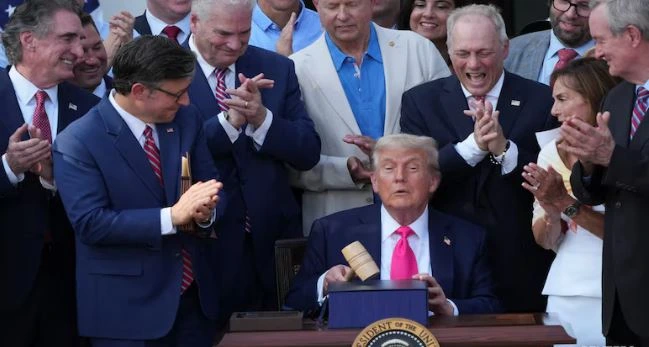
Trump signs sweeping One Big Beautiful Bill into law, enacts major tax cuts and deportation drive

Published

on

Donald Trump

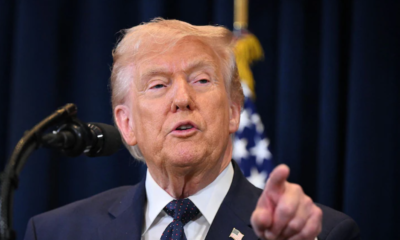
US President Donald Trump has signed into law his flagship legislation, dubbed the “One Big Beautiful Bill,” coinciding with the United States’ 249th Independence Day celebrations. The nearly 900-page legislation, passed with the support of Republican leaders in Congress, aims to fulfill a series of promises made during Trump’s presidential campaign — including extending tax cuts, reinforcing immigration enforcement, and bolstering military strength.

Major tax reforms and business incentives

At the heart of the new law is a massive $4.5 trillion package of tax cuts aimed at both individuals and businesses. With previous Trump-era tax reductions set to expire by year-end, this legislation makes many of those cuts permanent. New deductions have also been added — including ones for overtime pay, tipped income, and auto loan interest.

Seniors earning under $75,000 annually will receive a $6,000 deduction, while the child tax credit will increase from $2,000 to $2,200, although lower-income families may not benefit fully. The cap on state and local tax deductions has been raised to $40,000 for five years.

Businesses stand to gain substantially, with 100% immediate write-offs for equipment and research spending. However, critics point out that the wealthiest households will see an average tax benefit of $12,000, while the poorest could lose $1,600 per year due to cuts in welfare programs.

Border wall funding and aggressive deportation plans

Trump’s bill allocates $350 billion to his border security initiatives, which include expanding the U.S.-Mexico border wall and increasing migrant detention capacity to 100,000 beds. The legislation also funds 10,000 new Immigration and Customs Enforcement (ICE) agents, each receiving a $10,000 signing bonus, and a surge in Border Patrol recruitment.

Additionally, new fees will apply to immigrants, especially those applying for asylum, as part of the financial framework supporting Trump’s aim of deporting up to one million individuals annually.

Increased defence spending and missile shield development

The Pentagon receives a major funding boost for naval shipbuilding, weapons development, and personnel welfare. The bill also designates $25 billion for the early development of a U.S.-based “Golden Dome” missile defense system, modeled after Israel’s Iron Dome. The system is expected to be operational by 2029, with an estimated total cost of $175 billion.

Deep cuts to Medicaid and food assistance

In a controversial move, the legislation enforces strict new eligibility criteria for social welfare programs. Adults up to age 65 will need to work at least 80 hours a month to qualify for Medicaid or food stamps, even parents of teenagers. A new $35 co-payment may also be charged to Medicaid users. Planned Parenthood and similar providers that offer abortion services are temporarily barred from receiving Medicaid reimbursements for a year.

The Congressional Budget Office estimates that over the next decade, the bill will increase the federal deficit by $3.3 trillion.

Energy policy rollbacks and space funding

Tax incentives for renewable energy projects have been significantly cut, including an early expiration for electric vehicle tax credits now set for September 30, 2025, rather than 2032.

Conversely, funding has been approved for ambitious space programs, including billions for NASA’s Artemis moon mission and exploration of Mars. The bill also provides $88 million for pandemic response oversight and includes a $5 trillion hike to the national debt ceiling.

Other key provisions

The legislation introduces “Trump Accounts,” a new federal savings initiative for children, with a $1,000 initial deposit. It also imposes a 1% excise tax on money transfers abroad and on university endowments, while eliminating taxes on gun silencers and short-barreled firearms.

Latest world news

Hindu man lynched and set on fire in Bangladesh during anti-India protests

A Hindu man was lynched and set on fire in Bangladesh’s Mymensingh district amid rising anti-India protests after the death of a radical student leader.

Published

on

Hindu man set to fire in Bangladesh

A disturbing incident of mob violence against a minority community has been reported from Bangladesh, where a Hindu man was lynched and his body set on fire amid escalating anti-India protests following the death of a radical student leader.

Mob lynching reported from Mymensingh district

A 30-year-old Hindu man, Dipu Chandra Das, was lynched by a mob in Bhaluka Upazila of Mymensingh district after allegations surfaced that he had insulted Islam. According to media reports, the incident took place on Thursday night at an industrial area where Das was employed.

Das was accused of making derogatory remarks about Islam and Prophet Muhammad during an event organised at his workplace to mark World Arabic Language Day. The allegations spread rapidly within the factory premises and nearby areas, leading to heightened tension.

Eyewitness accounts cited in media reports said Das was assaulted by an angry crowd and died on the spot. After his death, the mob allegedly tied his body to a tree, beat it while raising slogans, and later set it on fire.

Body burnt at multiple locations, traffic disrupted

The violence did not stop there. Reports suggest the mob later moved Das’s body to a nearby bus stand area and again set it ablaze. Subsequently, the body was taken to the Dhaka–Mymensingh highway, where it was burned once more, leading to panic among locals and a temporary disruption of traffic on the busy stretch.

Confirming the incident, the local administration said a person was killed following allegations of insulting the Prophet. Officials added that the body has been taken into police custody and the situation is being monitored.

Interim government condemns violence

The lynching took place against the backdrop of widespread protests across Bangladesh following the death of Sharif Osman Hadi, a prominent leader linked to the July Uprising. The Muhammad Yunus-led interim government strongly condemned the killing, stating that there is no place for such violence in the country.

In an official statement, the government appealed to citizens to reject hatred and violence, stressing that those responsible for the crime would not be spared.

Anti-India sentiment intensifies after Hadi’s death

Tensions have been high in Bangladesh since Hadi’s death, with protests, vandalism and arson reported in several cities. Demonstrators targeted prominent media offices and symbolic locations linked to the country’s political history.

Hadi was known for his sharp criticism of India and the former prime minister, whose government was ousted during last year’s uprising. Groups formed after the political upheaval have been actively mobilising street protests and campaigns that fuel anti-India sentiment, particularly after the former premier went into exile in India.

The lynching of Dipu Chandra Das has further raised concerns over the safety of minority communities amid the ongoing unrest in the country.

Continue Reading

Latest world news

Bangladesh rocked by violent protests after student leader Sharif Osman Hadi’s death, anti-India slogans raised

Bangladesh has witnessed widespread violence and protests following the death of student leader Sharif Osman Hadi, with arson, anti-India slogans and a nationwide security clampdown.

Published

on

Bangladesh

Violent protests erupted across Bangladesh after the death of student leader and political figure Sharif Osman Hadi, triggering fresh instability in the country and a sharp rise in anti-India sentiment. The situation turned volatile in Dhaka and several other cities as thousands of demonstrators poured onto the streets demanding swift action against those responsible for his killing.

Hadi, 32, was shot in the head by masked assailants while launching his election campaign in Dhaka last Friday. He was later airlifted to Singapore for treatment, where he succumbed to his injuries. Known for his polarising views and strong anti-India rhetoric, Hadi had emerged as a prominent face during the 2024 student uprising that led to the ouster of former prime minister Sheikh Hasina.

Fires, arson and tense streets in Dhaka

Soon after news of Hadi’s death broke, protests intensified in the Bangladeshi capital. Several buildings, including those housing leading media organisations, were set on fire, with authorities confirming that staff members were trapped inside during the blaze. Fire services later said the situation was brought under control, while security forces were deployed in large numbers to prevent further violence.

Demonstrators were seen chanting slogans invoking Hadi’s name, vowing to continue protests until those behind the attack were arrested. Multiple areas in Dhaka remained tense late into the night as police and paramilitary units attempted to restore order.

Protests spread, Indian mission targeted in Chittagong

Violence was not limited to the capital. In the port city of Chittagong, protesters gathered outside the Indian Assistant High Commission, raising anti-India slogans amid heightened anger on the streets. Similar unrest was reported from other parts of the country, signalling the widening scale of the crisis.

In Rajshahi, demonstrators torched Bangabandhu Sheikh Mujibur Rahman’s residence and an Awami League office, causing extensive damage. Authorities have not yet released a detailed assessment of losses, but security has been tightened across sensitive locations.

Anti-India sentiment deepens diplomatic strain

The latest unrest comes amid deteriorating ties between India and Bangladesh following Sheikh Hasina’s flight to Delhi. Earlier in the week, protesters under the banner of “July Oikya” marched towards the Indian High Commission in Dhaka, demanding Hasina’s return and raising hostile slogans against India.

India has formally conveyed its concerns to Dhaka over threats to its diplomatic missions and inflammatory statements by Bangladeshi political figures. New Delhi has rejected allegations linking India to the attack on Hadi, calling such claims false and misleading.

Yunus calls for calm, state mourning announced

In a televised address, interim chief Muhammad Yunus described Hadi’s death as an “irreparable loss” to Bangladesh’s political and democratic space. He urged citizens to exercise restraint, warning that continued violence could derail the country’s path towards a credible election.

The interim administration has announced a day of state mourning in Hadi’s honour, with national flags to fly at half-mast and special prayers planned nationwide. Bangladesh has been under an interim government led by Yunus since August 2024, with national elections scheduled for February 12.

India issues advisory for its nationals

Amid the unrest, the Indian High Commission in Dhaka issued an advisory asking Indian nationals in Bangladesh to avoid non-essential travel and limit movement outside their residences. Emergency contact details of Indian missions have been shared for assistance.

Manhunt launched for attackers

Bangladesh police have launched a manhunt for those behind Hadi’s killing, releasing photographs of two suspects and announcing a reward of five million taka for information leading to their arrest. Yunus has described the attack as a premeditated attempt by a powerful network to sabotage the electoral process.

Continue Reading

Latest world news

India closes two more visa centres in Bangladesh amid worsening security concerns

India has temporarily closed visa application centres in Rajshahi and Khulna, citing security concerns following protests near Indian establishments in Bangladesh.

Published

on

India closes two more visa centres in Bangladesh amid worsening security concerns

India has shut two additional Indian Visa Application Centres (IVACs) in Bangladesh — in Rajshahi and Khulna — citing the prevailing security situation in the country. The move comes a day after protests were held near the Indian High Commission in Dhaka by radical groups, raising concerns over safety around Indian establishments.

An official notification issued on the IVAC website said the centres in Rajshahi and Khulna were closed on December 18 due to security reasons. Applicants who had appointments scheduled for the day have been assured fresh slots at a later date.

The decision follows the temporary shutdown of the visa application centre in Dhaka earlier, even as New Delhi flagged a rise in open hostility towards India, particularly targeting the northeastern region, under the interim government led by Muhammad Yunus.

Bangladesh rejects India’s security assessment

Bangladesh’s Foreign Affairs Advisor Touhid Hossain dismissed India’s concerns and denied any deterioration in law and order. He distanced the interim administration from recent inflammatory remarks made by National Citizen Party (NCP) leader Hasnat Abdullah, who had publicly threatened to cut off India’s “seven sisters” and also issued comments against the Indian High Commissioner.

Hossain said the individual was not part of the government and termed his statements irrelevant. He also claimed that security arrangements were in place and that the shutdown of the Dhaka visa centre coincided with a local programme, which raised security-related questions.

Political backdrop and India’s response

The NCP, which emerged from student-led protests that led to the fall of the previous Awami League government, has extended support to the Yunus-led interim setup. Though the party has limited political presence, radical elements associated with it have organised anti-India demonstrations in Dhaka.

India, in an earlier statement, urged the interim government to ensure internal law and order and hold peaceful elections so that Bangladesh can return to an elected administration. However, the interim government appeared dismissive of this advice, with Hossain stating that India need not advise Dhaka on conducting elections.

Observers in Bangladesh have pointed out that delays in elections could benefit the unelected interim government, while radical groups may attempt to create disruptions by projecting India as a hostile actor. New Delhi has so far maintained a measured stance, despite remarks that directly question India’s sovereignty and territorial integrity, particularly in the northeastern region.

Continue Reading

Trending

© Copyright 2022 APNLIVE.com