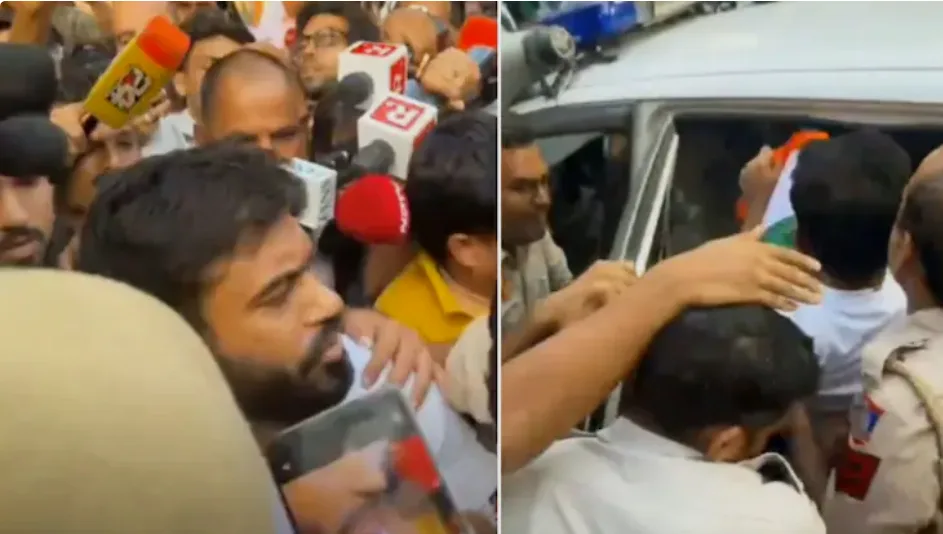
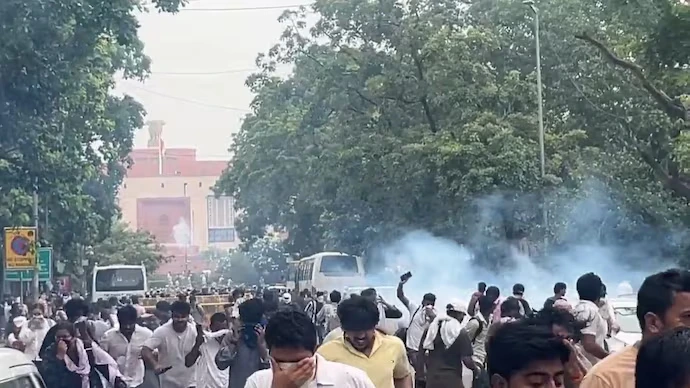
[vc_row][vc_column][vc_column_text]Uttar Pradesh Director General of Police (DGP) OP Singh said the police suspect a conspiracy behind Monday’s mob violence in Bulandshahr over cow slaughter when a nearly-400 strong mob attacked the police force and two people, including Inspector Subodh Kumar Singh, were killed.
The police had booked Bajrang Dal district chief Yogesh Raj, BJP youth wing member Shikhar Agrawal, Vishwa Hindu Parishad (VHP) member Upendra Raghav among as 27 people in two FIRs, while cases have been lodged against 50 to 60 unidentified people, the police said. So far, four arrests have been made.
Today (Wednesday, Dec 5) reports said a district court remanded three persons into judicial custody for 14 days in connection with the killing of Inspector Subodh Kumar Singh and a 20-year-old man Sumit in yesterday’s Bulandshahr violence. However, the main accused Yogesh Raj, who is said to be a Bajrang Dal activist is still on run. It has been reported that Raj led the violent mob which allegedly attacked the police team and killed Inspector Singh.
Chief minister Yogi Adityanath held a late night security review yesterday, but kept the focus firmly on cow slaughter. A government statement on the meeting last night indicates he ordered officers to speed up arrests for cow slaughter but there was not a word about the cop’s murder.
“The incident is part of a bigger conspiracy, and hence all those directly or indirectly related to cow slaughter should be arrested in a time-bound manner,” the official statement said.
After he was criticised for lopsided, weird priorities, a second statement put out this morning said Yogi Adityanath would meet the family of the policeman.
According to the opposition, Adityanath seems to be more concerned about catching cow slaughterers than the killers of a policeman.
Also, Adityanath announced a Rs 10-lakh financial assistance to the family members of the youth Sumit Kumar who was killed in the violence. He is reported to be named among the accused in mob violence.
For the meeting in Lucknow, chief minister Yogi Adityanath flew down from his home-base Gorakhpur, where he attended a sound and light show on Monday night and a kabaddi tournament on Tuesday.
This morning, the chief minister flew out of the state again to perform his other role as the BJP’s headline campaigner in state polls. He has three rallies in Telangana, which will vote on Friday along with Rajasthan.
Two cases were filed after the Monday incident – one on the murders and the other on cow slaughter.
Yogesh Raj, the main accused in the mob-killing and an activist of the right-wing group Bajrang Dal, is the complainant in the cow killing case and he is “missing”.
He had named seven people from a village near the spot where the dead cows were found. Two of them are boys, 11 and 12 years old, and four others appear to be fake names. The children were forced to spend hours in a police station last evening. “The cops brought us to the police station and kept us there for four hours. They took the names of the boys and took my phone number. I was told we would be called again if required,” said the father of one of the boys. The boys were not questioned or even detained, according to media reports.[/vc_column_text][/vc_column][/vc_row][vc_row][vc_column][vc_column_text css=”.vc_custom_1544016677996{border-top-width: 10px !important;border-right-width: 10px !important;border-bottom-width: 10px !important;border-left-width: 10px !important;padding-top: 10px !important;padding-right: 10px !important;padding-bottom: 10px !important;padding-left: 10px !important;background-color: #d6d6d6 !important;border-radius: 10px !important;}”]Uttar Pradesh has reported 11 cases of violence related to cow vigilantism since the BJP government of Yogi Adityanath took oath in March 2017. The state has reported a total of 16 such incidents since 2012 with nine deaths. The country witnessed 97 recorded cases of violence over cow protection with 39 deaths.[/vc_column_text][/vc_column][/vc_row][vc_row][vc_column][vc_column_text]Initial investigation by Uttar Pradesh police as well as eyewitness accounts from the spot, where a police officer and a civilian were killed on Monday, 3 December, in Bulandshahr, hint at an organised attempt at fuelling communal tension in the area.
There were conflicting claims on who discovered the “carcasses” — and the nature of what was found in the first place.
Raj, the absconding main accused in cop’s murder, claimed he and his associates saw “seven people slaughtering cows”.
However, the neighbour of the man on whose field the “carcasses” were found said farm workers had first flagged them.
Prem Jeet Singh (45), also a former pradhan, said: “My land is next to Rajkumar’s (plot) and he was informed by labourers working on the field about the incident. I went with him to the spot. It started with four or five villagers expressing their anger but later the crowd burgeoned.”
The sequence of events that led to rioting and violence in Bulandshahr all raise questions that still remain unanswered, reported TheQuint.
- Why Were Carcasses of Cows Hung in an Open Field?
Tehsildar Rajkumar Bhaskar, one of the first administrative officers to reach the spot in Mahaw village, told News18 that head and skin of a dead cow was hung in a sugarcane field. He pointed out that anyone who is involved in cow slaughtering will not publicly display a cow carcass, knowing the situation in the state where incidents of mob lynchings in the name of cow vigilantism have taken place.
- How Did a Mob of 300-500 People Gather so Quickly?
The tehsildar, while speaking with the news channel, said that as soon as the news of the dead meat spread, a large crowd consisting of members from different Hindu outfits, including the Bajrang Dal, gathered at the spot. The crowd then loaded the dead body of the cow in a tractor and headed towards the Bulandhshahr-Garhmukteshwar State Highway to protest.
- Location and Timing of the Incident Fuels Suspicion
The clashes broke out on the last day of a three-day congregation of Muslims – Tablighi Ijtema – in Bulandshahr. Around 10 lakh devotees, who were said to have attended the gathering, were supposed to take the same state highway where the protestors took the carcasses.
Almost a hundred men in tractors reportedly reached the Chingravati police post on the highway, where the crowd multiplied in size. Although the police tried to reason with the crowd, trying to calm them down, the mob refused to budge.
- Slain Officer Was Investigating Dadri Lynching Case
Siyana SHO Subodh Kumar, who was shot dead while trying to pacify the crowd at the Chingravati police chowk, was an investigating officer in the mob lynching of Md Akhlaq in Dadri from 28 September 2015 till 9 November 2015. However, the charge sheet was filed in the case by a different investigating officer in March 2016. Kumar played a key role in giving the meat samples in the case to forensic lab, DNA reported.
According to the News18 report, several police officers who were present at the spot, said the mob did not allow the injured SHO to be taken to the hospital.
The police told News18 that the SHO and the accompanying policemen were cornered by the mob. They added that an initial round of firing in the air fuelled the anger of the crowd further.[/vc_column_text][/vc_column][/vc_row]