English हिन्दी
Connect with us

India News

RSS not seeking political power, focused on uniting Hindu society, says Mohan Bhagwat

RSS chief Mohan Bhagwat said the organisation is not seeking political power but is focused on uniting Hindu society and promoting character-building during an interaction with athletes in Meerut.

Published

on

Mohan Bhagwat

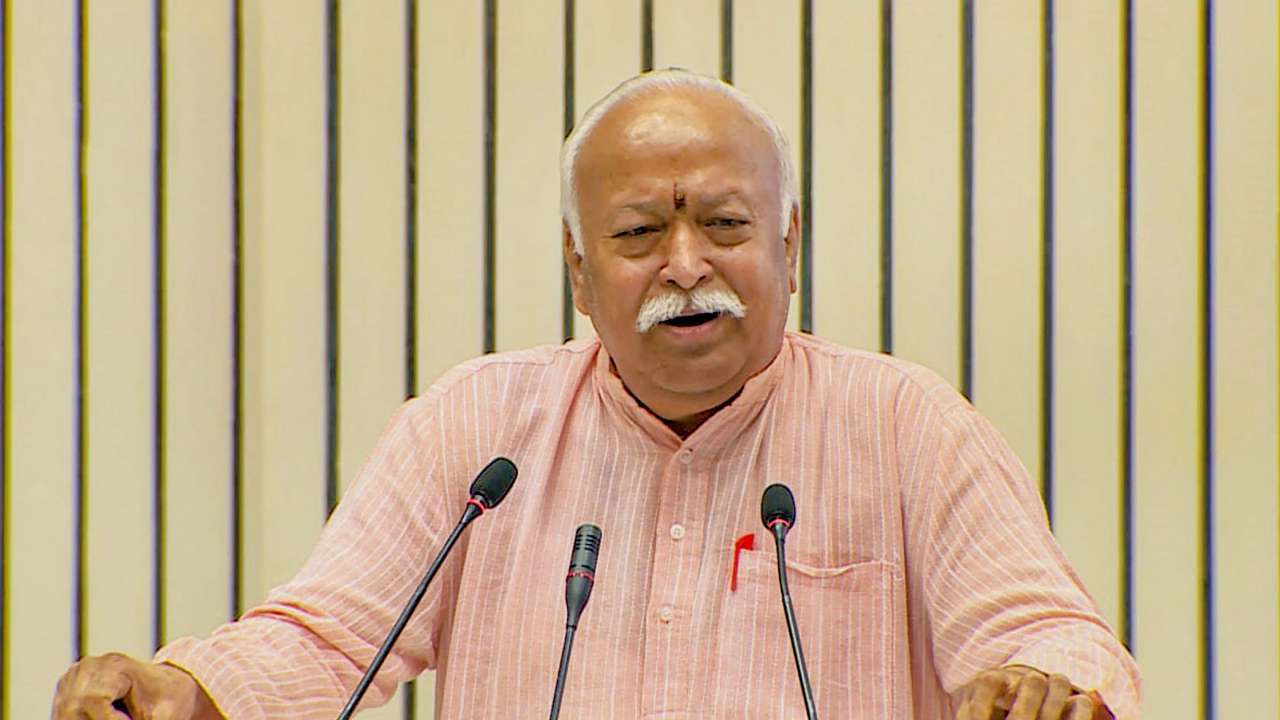
Rashtriya Swayamsevak Sangh (RSS) chief Mohan Bhagwat on Friday said the organisation is not driven by any ambition for political power and is instead dedicated to uniting Hindu society and building individual character.

He made the remarks while interacting with nearly 950 national and international sportspersons at Madhav Kunj in Shatabdi Nagar, Meerut, as part of the RSS centenary outreach initiatives. According to participants present at the event, Bhagwat spoke for about 50 minutes and stressed the importance of social harmony and collective responsibility in nation-building.

Quoting Bhagwat, a participant said the RSS’ “sole objective is the organisation of the entire Hindu society and character-building of individuals,” adding that the organisation does not function in opposition to or competition with any specific group.

Emphasis on unity and cultural roots

Explaining his idea of India, Bhagwat said the nation goes beyond geographical boundaries and draws inspiration from figures such as Lord Ram, Lord Krishna, Lord Buddha, Lord Mahavira, Swami Vivekananda, Swami Dayanand and Mahatma Gandhi, participants said.

He reportedly stated that the term “Hindu” reflects unity in diversity rather than caste identity. Differences in modes of worship and deities, he said, do not weaken society as long as cultural harmony is preserved. He added that whenever social unity declined, the country faced crises.

The RSS chief outlined four foundational pillars of society — value inculcation, Sanatan culture, the spirit of dharma and adherence to truth — reiterating that the Sangh’s mission centres on strengthening society through individual development. Volunteers, he said, are active across various spheres of social life and prioritise national interest.

Sports as a tool for nation-building

Addressing the athletes, Bhagwat described sports as a powerful medium for bringing people together. He said nation-building is not the responsibility of any single organisation but of society as a whole.

Referring to Meerut’s historic role in the First War of Independence in 1857, he said the legacy later inspired Keshav Baliram Hedgewar to establish the Rashtriya Swayamsevak Sangh in 1925.

Bhagwat also shared five guiding principles for those interested in associating with the RSS — understanding the organisation from within, engaging with its affiliated bodies, supporting its programmes, maintaining dialogue and working selflessly for the nation. He also answered questions from athletes during the session.

Outreach events in Uttar Pradesh

Bhagwat is currently on a tour of Uttar Pradesh. Earlier, he attended a two-day outreach event in Lucknow on February 17 and 18 and had also visited Gorakhpur. During his stay in Lucknow, he briefly met Chief Minister Yogi Adityanath, while both deputy chief ministers called on him before he left for Meerut.

Arjuna Award-winning wrestler Alka Tomar described the programme as grand and praised the organisational efforts of RSS volunteers. She said sportspersons must contribute to nation-building and appreciated Bhagwat’s emphasis on working in the national interest.

Para Cricket Club of India player Surya Pratap Mishra of Bareilly, selected for a Sri Lanka tour, said Bhagwat assured support for para athletes to help them enhance the country’s pride. Kabaddi coach Pintu Malik from Shukratal in Muzaffarnagar termed the interaction inspiring, especially the message that players should support one another.

Bhagwat reached Meerut on Thursday night and held breakfast discussions on Friday with representatives from the sports and industry sectors. On Saturday, he is scheduled to interact with members of the intelligentsia, including representatives from education, industry, medicine, literature, art and trade. Entry to the event is restricted to invitees with passes issued by the RSS headquarters.

India News

Jet fuel prices cut by Rs 5 per litre from July 1, easing costs for domestic airlines

The Centre has reduced aviation turbine fuel prices by Rs 5 per litre from July 1, bringing the effective rate to Rs 110 per litre and providing cost relief to domestic airlines.

Published

on

Domestic airlines have received some relief after the Centre reduced the price of aviation turbine fuel (ATF) by Rs 5 per litre with effect from July 1. The move is expected to lower fuel expenses for carriers, although there has been no official announcement regarding any reduction in airfares.

The effective ATF price has been brought down to Rs 110 per litre from the earlier Rs 115 per litre.

Bulk ATF price reduced to Rs 1.10 lakh per kilolitre

On a bulk purchase basis, the price of aviation turbine fuel has been reduced from Rs 1.15 lakh per kilolitre to Rs 1.10 lakh per kilolitre.

The reduction comes as the Centre revised export duties on petrol, diesel and aviation turbine fuel from July 1. However, the excise duty on petrol and diesel sold in the domestic market remains unchanged.

Fuel is one of the biggest operating expenses for airlines, and the latest price cut is expected to provide some financial relief to domestic carriers by reducing their fuel costs.

Continue Reading

India News

Monsoon likely to reach Delhi around July 3-4 as favourable conditions develop

The southwest monsoon is expected to reach Delhi around July 3-4 as favourable weather conditions develop. Meanwhile, IMD has forecast below-normal rainfall across India during July 2026.

Published

on

The southwest monsoon is expected to reach Delhi around July 3 or 4, bringing an end to the prolonged spell of hot and humid weather in the national capital, according to weather experts.

Delhi has continued to experience sweltering conditions over the past few days, but meteorologists say atmospheric conditions are becoming increasingly favourable for the monsoon’s arrival across northern India.

According to weather expert Mahesh Palawat, the seasonal monsoon trough currently stretches from Punjab to the north Bay of Bengal. The southwest monsoon has already advanced into many parts of Uttar Pradesh, most areas of Uttarakhand, Himachal Pradesh and Ladakh, along with additional regions of Madhya Pradesh.

IMD predicts below-normal rainfall during July

The India Meteorological Department (IMD) has forecast that the country’s average rainfall during July 2026 is likely to remain below normal.

The weather agency had released its first seasonal forecast for the southwest monsoon covering June to September on April 13 and later updated the outlook on May 29.

Monsoon advances further in Himachal Pradesh

The southwest monsoon continued its advance across Himachal Pradesh, covering the entire Kinnaur district along with most parts of Kullu and Lahaul and Spiti. It has also spread across many areas of Shimla and Mandi districts, besides some parts of Sirmaur and Kangra.

The Shimla Meteorological Centre said conditions remain favourable for the monsoon to cover the remaining parts of the state over the next two to three days.

Between June 1 and June 29, Himachal Pradesh recorded 63.8 mm of rainfall against the normal 95.4 mm, reflecting a rainfall deficit of 33 per cent.

Uttarakhand receives widespread rainfall

The southwest monsoon has also reached most parts of Uttarakhand, bringing widespread rainfall and relief from heat and humidity.

The Dehradun Meteorological Centre said weather conditions are favourable for the monsoon to spread across the remaining parts of the state within the next two to three days.

Among the rainfall recorded on Tuesday, Dehradun received 57.8 mm, Champawat 60 mm, Kalsi 49 mm, and Chakrata 14 mm.

Continue Reading

India News

Gujarat High Court says Hindu marriage requires rituals, registration alone not enough

The Gujarat High Court has ruled that registration alone cannot validate a Hindu marriage unless essential customary ceremonies such as saptapadi are performed, while setting aside a family court order in a marriage dispute.

Published

on

The Gujarat High Court has ruled that registering a marriage alone does not make a Hindu marriage legally valid if the essential customary rites and ceremonies prescribed under Hindu law have not been performed. The court observed that rituals such as saptapadi form the foundation of a valid Hindu marriage and cannot be replaced merely by documentation or registration.

The observation came while deciding an appeal filed by a UK-based man who challenged a family court’s refusal to declare an alleged marriage as void.

Court stresses importance of customary ceremonies

In its order dated June 23, a division bench comprising Justices Ilesh Vora and R.T. Vachhani said Hindu marriage is regarded as a sacrament (samskara) and must be solemnised through the customary rites and ceremonies recognised under the Hindu Marriage Act.

The bench noted that saptapadi—the ritual in which the bride and groom take seven steps together before the sacred fire—is one of the essential ceremonies that gives a Hindu marriage its spiritual, social and legal character.

According to the court, although marriage customs may vary across regions and communities, these ceremonies hold significant religious and cultural value and are believed to spiritually transform the individuals entering the marital union.

Appeal arose from marriage dispute

The appellant, Kaushal Sonar, who resides in the United Kingdom, approached the High Court after a family court dismissed his petition seeking to declare the alleged marriage null and void.

He claimed he became aware of the alleged marriage only after the woman visited his parents and produced a marriage certificate stating that she was his legally wedded wife.

The appellant maintained that no marriage ceremony had ever taken place between them, no Hindu rituals were performed, and the two had never lived together as husband and wife. He further alleged that his signatures on the marriage-related documents had been obtained fraudulently without his free consent.

Family court order set aside

The High Court observed that the woman had admitted before the family court that no marriage rites or ceremonies were performed and that the parties never shared a marital relationship.

In view of this admission, the High Court held that the family court had erred in rejecting the appellant’s plea.

Referring to Section 7 of the Hindu Marriage Act, the bench said a Hindu marriage must be solemnised in accordance with customary rites and ceremonies. Since no such ceremonies had taken place in the present case, the essential legal requirement for a valid Hindu marriage was absent.

Marriage is a sacred institution, says court

The court also made broader observations on the significance of marriage under Hindu law, stating that a wife is regarded as an equal partner and ardhangini while retaining her own independent identity.

It emphasised that marriage is not merely an occasion for celebrations, entertainment or commercial arrangements but a solemn institution that establishes a lifelong, dignified and consensual relationship between two individuals for building a family.

The bench urged young men and women to carefully understand the sanctity and responsibilities associated with marriage before entering into it.

According to the court, customary marriage ceremonies, despite regional and cultural differences, play an important role in giving Hindu marriage its recognised legal, social and spiritual status.

Continue Reading

Trending

© Copyright 2022 APNLIVE.com