English हिन्दी
Connect with us

India News

Galgotias University asked to vacate India AI Summit over Chinese robot dog row

Galgotias University has reportedly been asked to vacate its stall at the India AI Impact Summit after a Chinese-made robotic dog was allegedly presented as a university innovation.

Published

on

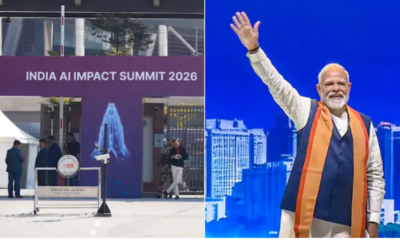
Galgotias University has reportedly been asked to vacate its exhibition space at the India AI Impact Summit in New Delhi after a controversy erupted over the display of a robotic dog at the event.

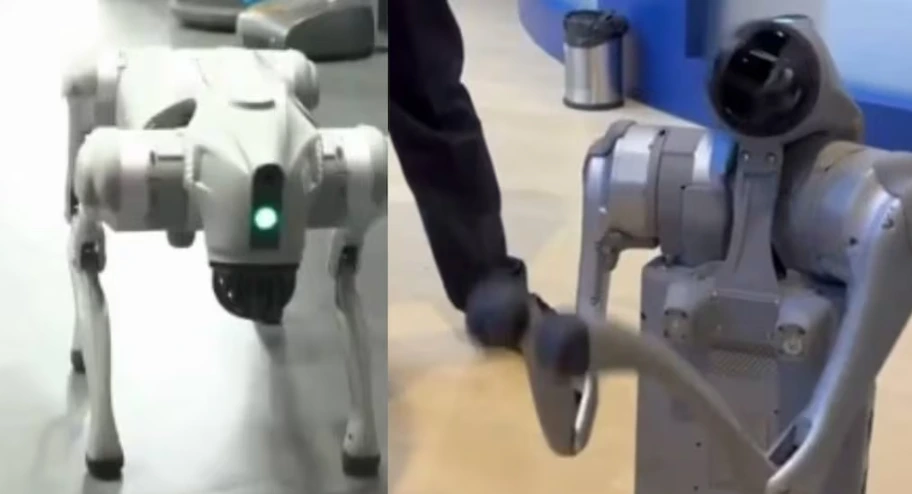
The Greater Noida-based institution came under scrutiny after a video from the summit went viral on social media. In the clip, representatives of the university were seen presenting a robotic dog as a product developed by its Centre of Excellence.

Robot identified as Unitree Go2

The robotic dog displayed at the summit was identified as the Unitree Go2, a commercially available quadruped robot manufactured by Chinese robotics company Unitree. The model is available for purchase in India at a price ranging between Rs 2 lakh and Rs 3 lakh.

At the summit, the machine was introduced under the name “Orion”. In one of the widely circulated videos, a university representative claimed during a media interaction that the robot had been developed at Galgotias University’s Centre of Excellence.

Another clip showed a professor making a similar assertion, stating that the robot was built by the university team. Social media users later pointed out that the device matched the Unitree Go2 model and alleged that imported technology was being presented as an indigenous innovation.

University issues clarification

Following the backlash, Galgotias University released a statement on X, formerly Twitter, clarifying that the robotic dog had been procured from Unitree and was being used as a learning tool for students.

In its statement, the university said the robodog was acquired to help students experiment and expand their technical understanding. It further stated that it had not built the robot nor claimed to have done so.

However, the clarification drew further criticism online. A Community Note was added to the university’s post, stating that the claim of never presenting the robodog as its own was misleading. The note highlighted that the robot had been renamed “Orion” and that university representatives had explicitly claimed it was developed by their team during the event.

Faculty response amid reports of removal

Responding to the controversy, Neha, a communications faculty member at the School of Management who had earlier described the robot as a Galgotias innovation, said the issue may have stemmed from a misunderstanding during interaction with the media. She stated that she is not part of the AI department and that the robot was brought for projection purposes.

Meanwhile, amid reports that the university had been asked to vacate its stall at the summit, Professor Aishwarya Shrivastava said that they had no such information at that point.

Social media backlash intensifies

The controversy gained momentum after several users on X shared side-by-side comparisons of the robot displayed at the summit and promotional images of the Unitree Go2 available online.

One widely circulated post stated:

“This is Unitree Go2, a Chinese robot that can be ordered online. How is this being presented as developed by the university?”

Another user wrote:

“Renaming a commercial product ‘Orion’ doesn’t make it indigenous. This is a standard Unitree model.”

Multiple posts questioned how a commercially available imported product was described as a Centre of Excellence innovation during a national AI-focused summit.

The university later described the criticism as part of a “propaganda campaign” against it. Its post itself carried a Community Note stating that video evidence showed representatives claiming the robot was developed in-house.

The episode has sparked wider debate online over transparency, attribution and accurate representation of technology at innovation events.

India News

Paytm Payments Bank licence cancelled by RBI, regulator moves for winding up

RBI revokes Paytm Payments Bank licence over regulatory violations and begins winding-up process.

Published

on

Reserve Bank of India

Central bank cites regulatory violations and depositor interest concerns, initiates process to shut down operations

The Reserve Bank of India (RBI) has cancelled the banking licence of Paytm Payments Bank Limited, marking a major regulatory action against one of India’s prominent digital banking entities. The decision came into effect from the close of business on April 24, 2026.

With the licence revoked, the bank is no longer permitted to carry out any banking activities, including accepting deposits or offering services defined under banking laws. The RBI has also said it will approach the High Court to initiate the process of winding up the bank.

Reasons behind RBI action

The central bank cited multiple serious concerns in its order. It stated that the affairs of the bank were conducted in a manner detrimental to the interests of depositors and the broader public. Additionally, the management practices were found to be prejudicial to depositor interests.

The RBI further noted that the bank failed to comply with conditions attached to its payments bank licence, and allowing it to continue operations would not serve any public interest.

Long history of regulatory issues

The latest move comes after prolonged regulatory scrutiny. Earlier, in January 2024, the RBI had already barred Paytm Payments Bank from accepting fresh deposits due to non-compliance issues, including lapses in customer due diligence, fund usage, and technology systems.

Over time, restrictions tightened as the bank failed to address regulatory concerns, ultimately leading to the cancellation of its licence.

What happens to customers

Despite the shutdown process, the RBI has indicated that the bank has sufficient liquidity to repay its depositors during the winding-up phase.

Customers are expected to be able to withdraw their existing funds, although the bank will not be allowed to continue normal banking operations going forward.

Impact on fintech sector

The cancellation of Paytm Payments Bank’s licence is being seen as one of the strongest regulatory actions in India’s fintech space. It signals stricter enforcement of compliance norms and could have wider implications for digital banking and payments companies operating under similar frameworks.

Continue Reading

India News

Raghav Chadha joins BJP, claims two-thirds of AAP Rajya Sabha MPs merging with ruling party

Raghav Chadha joins BJP and claims two-thirds of AAP’s Rajya Sabha MPs are merging, marking a major political shift.

Published

on

A major political development unfolded on Friday as Raghav Chadha announced his decision to join the Bharatiya Janata Party, claiming that a significant section of the Aam Aadmi Party’s Rajya Sabha members will also merge with the ruling party.

Addressing a press conference, Chadha said that nearly two-thirds of AAP’s Members of Parliament in the Rajya Sabha have decided to move to the BJP. He added that the decision has been formally communicated to the Chairman of the Upper House.

According to available information, AAP currently has around 10 MPs in the Rajya Sabha, which means roughly 6 to 7 members could be part of this shift.

Chadha described the move as a political and ideological decision, alleging that AAP had moved away from its original principles of clean and honest governance. He stated that he had been associated with the party for over a decade but now felt compelled to take a different path.

Several other MPs, including leaders like Sandeep Pathak and Ashok Mittal, were also present during the announcement and are expected to be part of the transition.

Political reactions and implications

The development is being seen as a major setback for AAP and its leadership under Arvind Kejriwal. The party has accused Chadha of betraying its mandate, while also criticising the BJP over the development.

On the other hand, the move could strengthen the BJP’s position in the Rajya Sabha, potentially aiding its legislative agenda in the Upper House.

Importantly, the merger may not attract disqualification under the anti-defection law, as Indian constitutional provisions allow such a shift if two-thirds of a party’s legislators agree to merge with another party.

This marks one of the most significant political realignments involving AAP in recent years and could have wider implications for opposition politics at the national level.

Continue Reading

India News

Mamata Banerjee says she will take over Delhi after Bengal win, sharpens attack on BJP

Mamata Banerjee says her party will move towards Delhi after winning Bengal, signalling national ambitions.

Published

on

Mamata Banerjee

West Bengal Chief Minister Mamata Banerjee has made a strong political statement during the ongoing West Bengal assembly elections 2026, saying her party will aim for a larger role at the national level after securing victory in the state.

Addressing a rally, Banerjee said that once her party wins the Bengal elections, it will move forward to “take over Delhi,” indicating a broader political strategy beyond the state. The remark comes at a time when campaigning has intensified across constituencies.

Her statement is being seen as part of a wider push by the Trinamool Congress to position itself as a key force against the Bharatiya Janata Party at the national level.

Banerjee has repeatedly expressed confidence that her party will return to power in West Bengal, aiming for another consecutive term.

Political context

The West Bengal elections have witnessed aggressive campaigning from both the ruling Trinamool Congress and the BJP. Leaders from both sides have exchanged sharp remarks, highlighting the high-stakes nature of the contest.

Banerjee’s latest comment adds to her earlier calls for opposition unity and signals her intent to expand political influence beyond the state. Similar remarks in recent weeks have indicated that her party sees the Bengal result as a stepping stone toward a larger national role.

At the same time, BJP leaders have projected confidence about their performance in the elections, further intensifying the political contest.

High-stakes election

The 2026 West Bengal assembly elections are crucial for both parties, with the Trinamool Congress seeking to retain power and the BJP aiming to make significant inroads in the state.

Banerjee’s “Delhi” remark underscores the broader national implications of the election, as regional parties increasingly position themselves in the national political landscape.

Continue Reading

Trending

© Copyright 2022 APNLIVE.com