English हिन्दी
Connect with us

India News

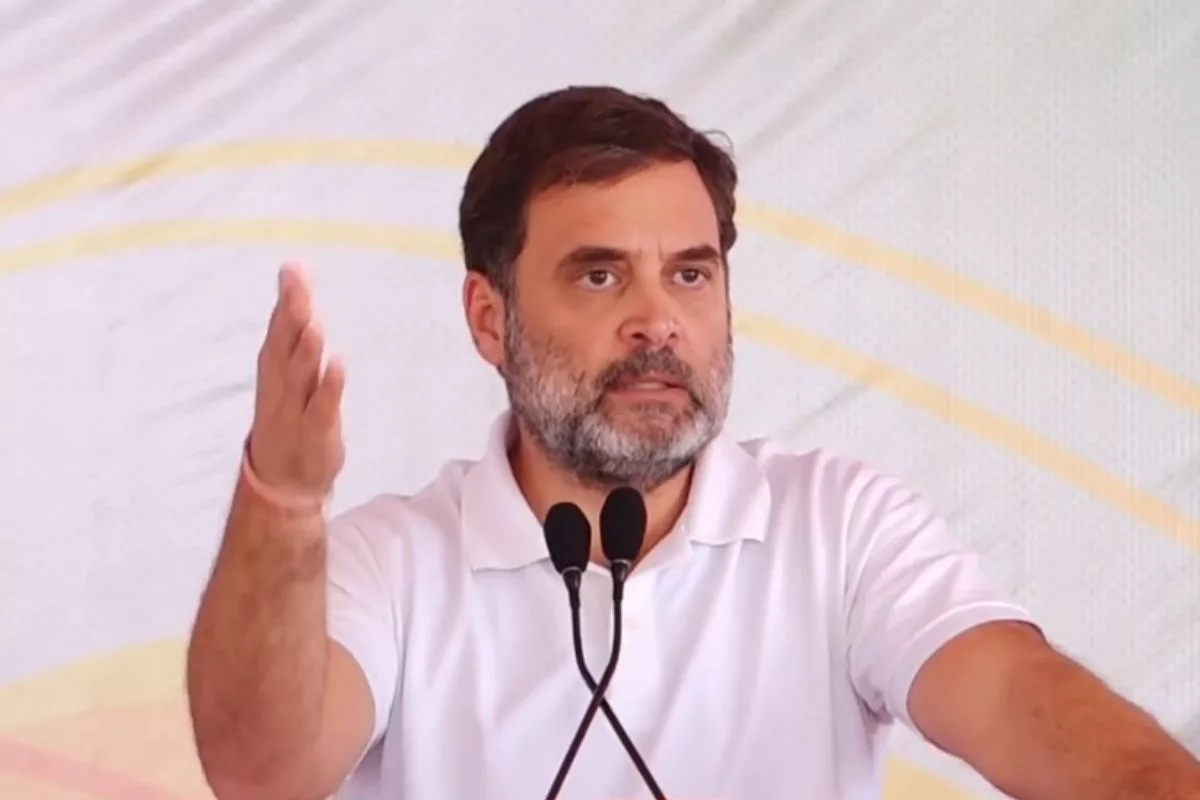
Rahul Gandhi Attacks Centre over G RAM G bill, calls it an attack on MGNREGA’s core principles

Rahul Gandhi has strongly opposed the G RAM G bill, accusing the Modi government of undermining MGNREGA and shifting the financial burden of rural employment schemes onto states.

Published

on

Rahul-Gandhi

Congress MP and Leader of the Opposition Rahul Gandhi on Monday sharpened his attack on the Centre over the introduction of the G RAM G bill in the Lok Sabha, alleging that the proposed law weakens the foundations of the Mahatma Gandhi National Rural Employment Guarantee Act (MGNREGA) and undermines the rights of the rural poor.

The bill, formally titled the Viksit Bharat Guarantee for Rozgar and Ajeevika Mission (Gramin) Bill, 2025, has been brought in to replace MGNREGA, which was enacted in 2005 under the UPA government.
Reacting to the move, Rahul Gandhi described the legislation as an “insult to the ideals of Mahatma Gandhi” and accused the Narendra Modi-led government of attempting to dismantle a scheme that guarantees livelihood security to millions of rural households.

Rahul Gandhi’s sharp criticism of the G RAM G bill

In a post on X, Gandhi alleged that Prime Minister Modi has consistently opposed the ideas associated with Mahatma Gandhi and has been trying to weaken MGNREGA since coming to power in 2014. He asserted that the Congress would oppose any attempt to dilute or dismantle the employment guarantee framework.

“Modiji has a deep hatred for two things – the ideas of Mahatma Gandhi and the rights of the poor,” Gandhi said, calling MGNREGA a living embodiment of Gandhi’s vision of village self-rule. He also highlighted the role of the scheme as an economic shield for rural India, particularly during the COVID period.

According to Gandhi, the Centre is now “determined to wipe out MGNREGA completely” by replacing it with a new framework that centralises power and alters the funding structure.

Opposition protests in Parliament

The introduction of the G RAM G bill triggered protests from several opposition MPs inside and outside Parliament. Congress MPs, including Priyanka Gandhi Vadra and Shashi Tharoor, raised objections to key provisions of the bill, particularly the removal of Mahatma Gandhi’s name from the scheme.

Opposition leaders argued that MGNREGA is rooted in the right to employment, decentralised decision-making by villages, and a funding structure where the Centre bears the full wage cost and most of the material expenses.

How G RAM G differs from MGNREGA

Rahul Gandhi pointed out that under MGNREGA, the Centre pays 100 per cent of wages for unskilled workers and 75 per cent of material costs, ensuring steady employment based on demand.

The new G RAM G bill proposes a shift to normative funding, under which states will have to bear 40 per cent of the overall costs. Gandhi claimed this would reduce work availability once budgets are exhausted or during crop harvest seasons, leaving rural workers without employment for extended periods.

The funding ratio for northeastern and Himalayan states has been set at 90:10, while union territories will be fully funded by the Centre. Of the estimated annual expenditure of Rs 1.51 lakh crore, the central government’s share is projected at Rs 95,692 crore.

Leaders from several opposition parties, including those from a key BJP ally, have also expressed concerns over the increased financial burden on states.

Government’s defence of the bill

Government sources have maintained that the G RAM G bill aligns with the broader ‘Viksit Bharat 2047’ vision. According to them, the shift from a demand-based to a normative funding model brings the scheme in line with budgeting practices followed for other central government programmes.

However, the sharp political pushback indicates that the replacement of MGNREGA is set to remain a major flashpoint in Parliament in the coming days.

India News

BJP, Congress join hands in Maharashtra town to block Shinde Sena, suspensions follow

A rare BJP-Congress alliance in Maharashtra’s Ambernath civic body has sidelined the Shinde Sena, leading to Congress suspensions and sharp political reactions.

Published

on

BJP

The political landscape in Maharashtra witnessed a sharp churn after the Bharatiya Janata Party (BJP) and the Congress came together in the Ambernath Municipal Council of Thane district, sidelining the Shiv Sena led by Chief Minister Eknath Shinde despite it emerging as the single largest party.

The unexpected post-poll arrangement, aimed at keeping the Shinde faction out of power, has triggered disciplinary action within the Congress and drawn criticism from alliance partners and rival parties alike.

BJP-led front secures majority in Ambernath

Following the municipal council elections, the BJP, Congress and the Nationalist Congress Party (Ajit Pawar faction) formed a joint front named the Ambernath Vikas Aghadi. The alliance includes 14 BJP councillors, 12 Congress councillors, four from the NCP (Ajit Pawar faction) and one independent corporator.

With the addition of the council president’s post, the alliance’s strength has reached 32 members, ensuring a clear majority in the civic body. BJP leader Tejashree Karanjule was subsequently elected president of the Ambernath Municipal Council.

The development is politically significant as the Shiv Sena (Shinde faction) had emerged as the single largest party after the elections but was kept out of power through post-result negotiations.

Congress suspends local leaders over alliance

The Maharashtra Congress leadership reacted sharply to the development, suspending Ambernath bloc chief Pradeep Patil along with all elected Congress corporators involved in the alliance. The state unit also dissolved the Ambernath block Congress committee, terming the move a violation of party discipline.

In a formal communication, senior state Congress leader Ganesh Patil said the decision to align with the BJP was “completely wrong” and taken without authorisation. The action was ordered by Maharashtra Congress president Harshvardhan Sapkal.

Fadnavis terms tie-up unacceptable

Chief Minister and senior BJP leader Devendra Fadnavis distanced the party’s central leadership from the local arrangement, calling the alliance unacceptable. He said that if local leaders had taken such a decision independently, it would be considered a breach of discipline and corrective action would follow.

Fadnavis added that instructions had been issued to scrap the alliance if it had been formed without approval.

Shiv Sena attacks BJP over ideology

The alliance has provided fresh ammunition to the Shiv Sena (Shinde faction), which accused the BJP of ideological inconsistency. Sena leaders described the tie-up as unethical, pointing to the BJP’s long-standing “Congress-free India” slogan.

Shinde faction MLA Balaji Kinikar said the development sent a confusing message within the Mahayuti alliance and argued that Ambernath should have seen a traditional BJP–Shiv Sena partnership. He warned that such political compromises could impact future municipal and civic elections across Maharashtra.

Local BJP defends move citing governance

Local BJP leaders defended the alliance, claiming it was formed in the interest of development and clean administration. BJP leader Gulabrao Karanjule Patil alleged that corruption cases had surfaced during the Shiv Sena (Shinde faction)’s earlier tenure, with former municipal presidents even facing jail time.

He said efforts were made to hold talks with the Shinde faction for a broader alliance, but there was no response, leaving the BJP with limited options to ensure stable governance in the council.

Strains surface within Mahayuti

The Ambernath episode has exposed visible cracks within the Mahayuti alliance, deepening mistrust between the BJP and the Shinde-led Shiv Sena. While the BJP-Congress arrangement has altered the power equation in the civic body, it has also raised larger questions about ideological consistency and future alliance dynamics in Maharashtra.

As political reactions continue, the Ambernath developments are being closely watched for their potential impact on upcoming municipal corporation and local body elections across the state.

Continue Reading

India News

Stones thrown at police during demolition drive near Delhi mosque, five injured

An MCD demolition drive near the Syed Faiz Elahi mosque at Turkman Gate turned violent after residents allegedly pelted stones at officials, injuring five police personnel.

Published

on

Demolition near turkman gate

At least five police personnel were injured after an anti-encroachment drive near a mosque at Delhi’s Ramlila Ground area turned violent early Wednesday, officials said.

The clashes broke out when around 300 officials and workers of the Municipal Corporation of Delhi (MCD), supported by police personnel, were carrying out a demolition drive at land adjoining the Syed Faiz Elahi mosque and graveyard near Turkman Gate. The action was undertaken following directions issued by the Delhi High Court.

According to the police, a group of local residents began pelting stones at officials during the demolition, forcing security forces to use tear gas to disperse the crowd and bring the situation under control.

Police use tear gas as stone-pelting escalates

A senior police officer said that around 25 to 30 people were involved in stone pelting during the operation, resulting in injuries to five policemen. All injuries were reported to be minor.

The demolition drive was conducted during night hours to minimise inconvenience to the general public. During the operation, a banquet hall and a dispensary located on the encroached land were demolished.

Police officials said more than 100 video clips are being examined to identify those involved in the violence. Cases will be registered based on statements from injured police personnel and MCD workers.

Encroachment clearance linked to high court order

Officials deployed nearly 30 bulldozers and 50 dump trucks to remove unauthorised constructions from the area. The action follows a November 2025 Delhi High Court order that granted three months to the MCD and the Public Works Department to clear encroachments spread across 38,940 square feet near the Ramlila Ground at Turkman Gate.

In December, the civic body stated that all constructions beyond 0.195 acres were unauthorised and liable for demolition. Authorities maintained that no documents were produced to establish ownership or lawful possession of the encroached land by either the mosque’s managing committee or the Delhi Waqf Board. The 0.195-acre parcel under lease houses the mosque and is not part of the demolition action.

The encroachments reportedly included parts of a road, footpath, parking area, a baraat ghar and a private diagnostic centre.

High court seeks responses on plea challenging demolition

Meanwhile, the Delhi High Court on Tuesday issued notices to multiple authorities, including the MCD, Ministry of Urban Development, Delhi Development Authority, PWD and the Delhi Waqf Board, on a petition challenging the demolition order.

Justice Amit Bansal observed that the matter required consideration and directed the authorities to file their responses within four weeks. The case has been listed for further hearing on April 22.

The mosque’s managing committee, which filed the plea, argued that the land is a notified waqf property governed by the Waqf Act and falls under the exclusive jurisdiction of the Waqf Tribunal. The committee said it has no objection to the removal of encroachments but raised concerns regarding the functioning of the graveyard on the land.

The MCD reiterated that no action is being taken against the 0.195-acre land leased in February 1940.

Continue Reading

India News

Will Trump kidnap India’s PM like Venezuela, asks Congress leader Prithviraj Chavan

Prithviraj Chavan’s Venezuela comparison amid the India-US tariff debate has drawn sharp criticism, with leaders calling the remark humiliating and irresponsible.

Published

on

Prithviraj chauhan

Congress leader Prithviraj Chavan has triggered a controversy after making a remark comparing India to Venezuela and questioning whether a similar situation could unfold under US President Donald Trump, a comment that drew sharp criticism and ridicule on social media.

Referring to a US military action in Venezuela that resulted in the capture of President Nicolas Maduro, Chavan posed a rhetorical question during his attack on the Narendra Modi government over India-US trade tensions. He asked whether something similar could happen in India and whether Trump could “kidnap” India’s prime minister — a statement many online users described as absurd.

The remark quickly went viral, prompting a barrage of criticism. Several social media users mocked the comparison, pointing out that India is a nuclear power and calling the statement irresponsible and ill-considered.

Former Jammu and Kashmir director general of police S P Vaid strongly criticised Chavan’s comments, calling them “humiliating for the entire country.” Vaid questioned whether such a comparison reflected the Congress party’s broader thinking and urged leaders to exercise restraint while speaking on sensitive geopolitical matters.

Tariff issue behind the political attack

Chavan’s comments came as part of the Congress’s criticism of the Modi government over steep tariffs imposed by the United States on Indian goods. He argued that a 50 per cent tariff effectively blocks bilateral trade, particularly exports from India to the US.

According to Chavan, such tariffs have reduced export earnings for Indian businesses, forcing the country to explore alternative markets. He said efforts were already underway to diversify trade destinations as a response to the situation.

Kharge targets Modi over Trump remarks

The controversy follows recent remarks by Congress president Mallikarjun Kharge, who cited comments attributed to Trump regarding India’s purchase of Russian oil. Kharge referred to an audio clip in which Trump claimed that India was willing to reduce its Russian oil imports after facing US tariffs.

Kharge used the remarks to allege that Prime Minister Modi was acting under pressure from the US president, questioning the nature of the much-publicised friendship between the two leaders. He compared the situation to a popular film dialogue to underline his criticism.

Trade data shows export growth despite tariffs

Despite the political sparring, official trade data shows that India’s merchandise exports to the United States rose 22.61 per cent to $6.98 billion in November, even after the imposition of steep tariffs.

During the April–November period of the current financial year, exports to the US increased by 11.38 per cent to $59.04 billion, while imports from the US rose 13.49 per cent to $35.4 billion, reflecting continued trade engagement between the two countries.

Continue Reading

Trending

© Copyright 2022 APNLIVE.com