English हिन्दी
Connect with us

Latest world news

China’s new air power push near Arunachal: 36 aircraft shelters built at Lhunze base

Satellite images confirm 36 new aircraft shelters at China’s Lhunze airbase near Arunachal Pradesh, raising security concerns for India amid growing regional tensions.

Published

on

China has completed the construction of 36 hardened aircraft shelters and multiple new facilities at its Lhunze airbase in Tibet, located around 107 kilometres from Arunachal Pradesh’s Tawang. The rapid military buildup, seen through fresh satellite imagery, marks a significant step in Beijing’s growing military posture along the India-China border.

Strategic concerns over China’s Lhunze expansion

The fortified shelters, along with new administrative blocks and an extended apron, are positioned just 40 kilometres north of the McMahon Line. Experts say these developments give China the ability to forward-deploy fighter jets and drones within striking distance of Indian air bases in Arunachal Pradesh and Assam.

Former Indian Air Force (IAF) chief Air Chief Marshal BS Dhanoa (Retd) noted that the construction signals serious military intent. “The day they start building hardened aircraft shelters in Tibet would mean that they are preparing for war with us,” he said, adding that such infrastructure removes a long-standing Chinese vulnerability in the region.

Former IAF vice chief Air Marshal Anil Khosla (Retd) termed the buildup a “serious strategic threat,” highlighting that the new infrastructure enables rapid aircraft deployment and improved operational readiness at high altitudes. He also pointed out that the shelters provide protection against precision-guided munitions, making the base more resilient to Indian airstrikes.

New images reveal drone presence

Recent satellite images from October 17 show what appear to be three CH-4 drones stationed on the Lhunze tarmac. These long-endurance drones can operate at over 16,000 feet and carry short-range air-to-surface missiles, enhancing China’s surveillance and strike capability in mountainous terrain.

India, meanwhile, is set to induct U.S.-made Sky Guardian drones starting 2029 for both the IAF and the Indian Army, aiming to counter the growing Chinese UAV presence. The Navy already operates the Sea Guardian variant, part of a $3.5 billion deal.

Shrinking geographical advantage for India

Former IAF vice chief Air Marshal SP Dharkar (Retd) observed that China’s expansion of hardened airfields across Tibet—including Tingri, Burang, Yutian, and Yarkant—has gradually eroded India’s traditional terrain advantage. “The buildup of hardened shelters makes air operations in the zone even more challenging,” he said.

Geo-intelligence analyst Damien Symon added that the Lhunze development represents Beijing’s effort to “expand air power in a historically sensitive region,” reducing India’s operational lead near the Line of Actual Control (LAC).

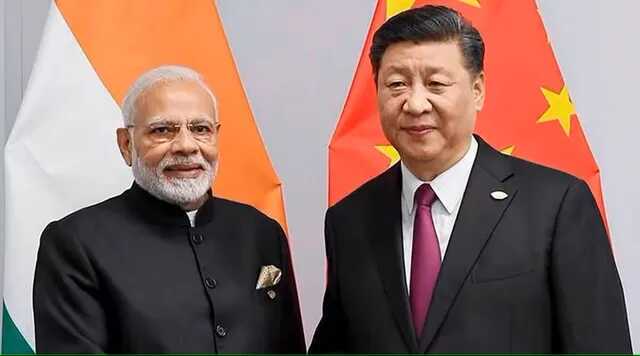
Despite recent diplomatic outreach—including Prime Minister Narendra Modi’s visit to China in August—both nations continue to upgrade their border air infrastructure, underscoring persistent military competition post-Galwan 2020.

Latest world news

Fresh tensions as Iran targets vessel despite ceasefire announcement

Iran fired at a vessel in the Strait of Hormuz shortly after a ceasefire announcement, raising concerns over regional stability.

Published

on

Attack on vessel highlights fragile situation in Strait of Hormuz despite renewed ceasefire push

Tensions in the Middle East escalated again after Iran opened fire on a commercial vessel in the Strait of Hormuz, just hours after US President Donald Trump announced a ceasefire extension.

According to maritime security officials, an Iranian Revolutionary Guard gunboat fired at a container ship early on April 22. The vessel was damaged in the incident, but no injuries or environmental damage were reported.

The attack comes amid already heightened tensions in the region, where the strategic Strait of Hormuz — a key global oil transit route — has seen severe disruptions in recent days.

Ceasefire efforts face immediate test

The firing incident occurred shortly after Trump signalled an extension of the ceasefire, reportedly aimed at creating space for renewed negotiations with Iran. However, the latest development has raised concerns about the durability of the truce.

Reports indicate that the Iranian action followed recent US military moves, including the seizure of vessels linked to Tehran and continued naval pressure in the region.

Shipping route remains volatile

The Strait of Hormuz remains a flashpoint, with shipping traffic significantly affected. In recent days, only a handful of vessels have been able to pass through the route, compared to normal volumes, leaving many ships stranded.

The waterway is critical for global energy supplies, handling a significant share of the world’s oil shipments. Any disruption has immediate implications for international markets.

No official response yet

Iran has not officially commented on the latest firing incident. Meanwhile, international observers and maritime agencies continue to monitor the situation closely, warning of risks to crew safety and global trade.

The latest escalation underscores the fragile nature of ongoing diplomatic efforts, with both sides yet to reach a stable agreement.

Continue Reading

Latest world news

Trump extends Iran ceasefire after Pakistan request, raises hopes for talks

The US extends its Iran ceasefire after Pakistan’s request, opening a window for diplomacy while tensions persist

Published

on

Donald Trump statement

The United States has extended its ceasefire with Iran, with former US President Donald Trump stating that the decision came after a request from Pakistan’s leadership. The move comes just hours before the truce was due to expire, offering a temporary pause in escalating tensions.

Trump said the extension is intended to provide Iran additional time to present a “unified proposal” for a broader peace agreement, signalling a shift towards diplomacy even as pressure on Tehran continues.

Pakistan steps in as mediator

Pakistan has played a key role in facilitating the ceasefire extension. Its leadership, including top civil and military figures, urged the US to delay further action and allow diplomatic efforts to continue.

The development positions Pakistan as an emerging mediator in the crisis, with efforts underway to encourage dialogue between Washington and Tehran. The country has also indicated willingness to support or host discussions aimed at de-escalation.

Pressure remains despite pause

Despite the extension of the ceasefire, the situation remains tense. The US has not rolled back its strategic posture in the region.

Military readiness continues, and restrictions such as the naval blockade linked to Iran remain in place. This indicates that while direct confrontation has been paused, broader pressure tactics are still active.

What Pakistan could gain

Pakistan’s involvement in the ceasefire process could bring several advantages.

First, it enhances the country’s global diplomatic standing by placing it at the centre of a major international issue. Acting as a mediator between two adversaries can improve its credibility on the world stage.

Second, stability in the region is directly beneficial for Pakistan’s economic interests, particularly given its reliance on energy supplies linked to the broader Middle East.

Finally, successful mediation could strengthen Pakistan’s strategic influence, giving it a more prominent role in future geopolitical developments.

Uncertain road ahead

While the ceasefire extension has reduced immediate risks, uncertainty remains over how the situation will evolve. Much will depend on whether Iran presents a proposal acceptable to the US and whether negotiations can move forward.

For now, the extension reflects a temporary shift away from confrontation, but the underlying tensions remain unresolved.

Continue Reading

Latest world news

Trump may join Iran-US peace talks in Pakistan, attendance uncertain

Donald Trump could join Iran-US peace talks in Pakistan either in person or virtually, as discussions move forward amid uncertainty over participation.

Published

on

Donald Trump statement

Peace talks between the United States and Iran are being considered in Islamabad, with uncertainty over participation and format

Peace talks between the United States and Iran are being considered in Islamabad, according to media reports, with the possibility that former US President Donald Trump may participate either in person or virtually. However, no final decision on the venue, format or participation has been confirmed.

According to reports citing a Pakistani source, preparations for the talks are moving ahead as scheduled, and both sides are expected to engage in discussions aimed at resolving ongoing tensions.

The proposed talks come at a critical time, as diplomatic efforts continue to stabilise relations amid heightened geopolitical strain. Pakistan is expected to host or facilitate the discussions, hosting the discussions and coordinating with both Washington and Tehran to facilitate dialogue.

Officials familiar with the development indicated that Trump’s participation remains uncertain, with reports indicating he may attend either in person or virtually. His presence—either physically in Islamabad or through virtual means—would signal the importance of the outcome and potentially influence the direction of the talks.

Despite the progress in planning, uncertainty remains over the final composition of delegations and the level of participation from each side. Separate reports suggest that while preparations are underway, clarity over Iran’s attendance and broader engagement is still evolving.

The talks are expected to focus on easing tensions and exploring pathways toward a broader agreement, though key sticking points between the two sides remain unresolved.

Continue Reading

Trending

© Copyright 2022 APNLIVE.com