English हिन्दी
Connect with us

Latest world news

Indians in Iran asked to stay indoors for 48 hours as tensions escalate

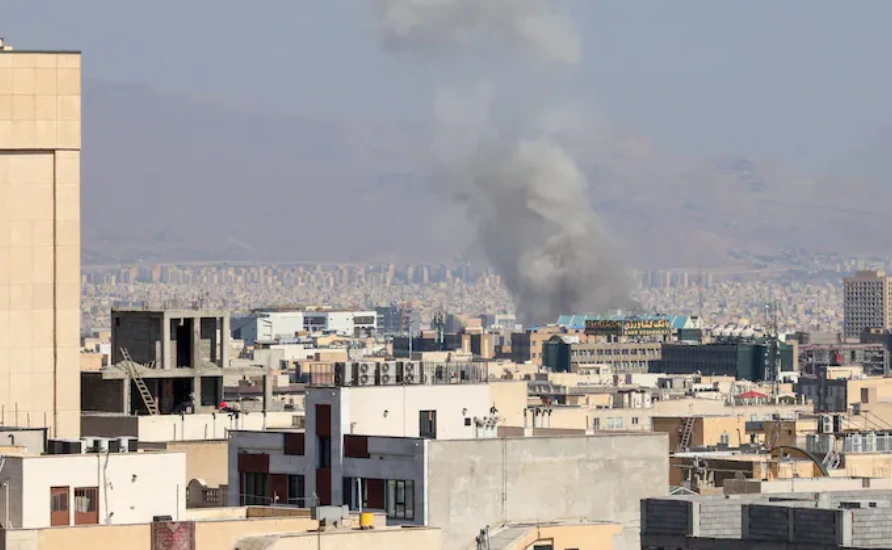
Indians in Iran have been advised to stay indoors for 48 hours as tensions rise, with the embassy issuing safety instructions and global developments intensifying.

Published

on

Indian advisory to indian nationals in iran

The Indian government has issued an urgent advisory for its citizens in Iran, asking them to remain indoors for the next 48 hours amid escalating tensions in the region.

The Embassy of India in Iran has directed Indian nationals to “stay where they are” and avoid unnecessary movement. The advisory emphasises strict precautions, including staying away from sensitive areas such as electrical and military installations.

Indians have also been advised to avoid staying on upper floors of multi-storey buildings and to remain inside their residences as a safety measure.

The embassy further instructed those staying in embassy-arranged accommodations to remain indoors and maintain regular contact with on-site embassy teams to ensure their safety.

Trump issues stark warning to Iran

Amid the rising tensions, former US President Donald Trump issued a strong warning directed at Iran. In a post on Truth Social, he suggested that a major and potentially devastating development could unfold soon.

He stated that although he does not wish for such an outcome, “a whole civilisation” could face destruction, calling the moment one of the most significant in global history. He also referred to decades of alleged corruption and conflict, suggesting a possible turning point.

Iran suspends communication with United States

Meanwhile, Iran has reportedly cut off all forms of diplomatic and indirect communication with the United States, according to media reports.

The development signals a sharp escalation in tensions between the two nations, with all message exchanges now suspended.

Latest world news

India condemns demolition of 125-year-old Gurdwara in Pakistan, seeks immediate restoration

India has condemned the demolition of the 125-year-old Gurdwara Sri Guru Singh Sabha Sahib in Pakistan’s Punjab province, urging Islamabad to investigate the incident, punish those responsible and restore the historic Sikh shrine.

Published

on

India has strongly condemned the demolition of the 125-year-old Gurdwara Sri Guru Singh Sabha Sahib in Pakistan’s Punjab province, describing it as a “highly deplorable” act of vandalism against a historic Sikh place of worship. The incident has also sparked protests from members of the Sikh community in Pakistan, prompting the Punjab provincial government to announce the shrine’s restoration.

The gurdwara, located in Farooqabad, was reportedly demolished on the night of June 24 by a local businessman without obtaining the mandatory No Objection Certificate (NOC) from the relevant authorities.

India urges Pakistan to investigate incident

Responding to the development, External Affairs Ministry spokesperson Randhir Jaiswal expressed deep concern over the destruction of the historic shrine and urged the Pakistan government to conduct a prompt investigation.

India called for those responsible for the demolition to be brought to justice and demanded that the damaged portions of the Gurdwara be restored and reconstructed without delay.

The government also expressed concern over reports that no meaningful action had initially been taken by local authorities or the Evacuee Trust Property Board (ETPB). According to New Delhi, the incident reflects a continuing pattern of attacks on religious minorities and their places of worship in Pakistan.

India further urged Islamabad to fulfil its responsibility of ensuring the safety, security and well-being of minority communities while taking effective measures to curb religious intolerance and sectarian violence.

Sikh community protest prompts official response

According to a Punjab government official in Pakistan, the demolition came to the attention of authorities only after members of the local Sikh community staged protests.

Following the demonstrations, Punjab Chief Minister Maryam Nawaz took notice of the matter.

Punjab Minorities Minister Ramesh Singh Arora later visited the demolished Gurdwara along with senior district officials and representatives of the Auqaf Department to assess the situation and hear concerns raised by local Sikhs.

During the visit, Arora announced that restoration work would begin immediately. He also directed the Auqaf Department to investigate the ownership and legal status of the land, noting that preliminary findings suggested the property was not registered as Auqaf land.

The minister said the provincial government remained committed to protecting minority rights and preserving religious heritage across Punjab.

Local traders raise concerns over restoration

While welcoming government intervention, several traders operating around the site expressed reservations regarding the restoration plan.

They claimed the premises had remained abandoned for nearly eight decades, during which families had settled there and commercial establishments had developed in the area.

The traders urged the authorities to provide alternative housing and livelihood support if any residents or shopkeepers were required to vacate the site during the restoration process.

Continue Reading

Latest world news

Trump says Congress can pass law after US Supreme Court upholds birthright citizenship

Donald Trump has urged Congress to introduce legislation to end birthright citizenship after the US Supreme Court struck down his executive order, reaffirming constitutional protections under the Fourteenth Amendment.

Published

on

donald-trump

US President Donald Trump has said he will support congressional efforts to introduce legislation aimed at ending birthright citizenship after the US Supreme Court rejected his administration’s executive order seeking to restrict the constitutional right.

Responding to the ruling on social media, Trump described the court’s decision as “too bad” for the United States but argued that Congress could still address the issue through legislation. He urged lawmakers to begin work immediately, saying they would have his “complete and total support” in pursuing changes to birthright citizenship.

Supreme Court rejects executive order

In a 6-3 ruling delivered on the final day of its term, the US Supreme Court struck down Trump’s executive order that sought to deny automatic citizenship to children born in the United States whose parents were either in the country illegally or were temporary residents. The order had previously been blocked by lower courts.

Chief Justice John Roberts, writing for the majority, said children born in the United States to parents who are unlawfully or temporarily present remain citizens at birth under the Citizenship Clause of the Fourteenth Amendment. The ruling reaffirmed the long-standing constitutional interpretation that birthright citizenship applies to nearly everyone born on US soil.

The court also made clear that the Constitution protects birthright citizenship, indicating that an executive order cannot override those constitutional guarantees.

Justice Department reiterates immigration enforcement

Following the judgment, the US Justice Department said it would continue efforts to combat illegal birth tourism and enforce immigration laws. The department stated that individuals attempting to exploit the immigration system to obtain automatic citizenship for their children would face legal action.

Trump’s birthright citizenship order, signed on the first day of his second presidential term, formed a key part of his administration’s broader immigration agenda. The Supreme Court’s decision marks a significant legal setback for that policy.

Continue Reading

Latest world news

US Supreme Court upholds state bans on transgender athletes in women’s sports

The US Supreme Court has upheld laws in Idaho and West Virginia barring transgender girls and women from competing in female school sports, a decision likely to affect similar laws across the country.

Published

on

The United States Supreme Court on Tuesday upheld laws in Idaho and West Virginia that prohibit transgender girls and women from participating in female school sports teams, marking a major legal victory for supporters of sex-based sports categories in the country.

In a closely watched decision, the court ruled by a 6-3 majority in favour of the state laws, overturning lower court rulings that had previously sided with transgender student-athletes challenging the restrictions. The judgment is expected to influence similar laws already enacted in more than two dozen US states.

The cases before the court involved Idaho’s Fairness in Women’s Sports Act and West Virginia’s Save Women’s Sports Act. Both laws require students to compete in sports teams based on their biological sex rather than gender identity. Transgender athletes Lindsay Hecox from Idaho and Becky Pepper-Jackson from West Virginia had argued that the measures violated constitutional equal protection guarantees and anti-discrimination provisions under Title IX.

Writing for the majority, the court concluded that states can maintain separate sports categories based on biological sex and that such policies do not violate federal law. The ruling is expected to strengthen similar restrictions already in place across several Republican-led states.

The decision comes amid an ongoing national debate in the United States over transgender rights, fairness in women’s sports and the interpretation of federal anti-discrimination laws. The issue has become a major political and cultural flashpoint in recent years, with several states introducing legislation governing transgender participation in school and college athletics.

The Supreme Court’s verdict is also seen as part of a broader trend of rulings by the conservative-majority court on transgender rights issues, including previous decisions concerning gender-affirming care and military service policies.

Continue Reading

Trending

© Copyright 2022 APNLIVE.com