English हिन्दी
Connect with us

Latest world news

The Media Today: Unified support for a giant of the Senate

Published

on

John McCain

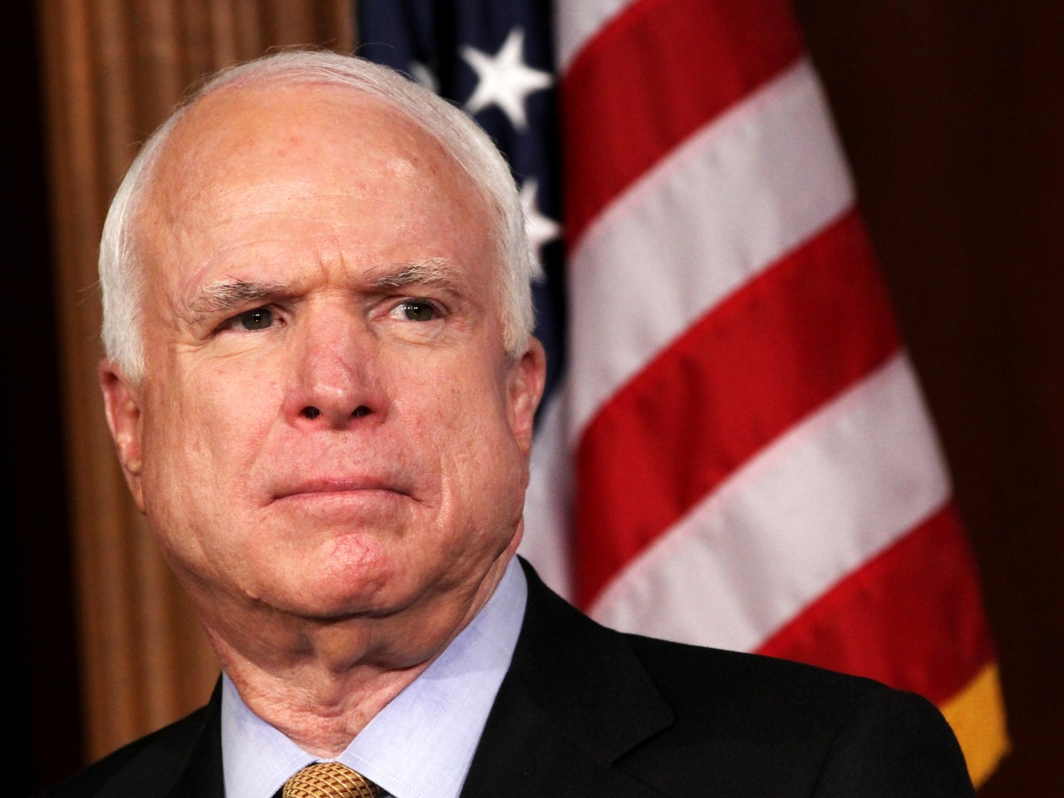
[vc_row][vc_column][vc_column_text]On another night jam-packed with news about the president and those in his circle, sad news about one of Washington’s legendary figures provided a moment of unity. Around 8 pm, we learned that John McCain has brain cancer. The longtime Arizona senator, former presidential candidate, and Vietnam War hero recently underwent surgery at the Mayo Clinic to remove a blood clot behind his eye. “Subsequent tissue pathology revealed that a primary brain tumor known as a glioblastoma was associated with the blood clot,” said a statement released by the senator’s office.

The shocked response from around the political and media world demonstrates the rare position the 80-year-old McCain occupies as a figure respected on all sides. President Trump and former Presidents Obama, Clinton, and George H.W. Bush all released statements of appreciation and support. Media members expressed respect for McCain’s candor and decency.

The son and grandson of US Navy admirals, McCain was shot down over Hanoi in 1967 and endured five years of captivity and torture, refusing numerous offers of release. He entered the Senate in 1986, and earned a reputation for working across the aisle on issues such as campaign finance reform.

In a time of vicious political polarization, McCain is one of the few figures in Washington who often manages to rise above the fray. Though he has recently been criticized by some for voting along party lines even as he speaks out forcefully against President Trump’s more troubling actions, McCain’s legacy as a giant of the Senate is secure.

Below, coverage past and present of McCain’s life.

“A warrior at dusk”: Meghan McCain offers a beautiful tribute to her father.

Difficult diagnosis: The Arizona Republic’s Ken Alltucker and Craig Harris speak with experts about glioblastoma, the aggressive form of cancer with which McCain has been diagnosed.

“He just keeps getting up”: CNN’s Chris Cillizza outlines the major events in McCain’s “absolutely remarkable” life.

McCain’s party: In 2005, The New Yorker’s Connie Bruck profiled McCain’s quest to become to the future of the Republican Party.

Dispatch from the “Straight Talk Express”: David Foster Wallace’s profile of McCain’s 2000 presidential campaign for Rolling Stone (no longer available on its website) is worth your time.

Other notable stories

In an Oval Office interview with The New York Times’s Peter Baker, Michael S. Schmidt, and Maggie Haberman, President Trump expressed frustration with Attorney General Jeff Sessions and took on Special Counsel Robert Mueller, who is leading the investigation into Russian meddling in the 2016 election. In addition to the main story, the Times posted an edited transcript of the 50-minute interview.

More from the Times: Mike McIntire reports that former Trump Campaign Chairman Paul Manafort was $17 million in debt to pro-Russian interests as of December 2015.

The Associated Press’s Vivian Salama writes that Trump’s soft approach on matters concerning Russia is causing a rift with advisers. “President Donald Trump’s persistent overtures toward Russia are placing him increasingly at odds with his national security and foreign policy advisers,” Salama reports.

One year after celebrated journalist Pavel Sheremet was murdered in Kiev, Cheryl L Reed writes for CJR that, “In a time of war, investigative reporting in Ukraine is a tough sell.

Three versions—from Reuters, The Wall Street Journal, and The New York Times—of a fascinating story: palace intrigue and filial betrayal in Saudi Arabia’s line of succession.

The Washington Post’s Callum Borchers writes that Charlie Spiering, Breitbart’s man in the White House, is no Trump sycophant. (Courtesy: Columbia Journalism Review)[/vc_column_text][/vc_column][/vc_row]

Latest world news

Trump rejects Iran peace proposal, warns Tehran over uranium dispute

Donald Trump has rejected Iran’s latest response to a US peace proposal, escalating tensions over uranium enrichment, sanctions relief and control of the Strait of Hormuz.

Published

on

Donald Trump statement

US President Donald Trump has rejected Iran’s latest response to a US-backed peace proposal, calling Tehran’s position “totally unacceptable” as negotiations aimed at ending the ongoing conflict remain stalled.

According to reports, Iran responded to the American proposal by demanding war reparations, the removal of sanctions, recognition of its sovereignty over the Strait of Hormuz, and the release of frozen Iranian assets. Tehran also warned it would retaliate against any fresh US military strikes and oppose the deployment of additional foreign warships in the region.

The dispute has intensified over Iran’s nuclear programme, particularly uranium enrichment. The US proposal reportedly sought strict limits on Iran’s nuclear activities, including a long-term halt to uranium enrichment and tighter international oversight. However, Iran’s counter-response did not accept key American demands related to dismantling or restricting its nuclear infrastructure.

Iran has maintained that its nuclear programme is for civilian purposes, while the US and its allies continue to push for stronger safeguards amid concerns over regional security.

The latest exchange comes amid continuing tensions in the Strait of Hormuz, a strategically important shipping route for global oil supplies. Concerns over disruptions in the region have already pushed oil prices higher in international markets.

Reports also suggest that the US proposal aimed to expand the current ceasefire framework and create conditions for broader negotiations involving regional conflicts and maritime security. However, both sides remain far apart on major issues, including sanctions relief and nuclear restrictions.

Continue Reading

Latest world news

Trump approves nearly $9 billion weapons sales to Israel, UAE and other allies amid Iran tensions

The US has fast-tracked nearly $9 billion in weapons sales to Israel, UAE and other allies as tensions linked to the Iran conflict continue despite a fragile ceasefire.

Published

on

Donald Trump statement

The United States has approved nearly $9 billion worth of weapons sales to key Middle Eastern allies, including Israel and the United Arab Emirates, amid ongoing tensions linked to the Iran conflict.

The decision, cleared by the administration of Donald Trump, includes expedited military transfers to Israel, the UAE, Qatar, and Kuwait. The approvals were granted under an emergency provision, allowing authorities to bypass the usual congressional review process.

Emergency clearance amid ongoing conflict

Officials said the move was necessary due to the evolving security situation in the region, particularly as the conflict involving Iran continues despite a fragile ceasefire. The war, which began earlier in 2026, has heightened instability across West Asia.

US Secretary of State Marco Rubio invoked emergency powers to fast-track the deals, citing urgent defence requirements for allied nations.

What the arms package includes

The approved package includes a mix of advanced defence systems and precision weapons:

  • Patriot missile defence replenishments worth over $4 billion for Qatar
  • Precision-guided weapon systems for multiple countries
  • Integrated battle command systems for Kuwait
  • Additional advanced weapons support for Israel and the UAE

The total value of these deals is estimated at over $8.6 billion, often rounded to nearly $9 billion.

Timing linked to iran war

The approval comes nearly nine weeks into the conflict involving the US, Israel, and Iran, with tensions still high despite a ceasefire that has been in place for several weeks.

Analysts note that the move signals continued US military backing for its regional allies, particularly in strengthening air defence and precision strike capabilities during uncertain conditions.

Criticism and concerns

The decision to bypass congressional oversight has drawn criticism from some quarters, particularly over transparency and the broader implications of increasing arms supplies in a conflict-prone region.

Continue Reading

Latest world news

Trump and Putin hold over 90-minute call, discuss Iran war and Ukraine conflict

Trump and Putin held a 90-minute call focusing on Iran tensions and the Ukraine conflict, with warnings over escalation and talks of ceasefire.

Published

on

Vladimir Putin and Donald Trump

US President Donald Trump and Russian President Vladimir Putin held a phone conversation lasting more than 90 minutes, focusing on escalating tensions in the Middle East and the ongoing war in Ukraine.

According to official statements, the discussion was described as “frank and businesslike,” with both leaders addressing key global security concerns. A major part of the conversation centred on the situation involving Iran and developments in the Persian Gulf.

Putin supported Trump’s decision to extend the ceasefire related to Iran, suggesting that continued restraint could create space for negotiations and help stabilise the region. However, he also issued a strong warning, stating that renewed military action by the United States or Israel could lead to “extremely damaging consequences” not only for Iran but for the wider international community.

Ukraine conflict also discussed

The leaders also discussed the ongoing war in Ukraine, which has continued for several years since Russia’s invasion in 2022. During the call, there were indications of potential efforts toward a temporary ceasefire, although no final agreement has been confirmed.

Reports suggest that the idea of a short-term pause in hostilities was explored, possibly linked to upcoming symbolic dates, but significant differences between the parties remain unresolved.

Focus on diplomacy amid global tensions

The call highlights ongoing diplomatic engagement between Washington and Moscow at a time of heightened geopolitical tensions involving both the Middle East and Eastern Europe.

While both sides acknowledged the importance of dialogue, the situation on the ground in both conflict zones remains complex, with no immediate resolution in sight.

Continue Reading

Trending

© Copyright 2022 APNLIVE.com